
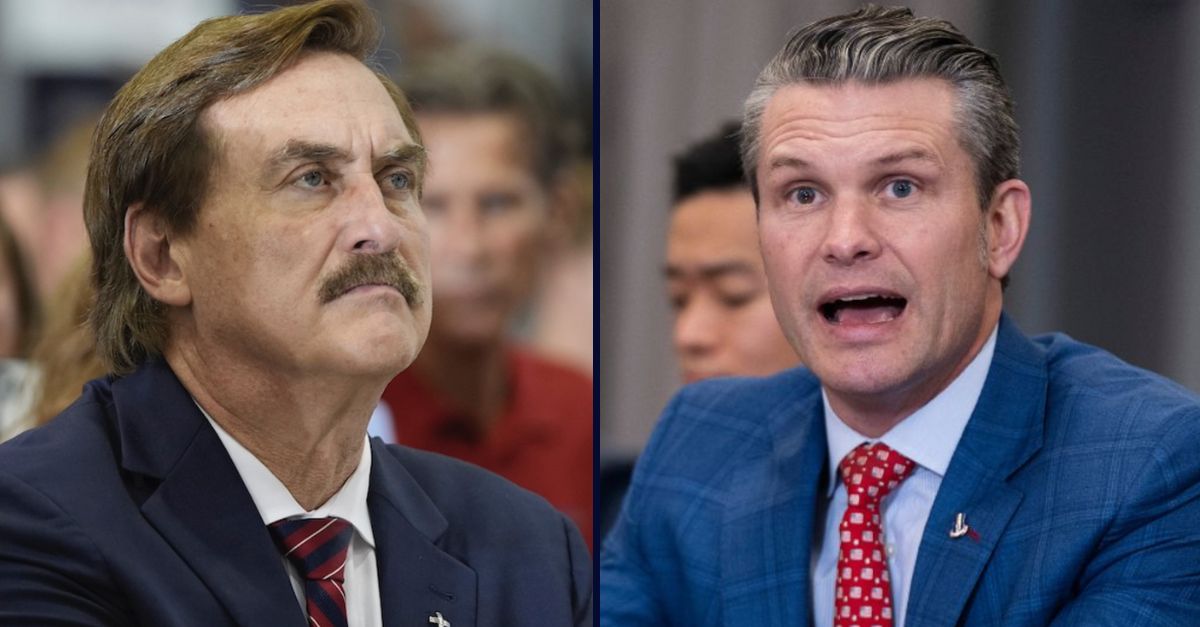
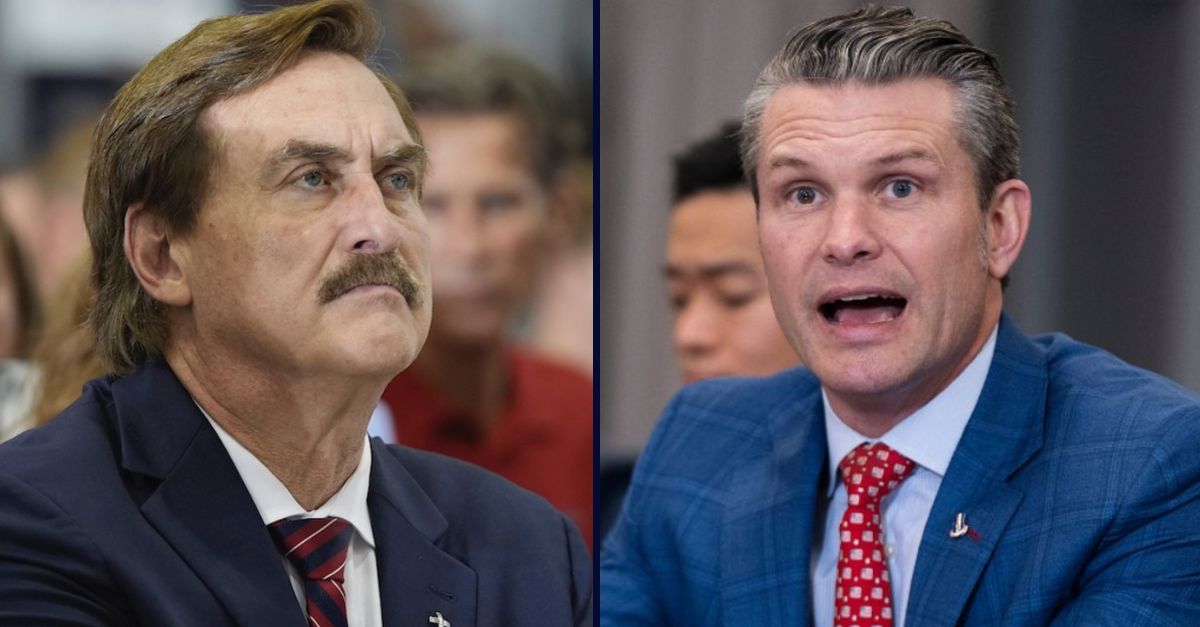
Left: Mike Lindell, also known as the My Pillow Guy, listens to former President Donald Trump speak in July 2024 (AP Photo/Alex Brandon). Right: Secretary of Defense Pete Hegseth responds to a reporter”s question before the start of a meeting with visiting Australian Deputy Prime Minister and Defense Minister Richard Marles at the Pentagon, Friday, Feb. 7, 2025, in Washington. (AP Photo/Manuel Balce Ceneta).
Mike Lindell, a 2020 election conspiracy theorist, pillow mogul, and avowed supporter of President Donald Trump, has press access at the Pentagon, but the New York Times does not — a case in point that Defense Secretary Pete Hegseth’s policy is “unconstitutional,” a federal lawsuit alleged on Thursday.
The Times’ lead attorney, Ted Boutrous, who has represented Mary Trump and CNN, asserted in a 40-page complaint that Hegseth’s media restriction policy must be blocked and declared unlawful under the First Amendment.
The controversy stems from the Pentagon’s demand that media organizations sign loyalty pledges not to report information to the public that hasn’t been approved by the Defense Department, even if that information is unclassified. Rather than signing on, many legacy media journalists exited the Pentagon in October and forfeited their badges. Several conservative media organizations followed suit in refusing to sign a policy that contemplated expulsion or more serious penalties for reporting, such as being branded a “security or safety risk.”
According to the Times lawsuit, Pentagon Facility Alternate Credentials (PFACs) under Hegseth’s rules give the Defense Department and the federal government “unbridled discretion to immediately suspend and ultimately revoke a reporter’s PFAC for engaging in lawful newsgathering, both on and off Pentagon grounds, or for reporting any information Department officials have not approved,” making the rules “neither reasonable nor viewpoint-neutral.”
Love true crime? Sign up for our newsletter, The Law&Crime Docket, to get the latest real-life crime stories delivered right to your inbox
“It is exactly the type of speech- and press-restrictive scheme that the Supreme Court and D.C. Circuit have recognized violates the First Amendment,” the lawsuit said, calling the move “a radical departure from longstanding tradition” and “inflicting irreparable harm on The Times and its reporters, including [Julian] Barnes, and on the American public.”
That Mike Lindell and other openly pro-Trump figures have access to the Pentagon in place of journalists who wouldn’t sign the so-called policy “Acknowledgment” says it all, the suit continued.
“While Plaintiffs and many other journalists and news organizations no longer possess PFACs because they refused to accede to a Policy that would restrict independent reporting, the Department has welcomed what it calls the ‘next generation of the Pentagon press corps’ — individuals and media outlets strongly supportive of the Trump administration and whose viewpoints the Department favors,” the complaint went on. “Among that group are Mike Lindell, the chief executive of MyPillow, who has promised to ‘make [the Administration] proud’ with his Pentagon coverage; Laura Loomer, an influential pro-Trump activist; and Raheem Kassam, editor in chief of the National Pulse, who described his publication as ‘basically an industry mag/site for MAGA world.'”
“These developments place the purpose and effect of the Policy in stark relief: to fundamentally restrict coverage of the Pentagon by independent journalists and news organizations, either by limiting what kind of information they can obtain and publish without incurring punishment, or by driving them out of the Pentagon with an unconstitutional Policy,” the lawsuit added.
Read the complaint in full here.


