
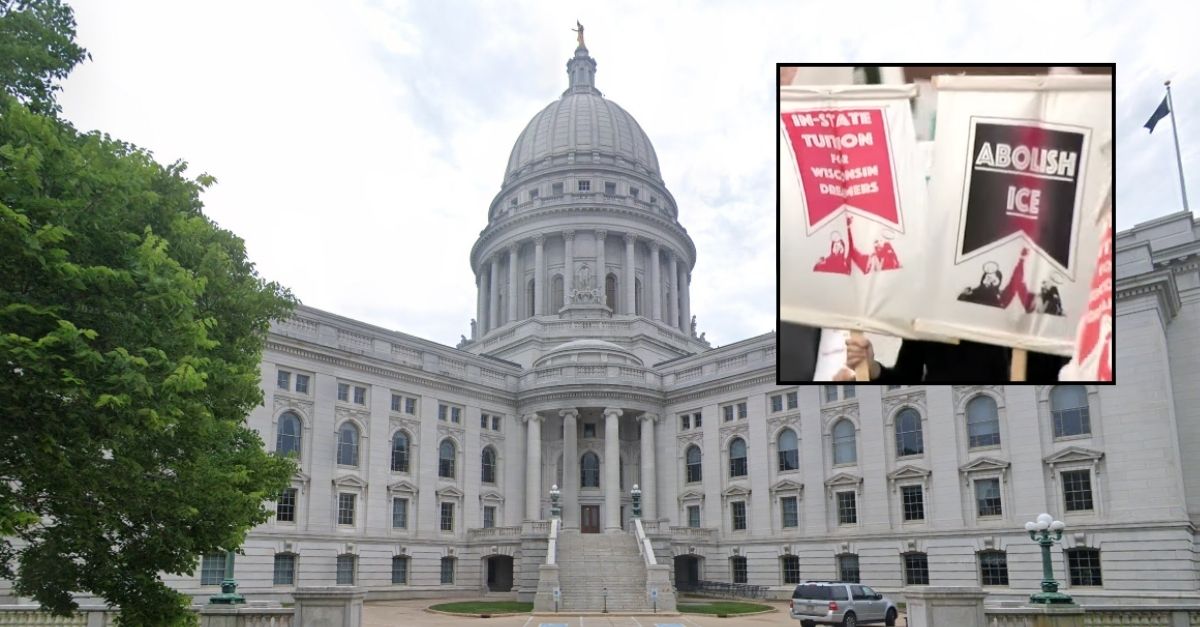
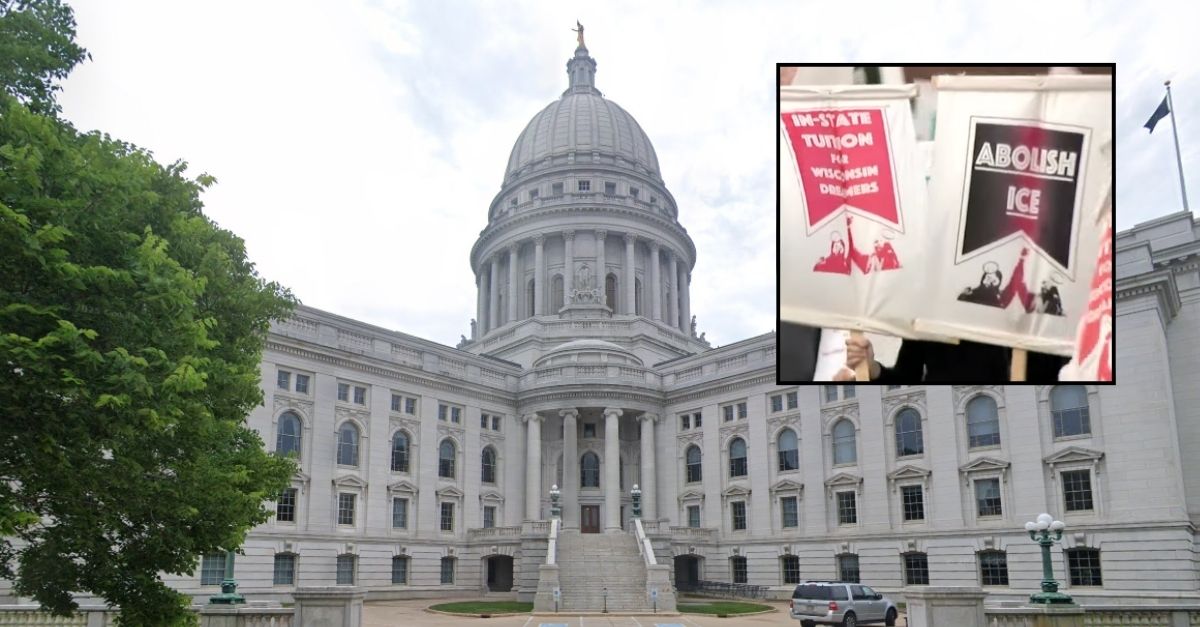
Background: The Wisconsin State Capitol building in Madison, Wisconsin (Google Maps). Inset: Protesters hold up pro-immigrant-rights and anti-ICE signs at a rally in Milwaukee, Wisconsin, in November 2025 (WISN/YouTube).
The Wisconsin Supreme Court is set to rule on whether local law enforcement agencies can hold people in their jails at the request of the Trump administration.
The decision from the state”s high court will have major implications for immigrants’ rights, which groups say are being violated when sheriff’s offices comply with Immigration and Customs Enforcement (ICE) detainers and hold a suspected illegal immigrant for up to 48 hours so the federal agency “can take custody of and deport them.”
Love true crime? Sign up for our newsletter, The Law&Crime Docket, to get the latest real-life crime stories delivered right to your inbox.
The lawsuit contends that “honoring an ICE detainer constitutes an arrest, and Wisconsin law enforcement does not have the authority to make arrests based solely on ICE’s civil administrative ‘warrants.'”
The state’s high court agreed to take up the case from the American Civil Liberties Union (ACLU), which argued on behalf of an immigrant rights group that the justices should bypass the lower courts and hear their petition directly because “people throughout the state are being illegally held for days so that ICE can pick them up.”
“The petition for leave to commence an original action is granted,” the state’s supreme court ruled on Wednesday, “this court assumes jurisdiction over this entire action, and the petitioner may not raise or argue issues not set forth in the petition for leave to commence an original action except as otherwise ordered below by this court.”
The petition from the ACLU and Voces de la Frontera said at the time of the lawsuit in September that “ICE sends detainers even for people with no criminal records or people who still have charges pending in Wisconsin courts.” They listed five state sheriff’s offices as respondents — from the counties of Walworth, Brown, Kenosha, Sauk, and Marathon — and noted that they have complied with ICE’s requests.
The Wisconsin Supreme Court ordered Voces de la Frontera to submit a brief within 30 days, and then the sheriff’s offices will have 20 days to respond.
The seven justices were split on whether to expedite the case. A majority is required for the state’s high court to bypass the lower courts to take a case and two justices indicated they were opposed to the decision.
The disagreement underscores the significance of the makeup of The Badger State’s high court. In the lead-up to Wisconsin’s last two state Supreme Court elections — both of which the liberal candidate won — national Democrats and Republicans funneled money into their respective candidate, recognizing how important a majority would be.
The distinction between acquiescence and opposition to ICE and the Trump administration’s immigration priorities has been a defining characteristic of many local leaders and officials. It is perhaps most notable in so-called “purple” states such as Wisconsin.
The ACLU celebrated the Wisconsin Supreme Court’s decision to take up the case.
“ICE continues to send hundreds of these detainers to Wisconsin jails, and people throughout the state are being illegally held for days so that ICE can pick them up,” said Tim Muth, ACLU of Wisconsin senior staff attorney. “ICE sends detainers even for people who have never been convicted and only have minor charges pending in Wisconsin courts. Sheriffs are overstepping their authority under Wisconsin law by honoring ICE detainers.”
Law&Crime reached out to ICE for comment.


