
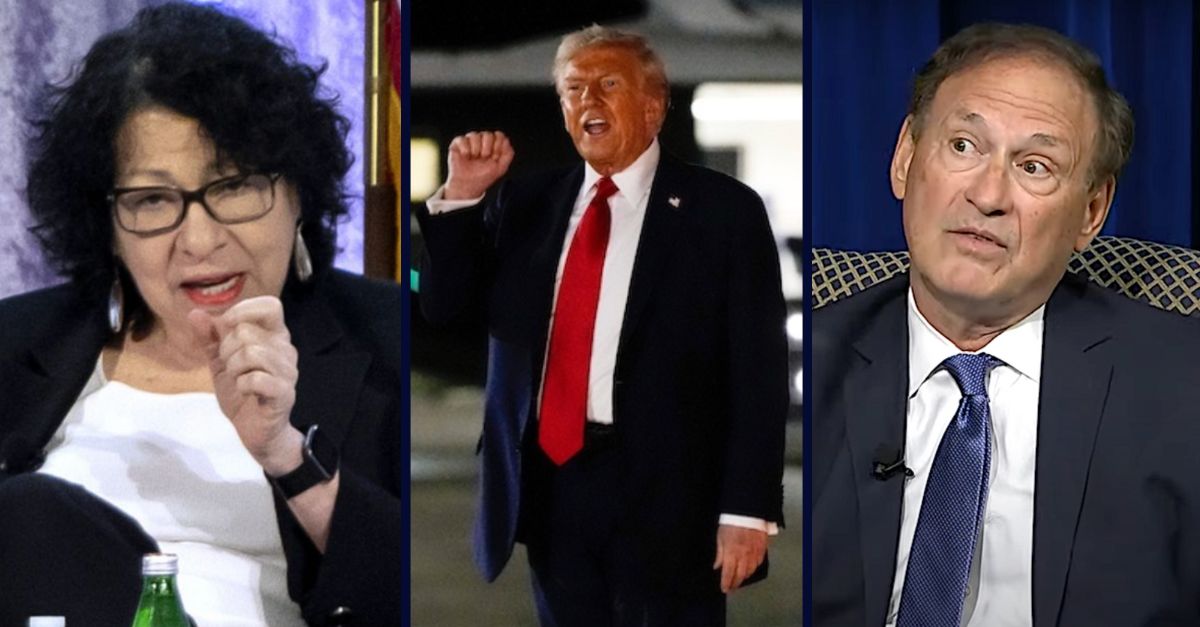
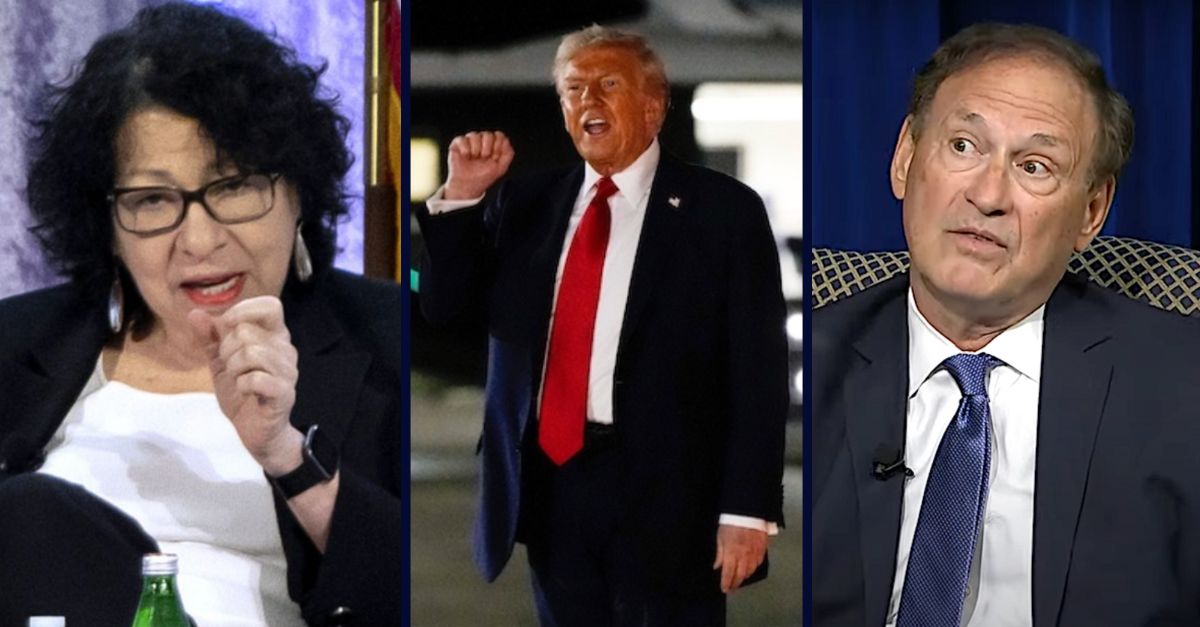
Left: Supreme Court Justice Sonia Sotomayor speaks during a panel discussion at the winter meeting of the National Governors Association, Friday, Feb. 23, 2024, in Washington (AP Photo/Mark Schiefelbein). Center: President Donald Trump gestures to members of the media before walking to Marine One, Sunday, Sept. 21, 2025, at Joint Base Andrews, Md. (AP Photo/Julia Demaree Nikhinson). Right: Justice Samuel Alito speaks in October 2022 after the leak of Dobbs v. Jackson Women”s Health opinion (The Heritage Foundation/YouTube).
Justice Sonia Sotomayor attempted to pin down the Trump administration’s solicitor general on what exactly the consequences would be if the Supreme Court agrees to overturn a 90-year-old precedent protecting the Federal Trade Commission’s head from causeless firing, but Justice Samuel Alito swooped in a short time later with an assist.
U.S. Solicitor General D. John Sauer was peppered with questions on President Donald Trump’s efforts to fire FTC Commissioner Rebecca Kelly Slaughter, a Democrat, for reasons other than “inefficiency, neglect of duty, or malfeasance in office,” the removal causes identified in the landmark Humphrey’s Executor case from 1935.
The oral arguments came days after a Trump-appointed majority on the U.S. Court of Appeals for the District of Columbia Circuit ruled that the president “permissibly removed” Democratic members of the National Labor Relations Board (NLRB) and Merit Systems Protection Board (MSPB), citing SCOTUS’ 2020 decision in Seila Law v. Consumer Financial Protection Bureau (CFPB).
The Trump administration had argued that Seila Law was clear that the notion the CFPB director could only be removed for causes of “inefficiency, neglect, or malfeasance” violated the separation of powers, because the president’s authority under Article II of the Constitution “generally includes the power to supervise—and, if necessary, remove—those who exercise the President’s authority on his behalf” — principals wielding “substantial powers that are both executive in nature and different from the powers” Humphrey’s Executor deemed to be “merely quasi-legislative or quasi-judicial.”
Nearly the first words Sauer uttered Monday were Seila Law, as he called Humphrey’s Executor an “indefensible outlier” that has “not withstood the test of time” and is little more than a “decaying husk with bold and particularly dangerous pretensions.”
“It was grievously wrong when decided” and “must be overruled,” Sauer said.
By way of background, Humphrey’s Executor was a Supreme Court case that held then-President Franklin Delano Roosevelt did not have the power to fire FTC Commissioner William Humphrey without cause after policy disagreements. Humphrey’s estate sued for back pay and succeeded in arguing that Congress expressly intended to insulate the independent fair competition agency from being unfairly subjected to the whims of the executive and, by extension, politicization and dysfunction.
On Monday, when Justice Clarence Thomas asked if a president’s reasons for firing a principal officer can be “completely arbitrary,” Sauer didn’t say no, pointing the landmark presidential immunity case Trump v. United States to state that the chief executive’s power to remove is “conclusive and preclusive” — and there’s nothing the courts can do about it.
“Any review of arguably bad reasons for the President to remove an executive officer would be subject to the political process,” Sauer said. “It would not be subject to judicial review, and certainly not subject to statutes regulating that.”
Love true crime? Sign up for our newsletter, The Law&Crime Docket, to get the latest real-life crime stories delivered right to your inbox
After Chief Justice John Roberts pointed out that there are “a lot of agencies” in the federal government for which it is “hard to parse whether it’s an executive function it’s engaged in or a legislative function,” raising the question of what the high court can do across the board if it ultimately agrees with the Trump administration, Sotomayor jumped in with a series of pointed questions and pronouncements about the government’s aims.
“You’re asking us to overturn a case that has been around for over 100 — nearly 100 years,” Sotomayor said, pressing Sauer to name another case the Supreme Court has decided that “fundamentally altered the structure of government.”
“Actually, since 1887 we’ve had multi-member boards, and that’s the entire government structure,” she added.
Sauer responded that the Humphrey’s Executor framework is a “distortion” of the law.
“Aren’t you asking us to distort it in a different way?” Sotomayor shot back.
“Neither the king, nor Parliament, nor prime ministers, England at the time of the founding ever had an unqualified removal power,” she said. “You’re asking us to say that at a time the founding and the Constitution doesn’t speak about this at all, where there was robust debate over this issue among legal scholars at the time, that we ourselves have said repeatedly in Humphrey’s and other cases — Weiner, even in Myers — that that those cases you mentioned did not establish this absolute power of the president.”
“You’re asking us to destroy the structure of government and to take away from Congress its ability to protect its idea that the government is better structured with some agencies that are independent,” Sotomayor accused Sauer.
Sauer responded the there were at least nine other decisions — the “dominant line of authority” beginning in 1839 — that the Trump administration is asking the high court to “return to.”
Sotomayor was not persuaded.
“You still haven’t answered my question. Where else have we so fundamentally altered the structure of government?” she followed up.
“I think the fundamental alteration of the structure of the government was ushered in by Humphrey’s, and then the Congress kind of took Humphrey’s and ran with it in the building of the […] administrative state in the proliferation of independent agencies,” the solicitor general replied.
Sotomayor, countering that independent agencies have been around since the founding era and are not a “modern contrivance,” worried that the logic of Sauer’s arguments could put “at risk” the independence of other entities, like the Tax Court and the Federal Claims Court.
Justice Brett Kavanaugh wondered next about concerns — concerns he said he “shared” — about the “independence” of the Federal Reserve. Trump has tried to fire governor Lisa Cook on the strength of alleged, denied, and unadjudicated mortgage fraud claims.
On that point, Sauer replied that he accepts what the court has said — that the U.S. central bank is “unique and distinct” in the “historical tradition.”
With Justice Elena Kagan suggesting that there’s no end in sight to the Trump administration’s at-will firing power “logic,” Alito picked up where Sotomayor left off — and challenged her conclusions.
“It’s been suggested that if we were to rule in your favor about the Federal Trade Commission, put aside these other agencies. Just about the Federal Trade Commission, which is the issue that’s before us, the entire structure of the government would fall. You want to take a minute to address that?” Alito asked.
Referring again to Seila Law, Sauer said “these kinds of predictions of doom” have not come to pass.
“The sky did not fall,” he added. “So also, if the FTC, the MSPB, the NLRB, are made subject to political process, the political discipline of being accountable to the president, the sky will not fall. In fact, our entire government will move towards accountability to the people.”


