
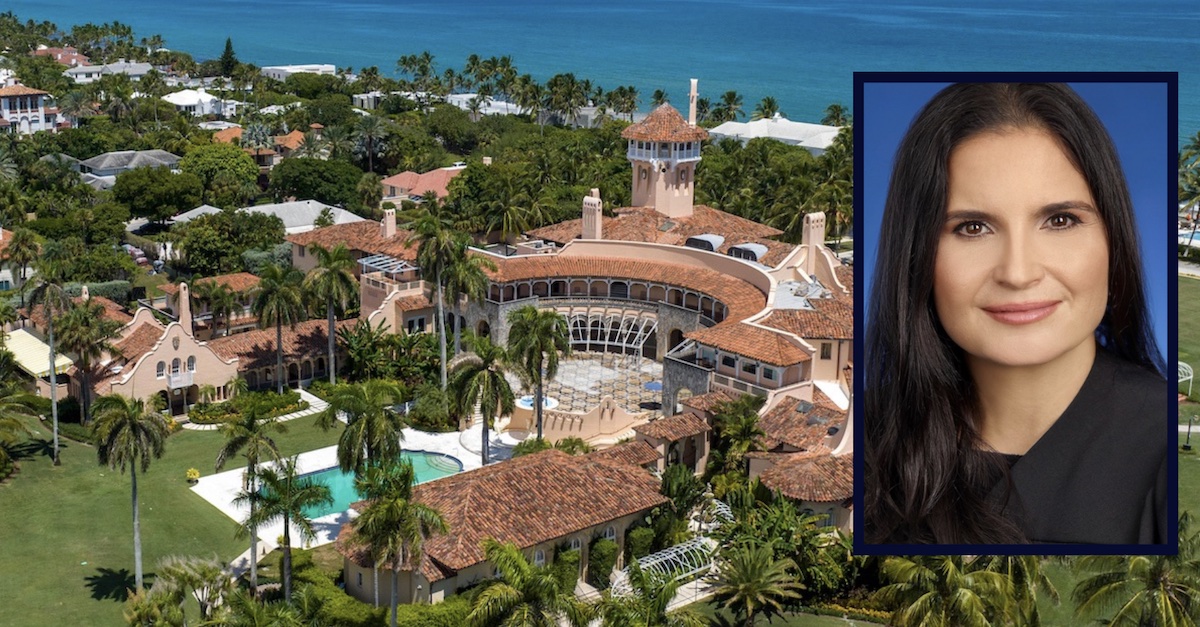
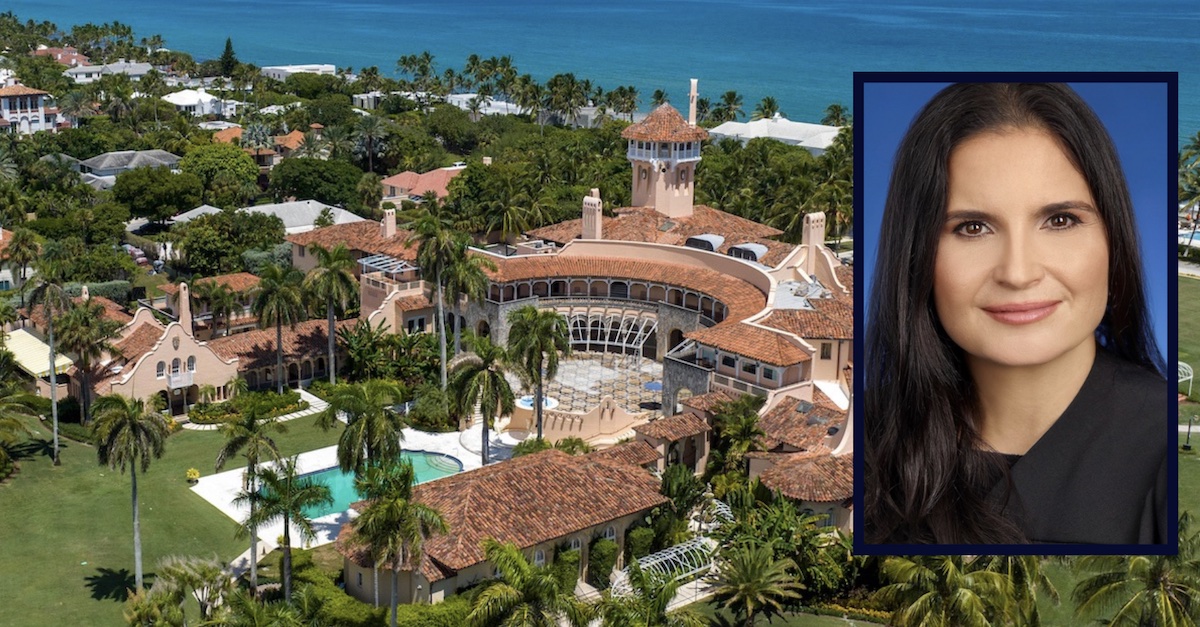
Main: An aerial view of former President Donald Trump”s Mar-a-Lago club in Palm Beach, Fla., on Aug. 31, 2022 (AP Photo/Steve Helber/File). Right inset: U.S. District Judge Aileen Cannon (U.S. District Court for the Southern District of Florida).
The day before ex-special counsel Jack Smith was set to testify before Congress behind closed doors, Fox News published a story about FBI internal emails doubting “probable cause” for the August 2022 “raid” of Mar-a-Lago in search of classified documents, rehashing grievances about the case that not even the judge who dismissed it bought.
The opening lines of the “exclusive” Fox story contended Tuesday that “newly declassified documents” showed the “Biden Justice Department” engaged in a pressure campaign to move the Mar-a-Lago probe forward, quoting former Deputy Assistant Attorney General George Toscas as saying on a 2022 call that he didn’t “give a damn about the optics” surrounding the eventual search.
If there was any question about the perceived impact of the article, President Trump cleared that up for himself in a reaction on Truth Social.
“Unreasonable Search and Seizure!!! That was the FBI’s CRIMINAL RAID on Mar-a-Lago. This can never be allowed to happen again!!! President DJT,” the Tuesday night post said.
White House Press Secretary Karoline Leavitt likewise drew attention to the piece by screenshotting the headline and stating with an alarm emoji: “Here’s a story that matters…”
🚨Here’s a story that matters…
“The FBI did not believe it had probable cause to raid President Donald Trump’s Mar-a-Lago home in 2022, but moved forward amid pressure from the Biden Justice Department, with an official saying he didn’t ‘give a damn about the optics’ of the… pic.twitter.com/zUet61Z8B9
— Karoline Leavitt (@PressSec) December 16, 2025
There’s just one problem: U.S. District Judge Aileen Cannon, the Trump-appointed judge who ruled in mid-July 2024 that Smith was unlawfully appointed as special counsel, did not say what the White House has regarding the Mar-a-Lago search.
If the didn’t “give a damn about the optics” line sounded familiar, that’s because it showed up repeatedly in a Trump defense motion from more than a year ago challenging the validity of the warrant based on alleged “omissions” by the government.
The May 2024 “Motion for Relief Relating to the Mar-a-Lago Raid and Unlawful Piercing of the Attorney-Client Privilege,” signed by Todd Blanche, now the deputy attorney general of the United States, used the same quote to argue the search was “unconstitutional” and starkly different from the way the Clintons were treated.
The defense complained that the search went forward despite “FBI objections” and internal debate. Blanche bristled that President Joe Biden’s DOJ leadership, specifically Deputy Assistant AG Toscas, “frankly [did]n’t give a damn about the optics” of the search of then-former president Trump’s Florida home, a search then-Attorney General Merrick Garland ultimately signed off on.
“On August 8, 2022, armed FBI agents stormed the private residence of a former president of the United States. What was unthinkable with respect to President Clinton’s recordings, and deemed unwarranted with respect to Hillary Clinton’s destruction of evidence, was determined to be appropriate by the Biden Administration for President Biden’s chief political rival,” court documents said. “Personally authorized by Attorney General Garland, and supported over FBI objections by DOJ leadership who did not ‘give a damn about the optics’ of these unprecedented steps, the raid of Mar-a-Lago was unconstitutional.”
Love true crime? Sign up for our newsletter, The Law&Crime Docket, to get the latest real-life crime stories delivered right to your inbox
The defense asked Cannon to order a Franks hearing — a type of hearing in criminal cases in which a defendant challenges the truthfulness of an affidavit used in support of a search warrant — claiming it could make a “substantial preliminary showing” that the government lied by omission and asserted those “omitted facts,” had they been included in the government’s search warrant application, “would have prevented a finding of probable cause.”
In this context, Trump attorneys Blanche and Christopher Kise alleged an unnamed FBI special agent who submitted the application and an affidavit “intentionally or recklessly misled the issuing magistrate” on “at least four issues,” one of those issues being internal FBI debate on whether executing a search warrant was necessary at all.
“First, Agent FBI 21A failed to disclose that the FBI had taken the position—in writing, apparently—that it was not necessary to execute a search warrant at Mar-a-Lago. The FBI’s assessment conflicted with Agent FBI 21A[‘s] sworn assertion that the warrant application needed to be sealed because ‘disclosure … may have a significant and negative impact on the continuing investigation and may severely jeopardize its effectiveness …,'” the motion went on. “To the contrary, ADIC [Assistant Director in Charge] [Steven] D’Antuono, who was Agent FBI 21A[‘s] boss at the time, believed it was appropriate to seek consent for the search from President Trump’s attorney, [redacted].”
Further down in the motion, Trump’s lawyers dinged Smith for arguing “falsely” that the government “had ‘no choice but to seek a search warrant.'” The defense’s proof? The “omission” about the FBI’s apparent belief that the “objective of the search could have been accomplished through a call to” Trump’s lawyer, as combined with Toscas’ not giving “a damn” about “optics” remark.
“The intentional and improper nature of this omission is further supported by Toscas’ previously private declaration, as a DOJ supervisor, that he did not ‘give a damn about the optics’ of the raid,” the defense said, seeking a Franks hearing to “facilitate fact-finding regarding the motive behind the material omissions and their impact on the warrant application.”
Just 18 days before she tossed out the Espionage Act indictment against then-candidate Trump while repeatedly citing Justice Clarence Thomas’ solo concurrence in the Supreme Court’s presidential immunity decision Trump v. United States, Cannon on June 27, 2024, refused to grant Trump that hearing.
“Defendant Trump has not made the requisite ‘substantial preliminary showing’ to warrant a Franks hearing. He identifies four omissions in the warrant, but none of the omitted information—even if added to the affidavit in support of the warrant—would have defeated a finding of probable cause,” Cannon wrote straightforwardly, adding a footnote for extra clarity: “The Motion does not meaningfully challenge the presence of probable cause in the affidavit.”
Cannon didn’t stop here.
She found that the allegedly relevant omitted details about “dissenting views of other FBI agents” — and D’Antuono’s support for contacting Trump’s attorney, seeking consent to search Mar-a-Lago — were an “insufficient basis to believe” that the “evidentiary calculus in support of probable cause” would have been “altered” by the information’s inclusion in the application.
The “omissions” couldn’t defeat probable cause, but they were good enough for another news cycle.


