
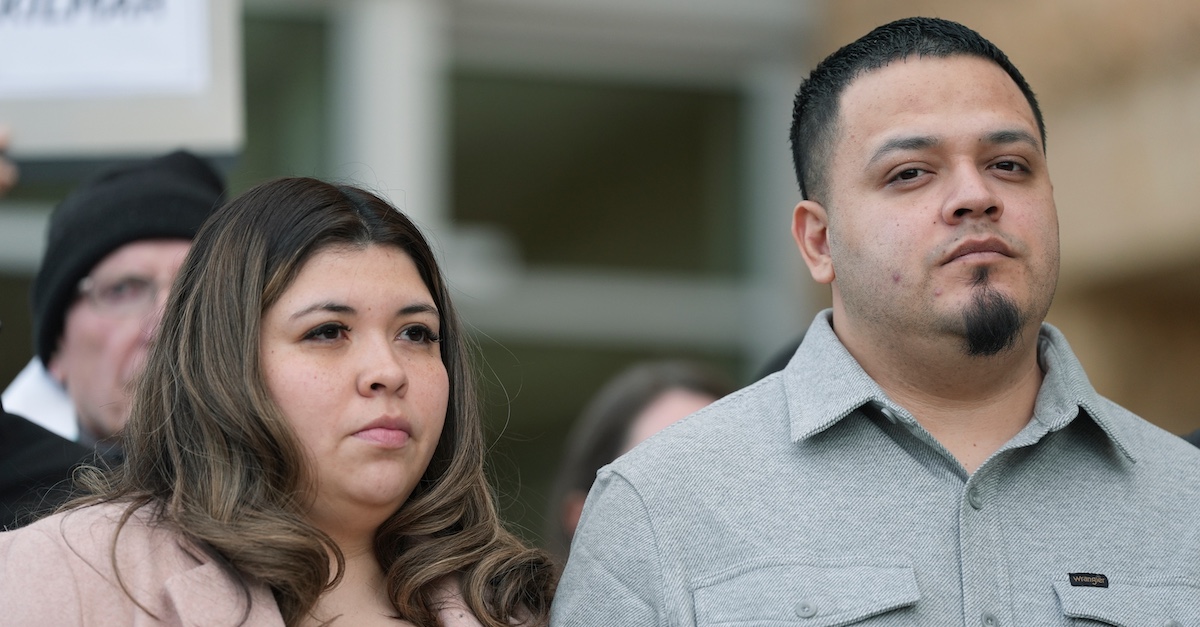
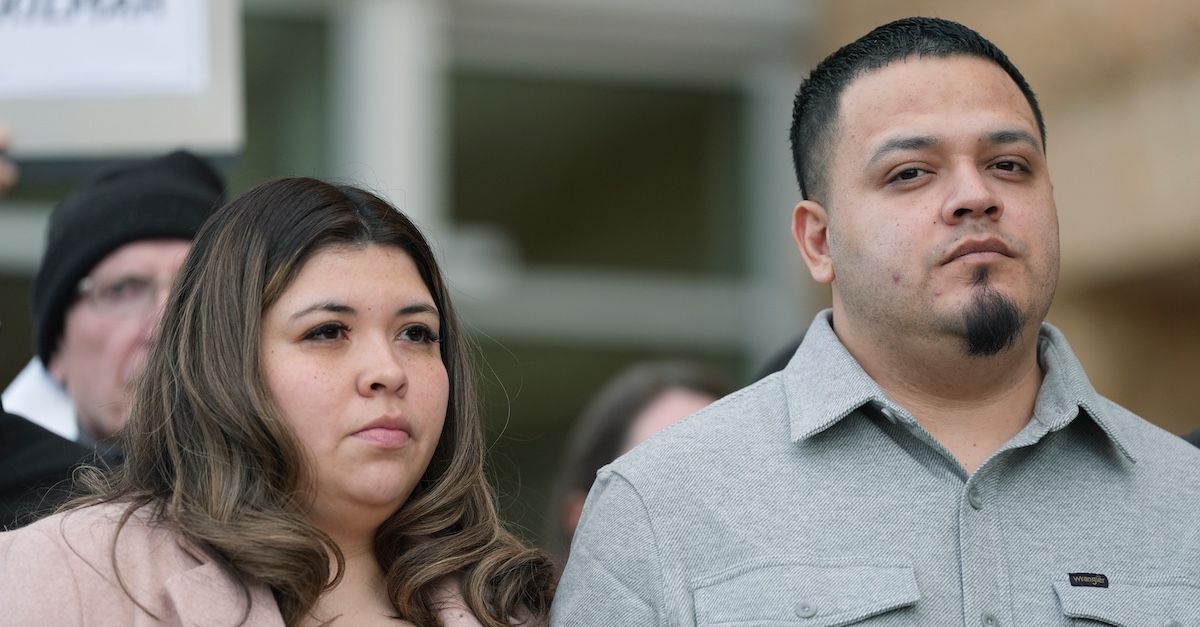
Kilmar Abrego Garcia and his wife Jennifer Vasquez Sura leave the United States District Court District of Maryland, Monday, Dec. 22, 2025, in Greenbelt, Md. (AP Photo/Stephanie Scarbrough).
With his human smuggling criminal trial canceled in Tennessee and a crucial evidentiary hearing upcoming in two weeks, one which could lead the case to be dismissed on vindictive prosecution grounds, Kilmar Abrego Garcia is trying to force the DOJ to hand over “two categories of key information” which the defendant says the Trump administration has “reneged” on producing.
The wongly deported Salvadoran man”s lawyers claim that the DOJ’s “about-face” on providing government witness information, plus a “privilege log of all documents the government submitted” for U.S. District Judge Waverly Crenshaw’s in-chambers review of the administration’s “asserted privilege claims,” only tends to confirm the feds are “unwilling and unable to rebut the presumption of vindictiveness that has already attached.”
Slamming an “unrelenting effort to impede an objective inquiry into the motives behind this prosecution,” Abrego Garcia claimed the Trump administration has, on the subject of the privilege log, “simply ignored the defense’s repeated written inquiries about when it might be produced.”
Attached as an exhibit to the motion was a Nov. 17 email from Associate Attorney General Stanley Woodward, who weeks before decried the defendant’s attempted intrusion into the inner workings of the highest levels of the DOJ and threatened to seek “extraordinary” appellate relief if Crenshaw tried to force Deputy Attorney General Todd Blanche to testify under oath about the origins of the criminal case.
Woodward took umbrage that Abrego Garcia “impugns the integrity of the United States by assuming bad faith” — in a case in which the judge already agreed that the “totality of events creates a sufficient evidentiary basis to conclude that there is a ‘realistic likelihood of vindictiveness’ that entitles Abrego to discovery and requires an evidentiary hearing[.]”
At the end of the letter, however, Woodward stated, “without waiving any objections,” that the government “will provide a privilege log that includes a brief description of each document produced to the court for in camera review and, where applicable, the privilege asserted.”
In December, the judge in Abrego Garcia’s habeas corpus case found he was held by ICE “without lawful authority” for months following his return to the U.S. from a prison notorious for torture in El Salvador.
U.S. District Judge Paula Xinis, a Barack Obama appointee, ordered Abrego Garcia’s release, also finding the Trump administration “affirmatively” misled the court on the facts.
The criminal defendant has claimed that the human smuggling charges amounted to retaliation for embarrassing the government in civil litigation.
On that score, Abrego Garcia says more of the same is afoot into the present day, claiming that the DOJ is “playing fast and loose” with Crenshaw, also an Obama appointee.
“It is clear that relevant, discoverable documents exist—some were produced to the Court—and the government should not be permitted to change positions now to prevent the defense from obtaining them,” the motion said, encouraging the judge to take this “stonewalling” as more evidence of the “stunningly vindictive nature of this prosecution.”
“The government’s about-face amounts to ‘playing fast and loose with the courts,’ and ‘changing positions ‘to suit an exigency of the moment,'” the defense added.
The evidentiary hearing is scheduled for Jan. 28, and on Thursday, Crenshaw ordered the DOJ to respond to Abrego Garcia’s motion to compel, at the latest, by Jan. 21, one week before the key proceedings.
Previously, Crenshaw canceled a January trial date to hold the one-day evidentiary hearing to see whether the DOJ can provide “objective, on-the-record explanations” for the human smuggling charges that rebut the defendant’s “prima facie showing of vindictiveness.”
The judge also explained why the hearing is so “critical.”
“Whether the government can produce such evidence is critical, for ‘[i]f the government fails to present evidence sufficient to rebut the presumption, the presumption stands and the court must find that the prosecutor acted vindictively,’ leading to ‘dismissal of the charges or other appropriate remedies,” Crenshaw wrote. “However, ‘[i]f the government produces evidence to rebut the presumption, the defendant must prove that the offered justification is pretextual and that actual vindictiveness has occurred.'”
In short, if the DOJ fails at the hearing the case will be tossed, but if the DOJ does enough to turn the tables, the burden will “shift back” to Abrego Garcia to show the “government’s rationale for prosecuting him is pretextual and that his prosecution is actually vindictive.”
Colin Kalmbacher contributed to this report.


