
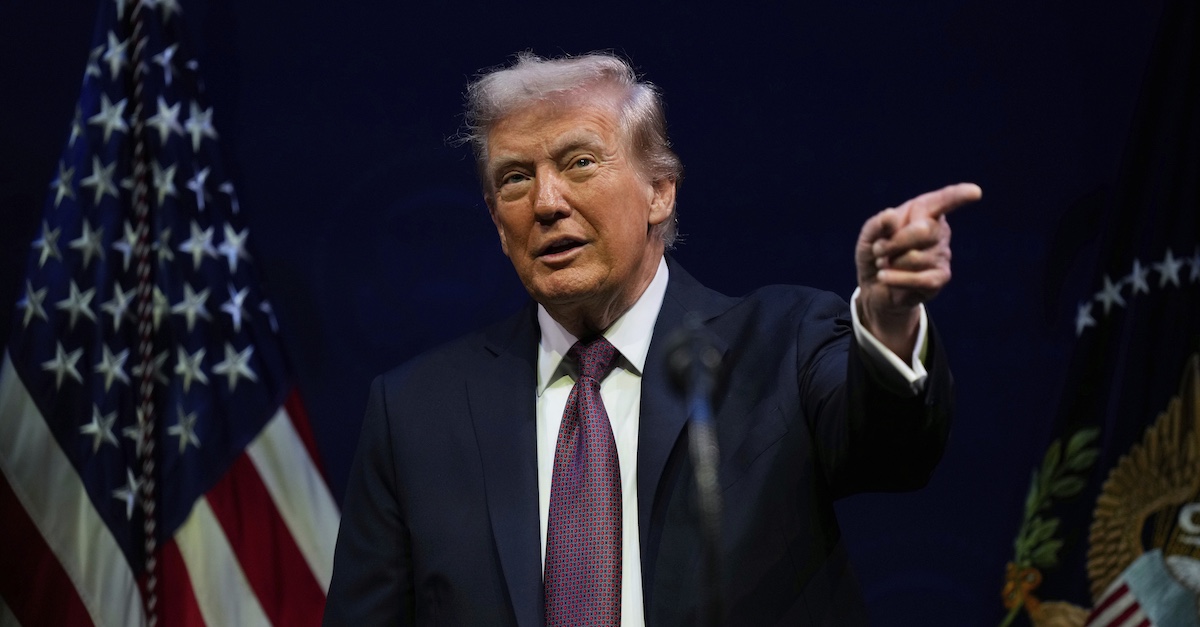
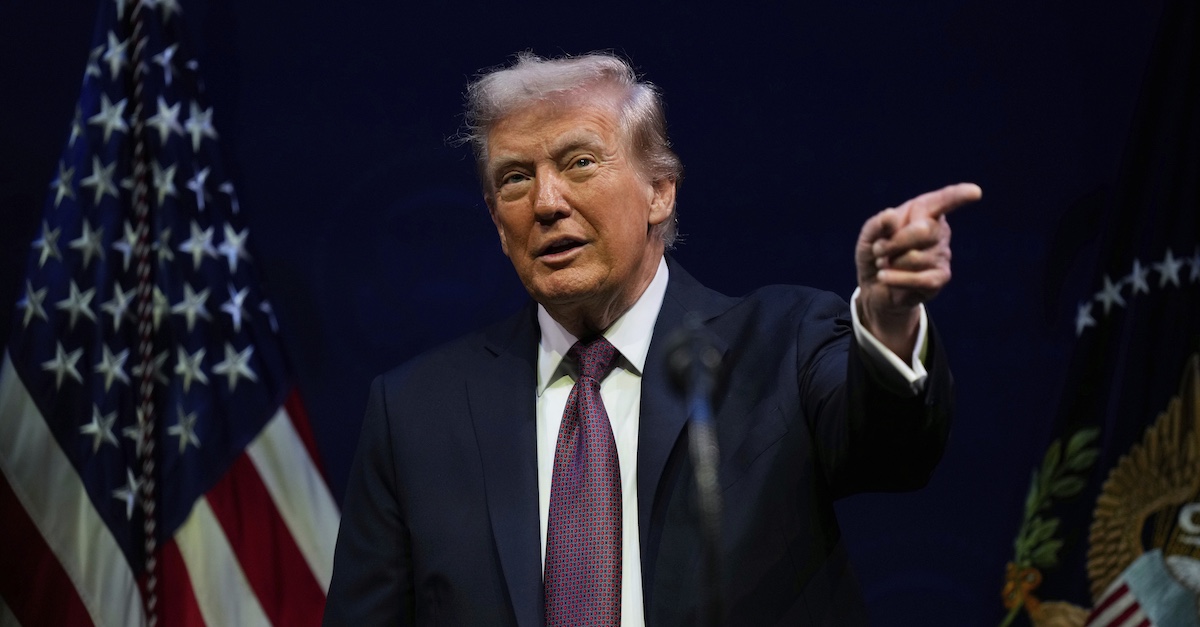
President Donald Trump speaks at a hearing of the Religious Liberty Commission at the Museum of the Bible, Monday, Sept. 8, 2025, in Washington (AP Photo/Alex Brandon).
The New York Times is vehemently pushing back against discovery demands by President Donald Trump in an ongoing defamation clash.
The paper of record insists the 45th and 47th president”s $15 billion lawsuit will likely be dismissed soon — making discovery unnecessary.
On Monday, the Times – along with book publisher Penguin Random House – filed a 16-page motion to stay merits discovery in the U.S. District Court for the Middle District of Florida.
“This Court should stay discovery because Plaintiff Donald J. Trump’s Amended Complaint is likely to be dismissed in its entirety, substantially narrowed, or transferred out of this District,” the motion begins.
Trump filed the lawsuit in September 2025. Within days, a federal judge deemed the complaint to be “decidedly improper and impermissible.”
In October 2025, Trump and his attorneys tried again, in a slimmed-down effort excising over half the pages from the original petition.
In December of last year, the defendants filed two different motions to dismiss. One motion is premised on the notion that, yet again, Trump has failed to properly state a claim. The second motion argues the lawsuit was improperly filed in the Sunshine State and should be moved to New York because “none” of the allegations concern Florida.
The day after Christmas last year, Trump filed a motion for venue discovery, bidding for all Florida-related “acts connected to the statements at issue.” Trump’s motion also contained several document-related discovery requests, including “the channels, distributors, and routing decisions that drove shipments and sales” of a book about Trump, “readership metrics” including “page views, unique visitors, subscriber views,” and information about “operative decisions” including “printing, warehousing and shipping pathways for Penguin and publication and distribution processes for The Times.”
The defendants harshly categorized Trump’s non-geographic discovery requests as “wide-ranging, burdensome, and irrelevant document discovery that goes far beyond venue.”
In sum, the defendants argue Trump’s discovery requests are particularly burdensome and violate their First Amendment rights.
From the filing, at length:
The President of the United States seeks to punish reporters and their publishers—to the tune of $15 billion—for publishing journalistic works with a perceived “anti-Trump narrative.” As the Eleventh Circuit recognized in [a recent precedent], “[f]orcing publishers to defend inappropriate suits through expensive discovery proceedings . . . would constrict that breathing space” that the First Amendment requires. Courts therefore grant stays of discovery pending resolution of motions challenging “the legal sufficiency” of defamation claims. This Court should do the same.
In other words, the defendants say the upshot of Trump’s lawsuit is — rather than real legal claims — an attempt by the government to harass journalists for exercising freedom of press by legalistic maneuvering that inhibits freedom of press. And, in turn, the defendants say, the judge overseeing the matter should not countenance such harassment because it violates the First Amendment.
The heart of the defense filing rests on the idea that Trump’s lawsuit simply lacks merit under basic tenets of defamation law.
“This is a defamation action based on 33 challenged statements about a candidate for the presidency, published at the height of a presidential campaign, spread across three different publications—the book Lucky Loser and two New York Times articles—written or published by five different defendants,” the motion goes on. “All of the claims fail for multiple independent reasons, as even a ‘preliminary peek’ at the Complaint and Defendants’ Merits Motion reveals.”
And from what the filings so far have shown, discovery under such circumstances is not warranted, according to the Times.
“Any time a ‘preliminary peek’ shows that a complaint is without merit and a motion to dismiss is likely to dispose of the case in its entirety, a stay of discovery is justified,” the motion continues. “But where, as here, a case is brought to punish First Amendment-protected speech and the discovery process itself furthers that punishment, a stay of discovery is particularly warranted.”
The defendants are asking the judge to stay discovery until their two motions to dismiss are dealt with, expressing confidence that at least one of those motions will be decided in their favor.
“[W]here, as here, a case is brought to punish First Amendment-protected speech and the discovery process itself furthers that punishment, a stay of discovery is particularly warranted,” the motion goes on. “Other circumstances particular to this case also heighten the prejudice to Defendants of having to engage now in discovery, including the breadth of discovery Plaintiff has signaled he intends to seek, the likelihood that the case will be significantly narrowed if not outright dismissed, and the materially different discovery rules and practices in the Southern District of New York, where this case belongs.”
As the motion continues, the Times notes that Trump himself has not even moved for merits discovery — and essentially acknowledged why expansive discovery at this point is not needed.
Again, the filing, at length:
In fact, although Plaintiff has not consented to stay discovery, his actions speak loudly. He has made no effort to obtain discovery going to the merits. Then, in seeking “limited” discovery concerning venue, Plaintiff appears to be in agreement that merits discovery is premature. In his motion for venue discovery, Plaintiff asks the Court to defer “expending resources on merits” considerations while “threshold” venue issues are resolved, in order to avoid “needless expense on the parties” and “wast[ing] judicial resources.” On this, the parties agree: a stay of merits discovery would benefit all parties.
The case is before Senior U.S. District Judge Steven Merryday, a George H.W. Bush appointee.


