
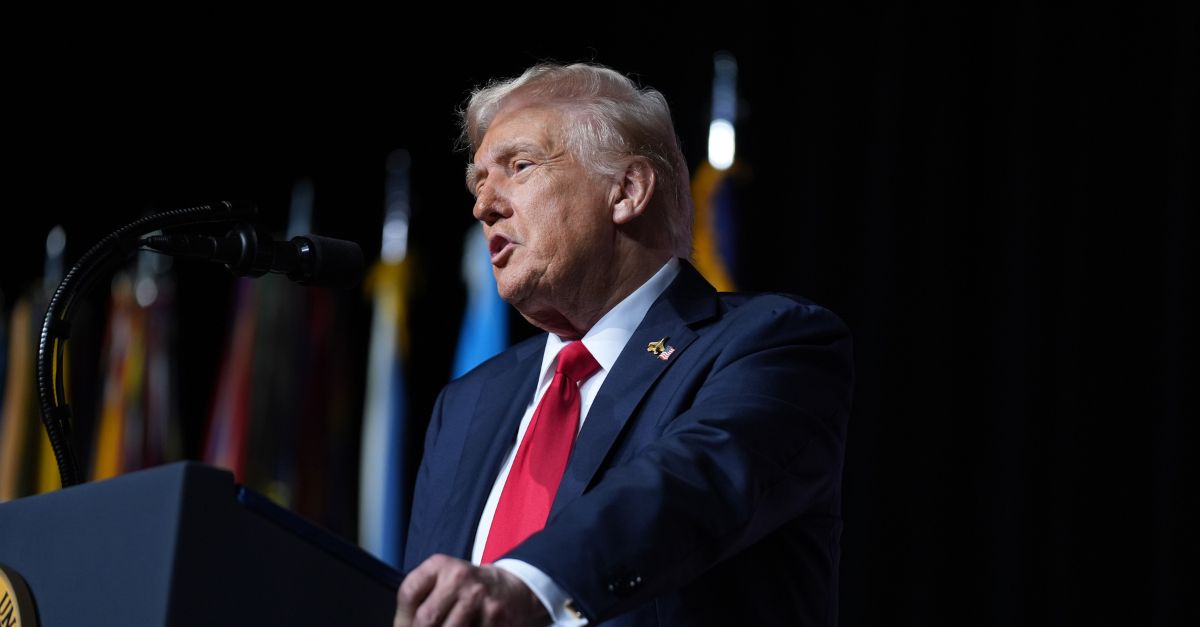
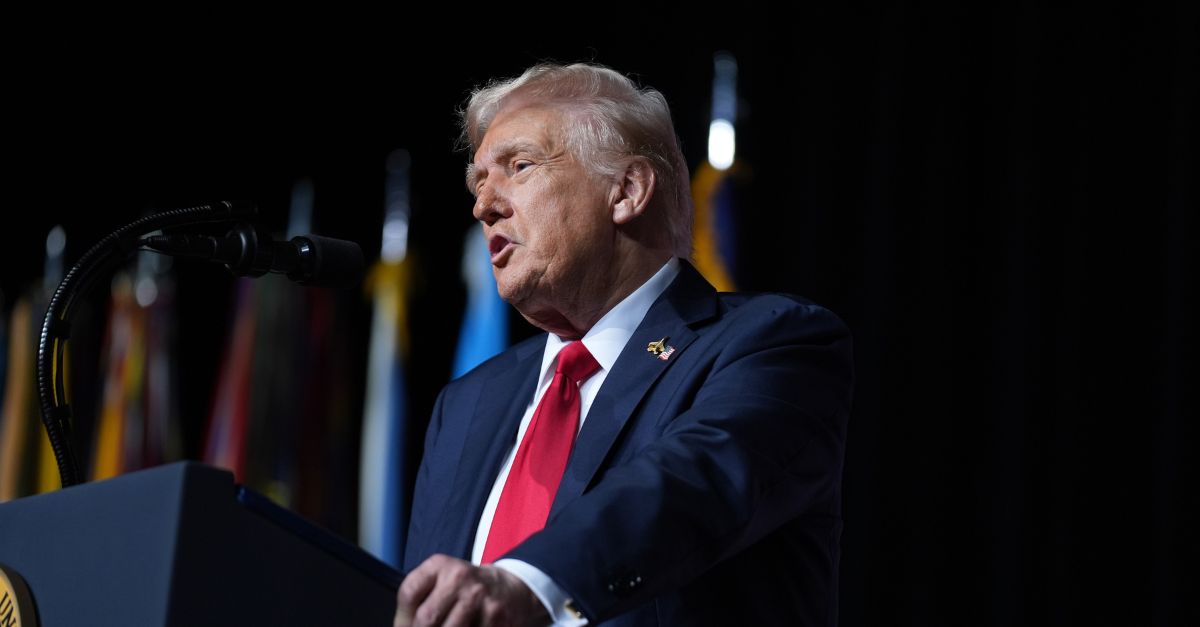
President Donald Trump speaks to a gathering of top U.S. military commanders at Marine Corps Base Quantico, Tuesday, Sept. 30, 2025, in Quantico, Va. (AP Photo/Evan Vucci).
The genesis of the FBI raid on Fulton County“s election hub is a referral from a former lawyer for President Donald Trump‘s failed 2020 reelection campaign, an affidavit unsealed Tuesday shows.
In an emergency motion filed earlier this month, Fulton County Board of Commissioners Chairman Robb Pitts sued the Trump administration, requesting the return of “all original seized materials” from the 2020 election, including some “656 boxes containing the original versions” of ballots, ballot images, tabulators, and voter rolls.
On Saturday, U.S. District Judge J.P. Boulee, a Trump appointee, ordered the docket’s unsealing and told the Department of Justice to file its search warrant affidavit by Tuesday as he considers the motion.
Now, the affidavit has been released and traces the underlying investigation back to Kurt Olsen, an election denialist who spoke with Trump several times on Jan. 6, 2021, and who tried to convince then-acting attorney general Jeffrey Rosen to back litigation specifically aimed at overturning Joe Biden’s victory at the U.S. Supreme Court.
“This warrant application is part of an FBI criminal investigation into whether any of the improprieties were intentional acts that violated federal criminal laws,” the affidavit reads. “The FBI criminal investigation originated from a referral sent by Kurt Olsen, Presidentially appointed Director of Election Security and Integrity.”
As the president and his campaign floundered in late 2020, Olsen suggested litigation based on a failed lawsuit filed by Texas Attorney General Ken Paxton (R) as a starting point.
“Thank you for calling me on behalf of AG Rosen,” Olsen wrote to Rosen’s deputy, John Moran, on Dec. 29, 2020. “Attached is a draft complaint to be brought by the United States modeled after the Texas action. As I said on our call, the President of the United States has seen this complaint, and he directed me last night to brief AG Rosen in person today and discuss bringing this action. I have been instructed to report back to the President this afternoon after this meeting.”
Olsen was appointed to his current role in October 2025. As a special government employee, he was tasked with investigating never-proven claims of widespread fraud during the 2020 election with a focus on obtaining information from states, according to the Wall Street Journal.
The affidavit maintains widely- and long-debunked claims “of electoral impropriety relating to the voting process and ballot counting in Fulton County,” while couching them as “allegations.”
“Some of those allegations have been disproven while some of those allegations have been substantiated, including through admissions by Fulton County,” the affidavit goes on.
The affidavit is penned by FBI Special Agent Hugh Raymond Evans and was submitted as part of an application for a search warrant to gather materials from the election center.
Fulton County, for its part, says the DOJ failed to establish probable cause for the search and seizure of the election materials.
“Given the lengthy history of widely debunked voter fraud theories, there is little reason to have confidence that the affidavit establishes probable cause,” a memo prepared by the beleaguered county argued. “Respondent’s own investigative history and the public record negate the very fraud theories on which probable cause appears to rest.”
Nevertheless, the warrant was signed by U.S. Magistrate Judge Catherine Salinas in the afternoon of Jan. 28. The raid was carried out later that same day. Notably, both Director of National Intelligence Tulsi Gabbard and FBI Deputy Director Andrew Bailey appeared on the scene as FBI agents carried the boxes into federal vehicles.
Among the “deficiencies or defects” mentioned in the document is an admission by Fulton County that it “does not have scanned images of all the 528,777 ballots counted during the Original Count or the 527,925 ballots counted during the Recount.”
The county has, in the past, said there was no legal requirement to retain those images in full, according to Reuters.
The federal government also cited another admission that “during the Recount of votes, some ballots were scanned multiple times.”
The county was reprimanded by the Georgia State Election Board in 2024 for double-scanning over 3,000 ballots during the second and final recount, according to the Atlanta Journal-Constitution. To date, however, it is unclear whether those ballots are actually counted as votes in either presidential candidate’s total.
The affidavit also cites the following additional claims:
c. During the Risk Limiting Audit, auditors counting the votes by hand reported vote tallies for batches inconsistent with the actual votes within the batch. The State’s Performance Review Board reported that Secretary of State investigators confirmed inaccurate batch tallies from the Risk Limiting Audit.
d. Auditors assisting in the Risk Limiting Audit reported counting purported absentee ballots that had never been creased or folded, as would be required for the ballot to be mailed to the voter and for the ballot to be returned in the sealed envelope requiring the voter’s signature for authentication.
e. On the day of the deadline to report the Recount results, Fulton County reported a recount totaling 511,343 ballots, 17,434 ballots fewer than original counted. The following day, Fulton County then reported a total of 527,925 ballots counted.
In the 2020 election, Biden defeated Trump narrowly but decisively by an official margin of 11,779 votes.
Fulton County has acknowledged errors in its counts. To date, there has never been any evidence of widespread voter or electoral fraud – despite often- and still-repeated claims made by the 45th and 47th president and many of his allies.
The affidavit itself stops short of making such claims.
“If these deficiencies were the result of intentional action, it would be a violation of federal law regardless of whether the failure to retain records or the deprivation of a fair tabulation of a vote was outcome determinative for any particular election or race,” the document reads. “[T]his warrant seeks the seizure of election records, to include paper ballots, ballot images, and absentee ballot envelopes, currently retained by the Fulton County Board of Registration and Election as evidence of violations of Title 52.”
Matt Naham contributed to this report.


