
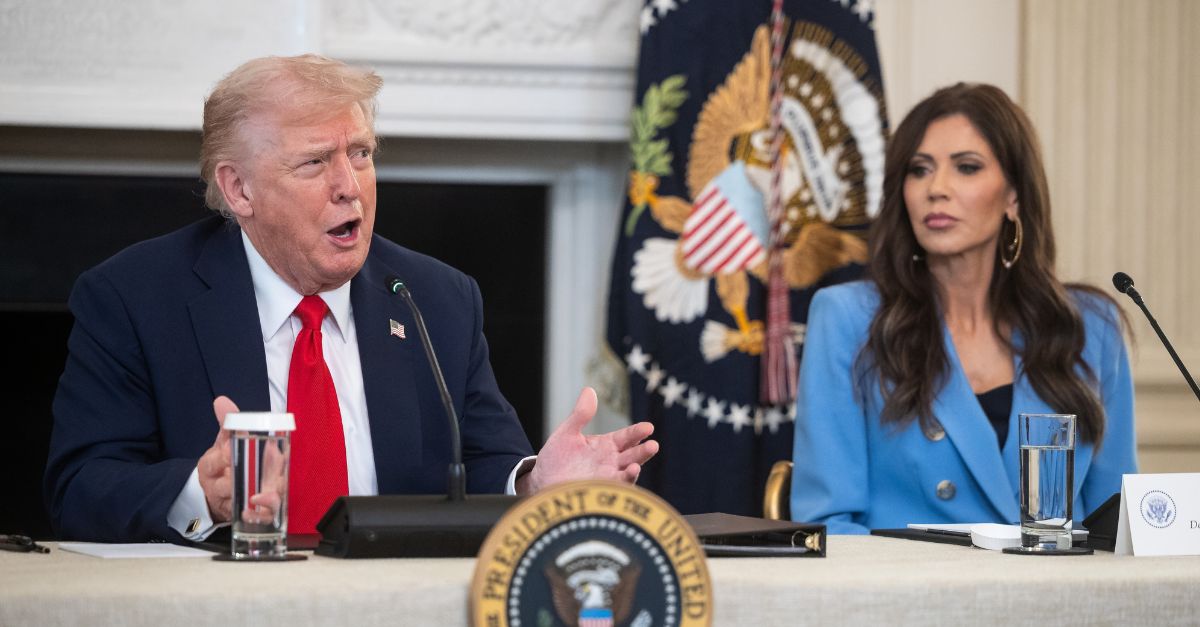
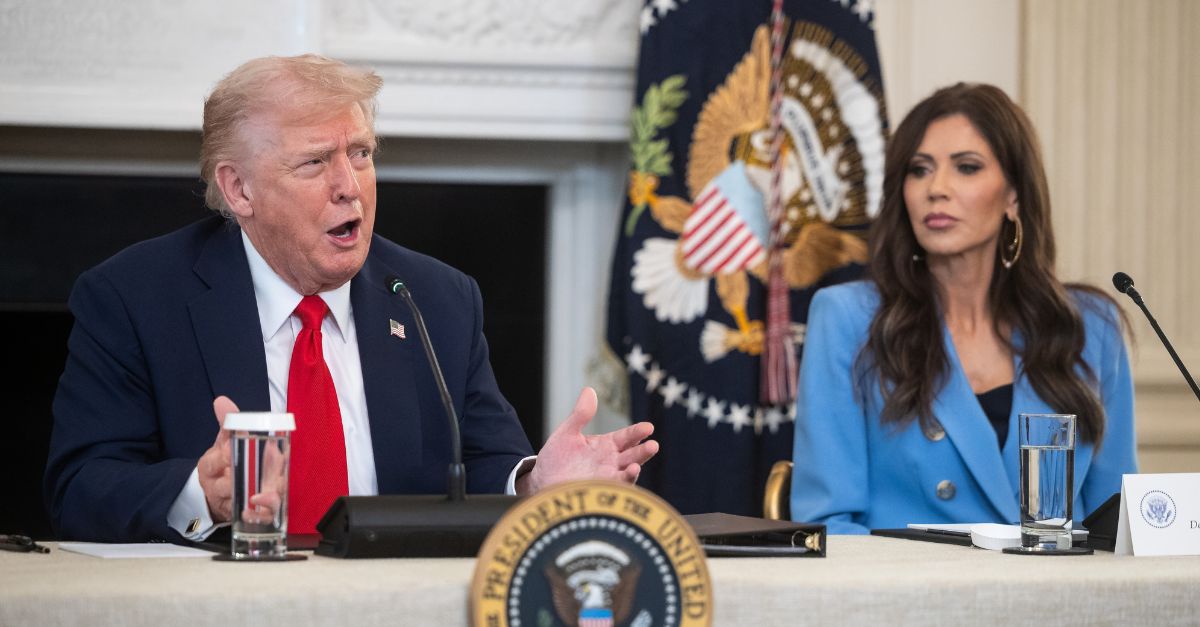
President Donald Trump speaks alongside Homeland Security Secretary Kristi Noem during a roundtable about antifa in the State Dining Room at the White House Oct. 8, 2025 (Francis Chung/POLITICO via AP Images).
A federal judge in West Virginia has given the Trump administration an ultimatum: Stop illegally detaining immigrants or face contempt rulings and “monetary sanctions against responsible officials.”
The 11-page memorandum opinion and order positions itself as a long-time-coming result since district judges across the country have shut down novel efforts to reshape how Immigration and Customs Enforcement (ICE) classifies immigrants in order to detain them.
The petitioner, Miguel Antonio Dominguez Izaguirre, won habeas corpus release by convincing U.S. District Judge Joseph R. Goodwin, a Bill Clinton appointee, his detention “violates his due process rights.”
As in many similar cases, the public record is scant because petitions for the writ of habeas corpus are frequently filed under seal.
Goodwin notes the petitioner “entered the United States in 2016, and currently lives in Cana, Virginia, with his two young kids who are both United States citizens” and that he was arrested and detained by ICE agents on Valentine”s Day “while traveling near Summersville, West Virginia.” On Feb. 19, his attorneys filed his habeas corpus petition.
While offering some biographical details about the petitioner’s individual case, the judge is focused on how Dominguez Izaguirre is similar to several other detained individuals – at least in legal terms.
First, the court quickly dispenses with the Honduran man’s case:
Petitioner’s due process rights have been violated. Despite facing no criminal charge, Petitioner sits in the local jail with no hearing to determine his custody…This violates his due process rights.
Immediate release is the only appropriate remedy. Where detention has been found unlawful and no constitutionally adequate bond hearing has been provided, continued custody cannot stand.
The judge notes that all his findings are being rendered “once again.”
Goodwin’s obvious frustration comes due to the repeat nature of the facts before the court. In the present case, as in numerous others, judges in the West Virginia district court system have ruled in favor of the petitioners and against the Trump administration.
West Virginia’s rejection is of a piece with a recent series of immigration cases in which detained immigrants have won habeas corpus relief by challenging the Trump administration’s novel interpretation of the Immigration and Nationality Act (INA).
Over the past eight months, in hundreds of district court disputes, judges have considered the interplay and applicability of two distinct INA statutes that outline the government’s detention authority. Many judges have rephrased those statutes using language from a 2018 U.S. Supreme Court ruling penned by Justice Samuel Alito.
In short, the government claims ICE has the authority to subject immigrants to mandatory detention under 8 U.S.C. §1225(b), which applies to “aliens seeking entry into the United States.”
Conversely, advocates for immigrants — as well as most judges who have ruled on the matter — have instead turned to 8 U.S.C. §1226(a), which applies to “aliens already present in the United States.”
In fact, not once has the government’s argument been accepted by federal judges in the Mountain State.
“This case is one of 17 immigration habeas petitions assigned to the court this week,” the opinion reads. “According to the Government, the detention of these Petitioners is ‘mandatory’ under 8 U.S.C. §1225, and regardless of the constitutional defects, the federal district courts lack jurisdiction over these claims—an argument unanimously rejected in this district.”
The court then asks a rhetorical question of sorts: “How can this be?”
The court notes that judges rejected the government’s interpretation of the statute on Feb. 4, (twice on) Feb. 5, Feb. 9, and Feb. 11. Overall, four different judges in the district have ruled against applying the INA in the way the Trump administration wants, Goodwin notes.
Now, the courts apparently have had enough.
“Today, the Government continues to wrongfully detain those petitioners without due process,” the opinion reads. “Even now the Government incredulously asserts that the federal district courts do not have jurisdiction, that petitioners cannot raise due process violations, and that the Government has authority to mandatorily and indefinitely detain noncitizens in the local jail. The Government is wrong. Judges in this district have said that over and over and over again. I have said it myself.”
But, Goodwin explains, this rejection is nothing new.
On Feb. 19, the judge alerted the U.S. Department of Justice that “the court would no longer tolerate the continued violation of the law in this district” and later confirmed that the message had been relayed. Then, during a hearing in yet another detention case, another judge confirmed that “ICE was indeed aware of the opinions of this district.”
“This court and other judges in this district have now ruled in numerous cases that discretionary detention without individualized custody determinations violates the Fifth Amendment’s Due Process Clause,” Goodwin muses. “In each case, the Government has presented no factual dispute and no legal argument beyond those this court has previously rejected.”
The judge goes on to upbraid the government, at length:
The holdings in those cases, particularly the constitutional interpretations, are not passing observations. They are constitutional rulings, and they govern the conduct of federal officers operating within the jurisdiction of this court.
Constitutional rulings of federal district courts are not advisory opinions. They are binding law within this jurisdiction unless and until reversed. Government officials—federal and state— subject to this court’s jurisdiction are required to conform their conduct to this court’s constitutional rulings. This court possesses inherent authority to enforce its constitutional determinations and will not permit systematic violations to continue.
“A constitutional ruling cannot be reduced to a temporary directive that must be relitigated each time the same conduct recurs,” Goodwin continues. “If officials could repeat practices already determined to be unconstitutional and require each affected person to begin anew, constitutional adjudication would become provisional, and judicial power would be reduced to commentary. The Constitution does not contemplate violations in installments.”
To that end, the judge says the opinion “serves as explicit notice to all officials—state and federal—involved in the detention of individuals whose cases come before this court.”
“Continued detention without individualized custody determinations, after this court’s repeated holdings that such detention violates the Fifth Amendment, will result in legal consequences,” Goodwin goes on. “For state jail officials, those consequences include personal civil liability without qualified immunity protection. For federal officials, those consequences include exercise of this court’s full inherent authority to enforce constitutional compliance including contempt.”
The court offers a detailed run-down of those would-be consequences:
If systematic violations continue despite repeated judicial findings of unconstitutionality, this court will employ the full range of its inherent authority, including (1) injunctive relief prohibiting detention without individualized custody determinations, (2) contempt proceedings against officials who defy this court’s orders or constitutional rulings, (3) monetary sanctions against responsible officials, and (4) any other such other relief as may be necessary to vindicate constitutional rights and enforce this Court’s rulings.
“This court will enforce the Constitution,” Goodwin concludes.


