
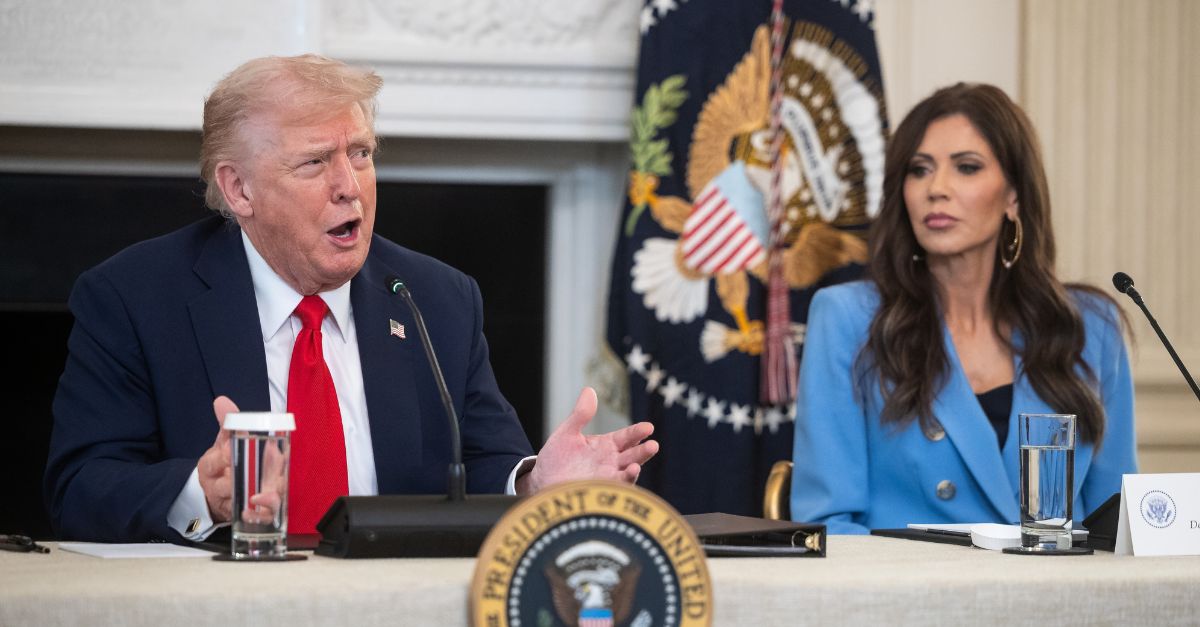
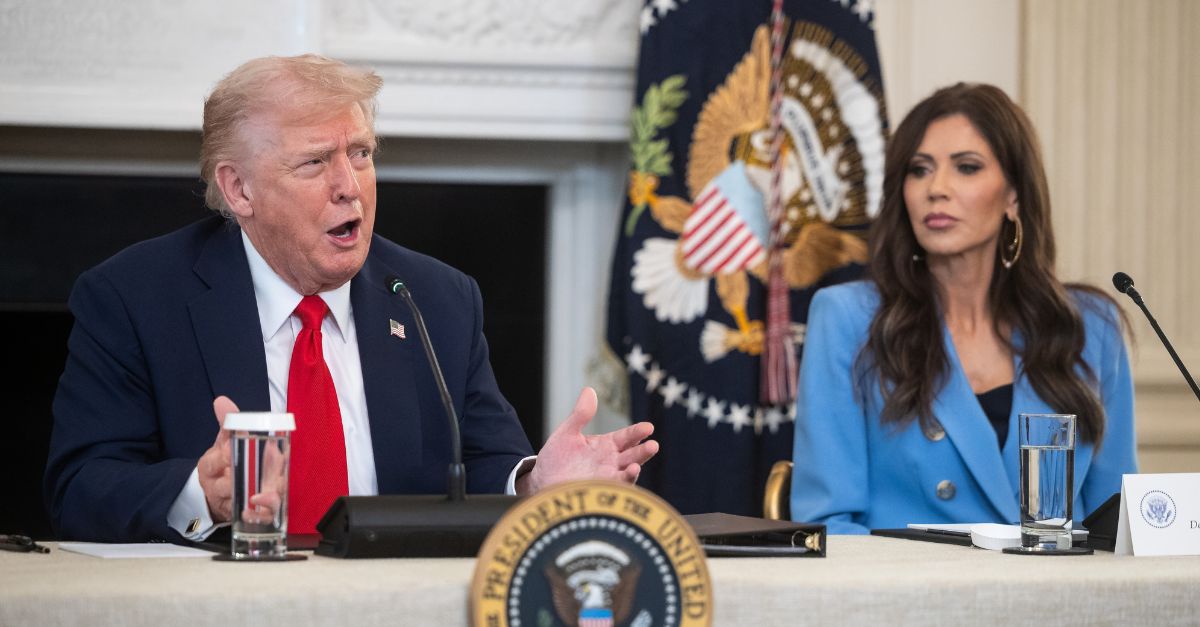
President Donald Trump speaks alongside Homeland Security Secretary Kristi Noem during a roundtable about antifa in the State Dining Room at the White House, Oct. 8, 2025 (Francis Chung/POLITICO via AP Images).
The Trump administration is imploring the U.S. Supreme Court to put the kibosh on a district court order that maintained some special immigration protections for Haitian refugees.
In early February, U.S. District Judge Ana C. Reyes, a Joe Biden appointee, blocked the Department of Homeland Security (DHS) from terminating temporary protected status (TPS) for hundreds of thousands of Haitians who have been in the country since 2021.
In ruling for the plaintiffs, the judge found it “likely” that DHS Secretary Kristi Noem “preordained her termination decision and did so because of hostility to nonwhite immigrants.” Those attempts to end TPS violated both the Administrative Procedure Act (APA) and the Fifth Amendment right to equal protection, respectively, the judge ruled.
In due fashion, the Trump administration asked the D.C. Circuit to stay the Reyes ruling, but a majority on a three-judge panel declined.
Now, in a 40-page application for a stay, the U.S. Department of Justice argued the APA claims “are clearly not reviewable and are in all events meritless” and that the “precedent-defying equal-protection challenge would apparently invalidate every” similar action taken by DHS since President Donald Trump”s second term began.
Notably, the Reyes order blocking the policy comes amid several different – and differently judged – challenges to TPS terminations.
In several instances, TPS terminations have been allowed to go through. But in others, the courts have been a bit more circumspect.
The stay motion acknowledges this disconnect but argues the legal issues are similar enough that the government should prevail when a group of plaintiffs challenges a TPS termination.
In effect, the government says every case about TPS status involves “overlapping legal issues” over APA claims that “second-guess the underpinnings of Secretary Noem’s decisions.”
The government also says each challenge involves “similar irreparable-harm and balance-of-equities disputes, pitting the government’s determinations that the national interest and foreign-relations considerations dictate termination of TPS against TPS holders’ loss of employment authorization and exposure to removal proceedings.”
But the Trump administration also acknowledged the key difference in the cases where the plaintiff groups of immigrants have won.
“The main variation is that courts in some cases (including this one) endorse a far-fetched and far-reaching equal-protection claim based on decisionmakers’ purported racial animus — a theory that threatens to invalidate virtually every immigration policy of the current administration,” the stay motion argues.
The motion elaborated on the racial bias claims it finds unavailing.
“[T]he court embraced respondents’ equal-protection claim that ‘anti-black and anti-Haitian animus motivated’ the termination, citing an ‘X post’ and other statements evincing the Secretary’s supposed ‘animus towards nonwhite foreigners’ and statements from President Trump dating back to 2018.”
Here, the DOJ took significant umbrage – framing any bias claims as the product of an imaginative district court judge gone rogue.
“The only references to race are the district court’s own editorializing labels of ‘nonwhite foreigners’ and ‘predominantly nonwhite’ countries,” the stay motion complained.
Rather, the government argued that Reyes “cherry-picked” statements made by Noem and Trump “on the campaign trail” and argued that such statements were “remote in time and made in unrelated contexts” and “do not qualify as ‘contemporary statements’ probative of the decision at issue.” This legal argument is one of the primary holdings in the Supreme Court case that allowed the first Trump administration to enforce its controversial travel ban, which Trump referred to on the campaign trail as a “Muslim ban.”
The DOJ believes those statements were “advocating for policies that curb immigration and decrease crime,” but were used by the lower court as a “pretext” to bar the TPS termination.
“Those statements raise no plausible inference of discriminatory intent,” the stay motion goes on.
The filing also chides Reyes for using anything uttered by the 45th and 47th president as evidence in the case.
“Moreover, the district court’s recitation of President Trump’s prior statements—which, again, raise no plausible inference of animus—certainly could not show animus by the Secretary. Otherwise, courts could invalidate any agency official’s actions based on mere allegations that a more senior government official harbored some discriminatory motive,” the DOJ stated.
While heavily criticizing Reyes for her somewhat novel equal protection analysis, the DOJ hung its hat on the notion that the case before the high court is exceedingly similar to other cases decided in the government’s favor.
The filing reads, at length:
By preventing the Secretary’s termination of TPS for Haiti from going into effect, the D.C. Circuit departed from those “extraordinarily similar cases.” District courts across the country have likewise disregarded the import of this Court’s stay decisions and postponed TPS terminations based on similar allegations of preordained and pretextual decisionmaking and a failure to consult with appropriate agencies.9 And the plaintiffs in those cases have likewise raised equal-protection claims based on the same alleged animus that respondents assert here.10 The issues that this application presents are thus common among the numerous challenges to the Secretary’s TPS terminations, have been ventilated in litigation across the country, and cry out for immediate resolution.
“Here again, the lower courts committed the same legal errors that pervade stayed lower-court opinions,” the motion stated.
Specifically, the government said this case is akin to two cases where the nation’s high court allowed TPS status for Venezuelans to be revoked. The stay motion noted that in those prior instances, the “unambiguous” TPS statute itself was cited as a jurisdictional bar to lower court intervention.
The statute reads, in relevant part: “There is no judicial review of any determination of the Attorney General with respect to the designation, or termination or extension of a designation, of a foreign state under this subsection.”
“That bar encompasses the types of APA claims at issue here,” the DOJ argued. “Indeed, this Court has twice granted the government’s requests for stays when the government raised the same judicial-review bar regarding similar APA claims challenging the Secretary’s vacatur of her predecessor’s extension of Venezuela’s 2023 TPS designation and termination of Venezuela’s 2023 TPS designation.”
The motion also appeared to alert the justices to “lower courts’ ongoing refusal to heed this Court’s instruction” in cases decided on emergency motions. Here, the Trump administration is asking the Supreme Court to turn some of its shadow docket jurisprudence into formal holdings with the force of precedent.
“Given the pattern of lower-court rulings and the division of courts of appeals, this Court should grant review and provide guidance to lower courts,” the motion goes on. “This case provides a suitable vehicle for resolving those cross-cutting questions.”


