
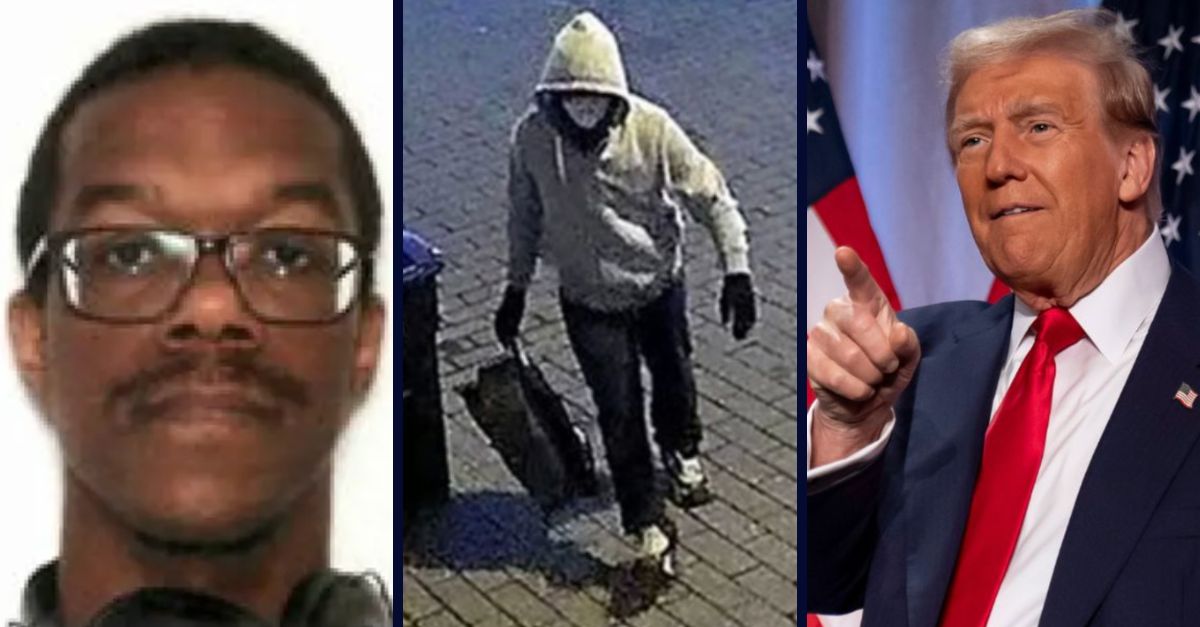
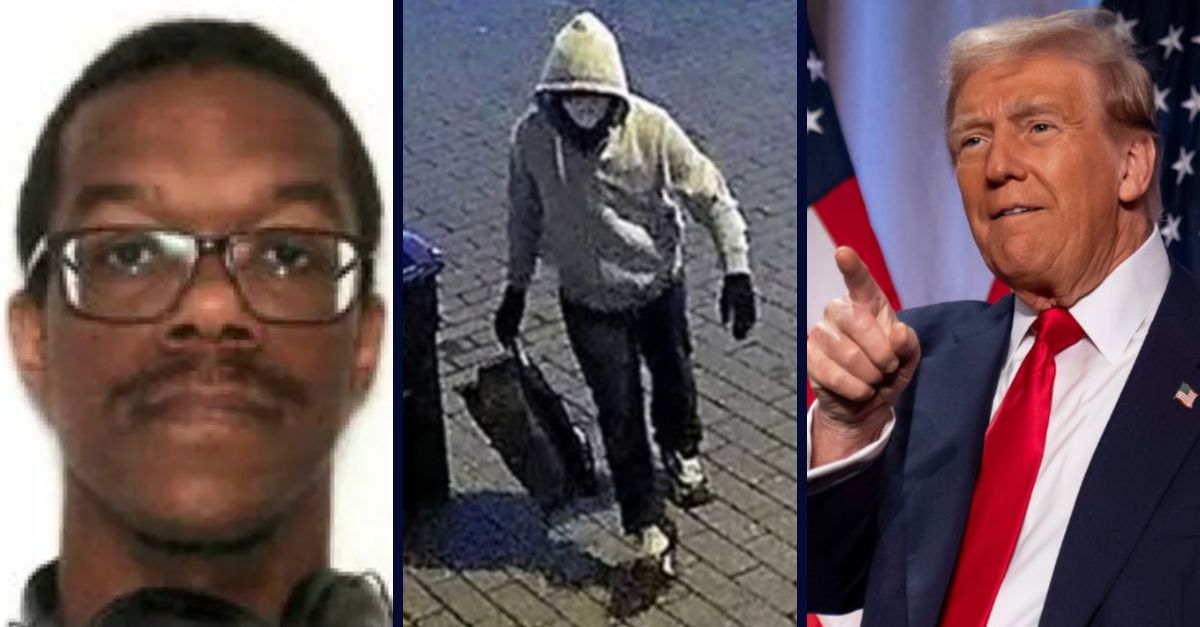
Left: Brian Cole Jr. (Department of Justice). Center: Surveillance footage allegedly shows Brian Cole Jr. walking around Washington, D.C., while placing pipe bombs at the RNC and DNC headquarters (DOJ). Right: President-elect Donald Trump arrives to speak at a meeting of the House GOP conference, Wednesday, Nov. 13, 2024, in Washington (AP Photo/Alex Brandon).
A federal judge in Washington, D.C., has rejected a bid to apply President Donald Trump”s mass clemency and pardon order for Jan. 6 participants to a Virginia man accused of planting pipe bombs the night before the pro-Trump attack on the U.S. Capitol Complex.
In a relatively terse three-page opinion and order, U.S. District Judge Amir H. Ali, a Joe Biden appointee, denied the motion to dismiss for lack of jurisdiction filed by Brian Cole in March.
The defendant was initially charged in December 2025 and formally indicted earlier this year on two counts. In April, a superseding indictment was handed up with one count each of interstate transportation of explosives, malicious attempt to use explosives, attempt to use weapons of mass destruction, and act of terrorism while armed over a series of bombs planted outside the headquarters of the Republican National Committee and the Democratic National Committee.
Cole’s lawyers moved to have the case dismissed by arguing the charges are “inextricably and demonstrably tethered” to the events of Jan. 6.
The court, for its part, said the facts of the case being linked to the events of the pro-Trump riot did not much matter in the end.
“Even assuming that the conduct Cole is charged with is ‘related to events that occurred at or near the United States Capitol on January 6, 2021,’ the pardon is expressly limited to people who had been ‘convicted of offenses’ related to those events,” the opinion reads. “Cole had not been convicted of the conduct at issue when the President issued the pardon; indeed, he was not charged until many months after the President’s proclamation.”
For Ali, the issue is a relatively simple matter.
“According to Cole, the President’s pardon applies to him because he is accused of planting two pipe bombs near the Democratic National Committee and Republican National Committee headquarters on January 5, 2021, the day before the Capitol riot,” the opinion goes on. “But the pardon does not apply to him.”
The defendant’s motion to dismiss argued that the government’s own “theory of motive places Mr. Cole’s alleged actions in the same political controversy that animated the January 6 crowd” and noted that the bombs in question were not discovered until Jan. 6, 2021.
“The Pardon—like it or not—applies to Mr. Cole, based on the ordinary and plain meaning of the Pardon’s language as applied to the relevant facts in this case,” the motion to dismiss reads.
The court, however, relies on the language of the pardon itself to deny the defendant his requested relief — and in a footnote construes the motion to dismiss as encapsulating all four charges, even though the defense motion was filed before the second indictment was issued.
“Cole does not try to explain how a pardon for ‘individuals convicted of offenses’ applies to him,” the opinion goes on, reiterating the idea that Trump’s blanket pardon was not prospective.
In a reply brief filed in late April, the defendant offered a new argument: that there is no time component to the pardon at all.
“A strict time limit does not exist in the text of the Proclamation and should not be inferred,” the reply argues. “The Proclamation directs the Attorney General to pursue dismissal of all pending indictments for covered conduct. This is an on-going directive.”
Again, the court rejected the defendant’s effort.
“[T]his argument does not work either,” the opinion continues. “Cole was first charged in December 2025—months after the President’s proclamation. He therefore did not have ‘pending indictments’ at the time of the President’s directive. For these reasons, the court denies Cole’s motion to dismiss.”
The court’s rejection is in line with the government’s own arguments against extending the 45th and 47th president’s pardon to Cole.
In April, the U.S. Department of Justice rubbished defense arguments as contrary to the “consistent, reasonable interpretation taken by the Executive Branch agency expressly charged with administering the proclamation.”
“Under its plain terms, the proclamation applied only to those convicted or under a pending indictment for the offenses described,” the DOJ argued.
The government also cited Cole’s alleged confession as a reason to reject the dismissal bid.
Federal prosecutors say the defendant learned how to make the bombs by playing video games. He allegedly admitted that he is a Trump supporter but does not like “either party.”
“[T]he defendant’s crimes on January 5 were not ‘related to’ the events at or near the United States Capitol on January 6 under the terms of the proclamation,” the DOJ argued.


