
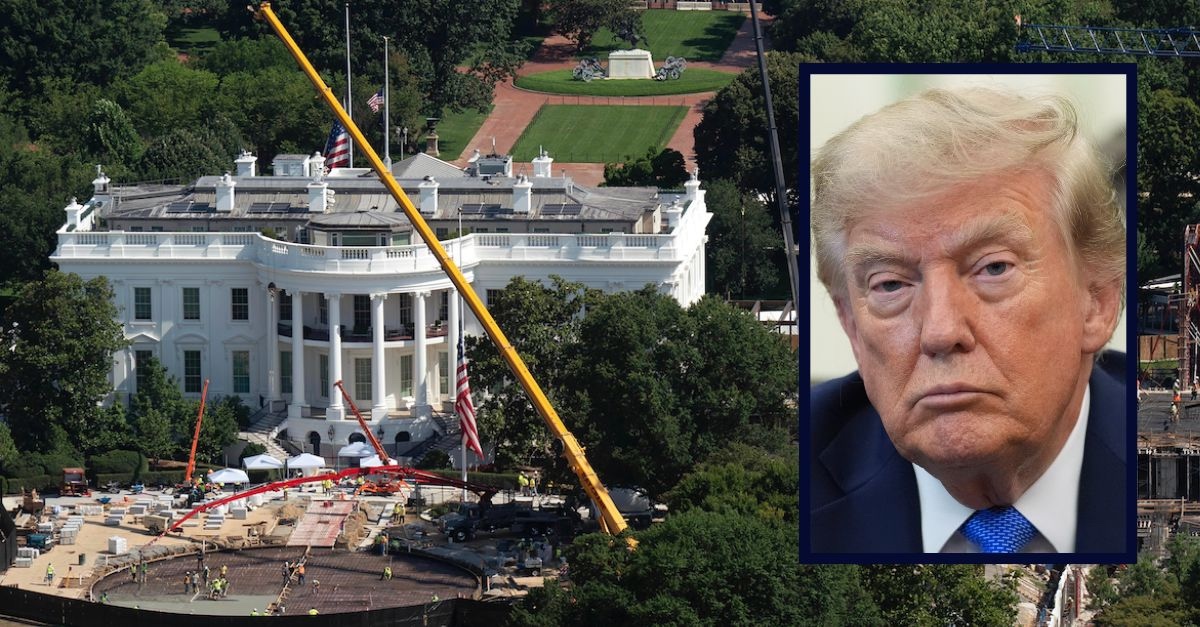
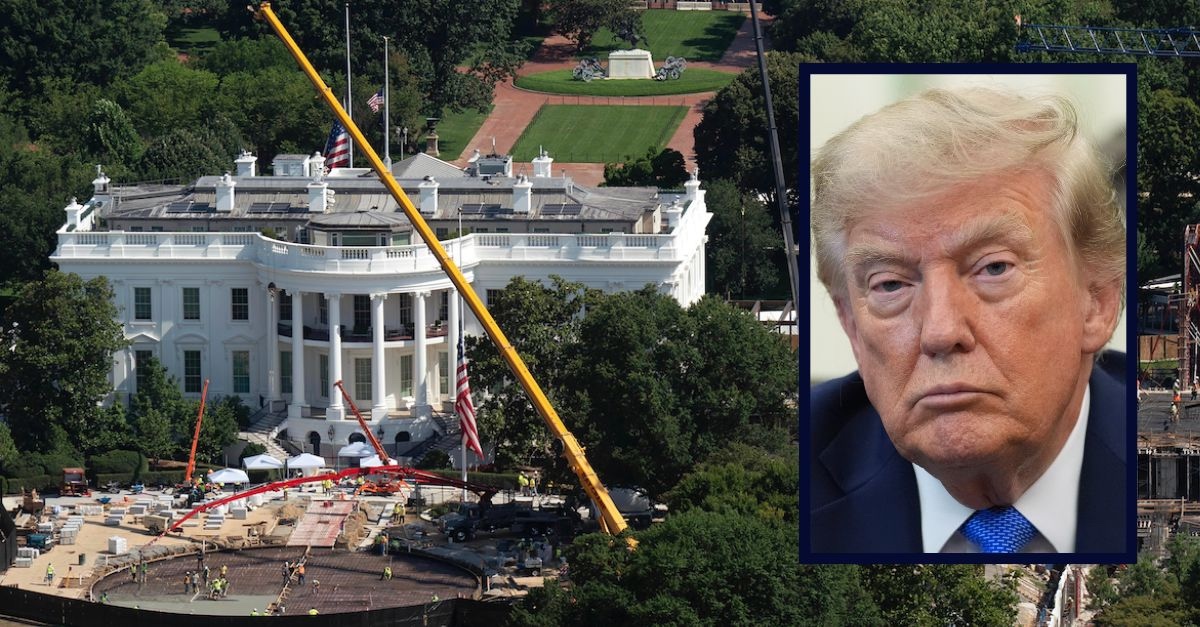
Main: Construction on a helipad on the South Lawn and the White House ballroom is seen from the Washington Monument, Monday, July 13, 2026, in Washington (AP Photo/Jose Luis Magana). Right inset: President Donald Trump listens in the Oval Office of the White House, Thursday, Aug. 6, 2026, in Washington (AP Photo/Alex Brandon).
A federal appellate panel in Washington, D.C., dealt a setback to President Donald Trump’s ballroom on Friday, rejecting the Trump administration’s controversial argument that it could suddenly raze the Statue of Liberty and no one would have standing to sue.
U.S. Circuit Judges Bradley Garcia and Patricia Millett, appointed by former Presidents Joe Biden and Barack Obama to the D.C. Circuit, affirmed the ruling of the exclamation-point-loving district judge who issued a preliminary injunction blocking the ballroom’s construction with the exception of “safety-and-security” measures.
“At bottom, the Defendants’ position is that, once the district court credited their argument that the independent underground construction alone could go forward, the court surrendered all power to stop the ballroom’s construction at all. No matter how unlawful that construction likely is and no matter that the construction will, by the Defendants’ own admission, cause permanent and irremediable harm, the Defendants insist that the ballroom project must be fait accompli and no injunction at all can or ever could issue,” the majority jointly said. “Worse still, the Defendants argue that even if they are acting entirely without authority and lawlessly, no court—not the district court, this court, or the Supreme Court—has the power to stop them since the East Wing has already been destroyed.”
Love true crime? Sign up for our newsletter, The Law&Crime Docket, to get the latest real-life crime stories delivered right to your inbox.
“That is wrong,” Garcia and Millett went on. “The bold assertion that the Executive can act with utter lawlessness, destroying treasured national landmarks and harming the interests of individuals, and that no court can stop it flouts our constitutional order.”
Mindful of the “great weight and deference” it owes to the president on matters of safety and national security, the majority said “invocations” of these concerns are “not an automatic get-out-of-law-free card” — because “[e]ach President is a temporary tenant, not the owner, of the White House and its Executive Residence,” and Congress “exercises plenary control over the building and its surrounding land.”
The ruling amounts to a temporary win for architectural historian Alison Hoagland and the National Trust for Historic Preservation, who sued in December alleging an irreparable aesthetic injury after the East Wing was demolished in October.
At oral arguments in early June, the majority peppered the DOJ with questions about just how far-reaching the government’s position might be.
In one striking exchange, Millett asked Principal Deputy Assistant Attorney General Yaakov Roth if “So just move fast and break things and nobody has standing?” accurately summarized the administration’s position.
“Nothing can be done?” the judge asked, in a hypothetical situation where the government bulldozes the Statue of Liberty before descendants of immigrants could sue to block it.
“I think that’s right,” Roth answered.
The majority rejected the DOJ’s “cramped standing theory,” because it “would deem no one injured by a decision to raze the Statue of Liberty, to obscure the names on the Vietnam War Memorial, or to install a political billboard atop Mount Rushmore.”
“The Defendants’ argument, in other words, simply brushes off the signification, emotion, meaning, and particularized value to individuals of witnessing certain places where their history happened, looking upon architectural marvels, reveling in sweeping landscapes, and viewing buildings, memorials, and monuments that tell the American story,” the opinion concluded.
The lone dissenter on the panel was U.S. Circuit Judge Neomi Rao, a Trump appointee. She criticized her colleagues for appointing themselves supervisors of the president’s construction project.
By signing off on Senior U.S. District Judge Richard Leon’s “blatant abuse of discretion,” Rao said, the majority “elevated the aesthetic displeasure of a single passerby” over Trump’s determination that the “ballroom is necessary for the overall security of the White House as well as to provide a secure space for hosting large presidential events.”
“In deciding the ballroom construction ‘has to stop!’ the district court transgressed the equitable authority of the federal courts,” Rao wrote, taking note of Leon’s exclamation point usage. “The preliminary injunction is a clear abuse of discretion and must be vacated. I respectfully dissent.”
The D.C. Circuit stayed its Friday decision, however, giving the DOJ two weeks to “seek Supreme Court review” — “if they choose[.]”
The post ‘Wrong’ DOJ claim that ‘nothing’ can be done if Trump suddenly tears down Statue of Liberty backfires on president’s East Wing project first appeared on Law & Crime.


