
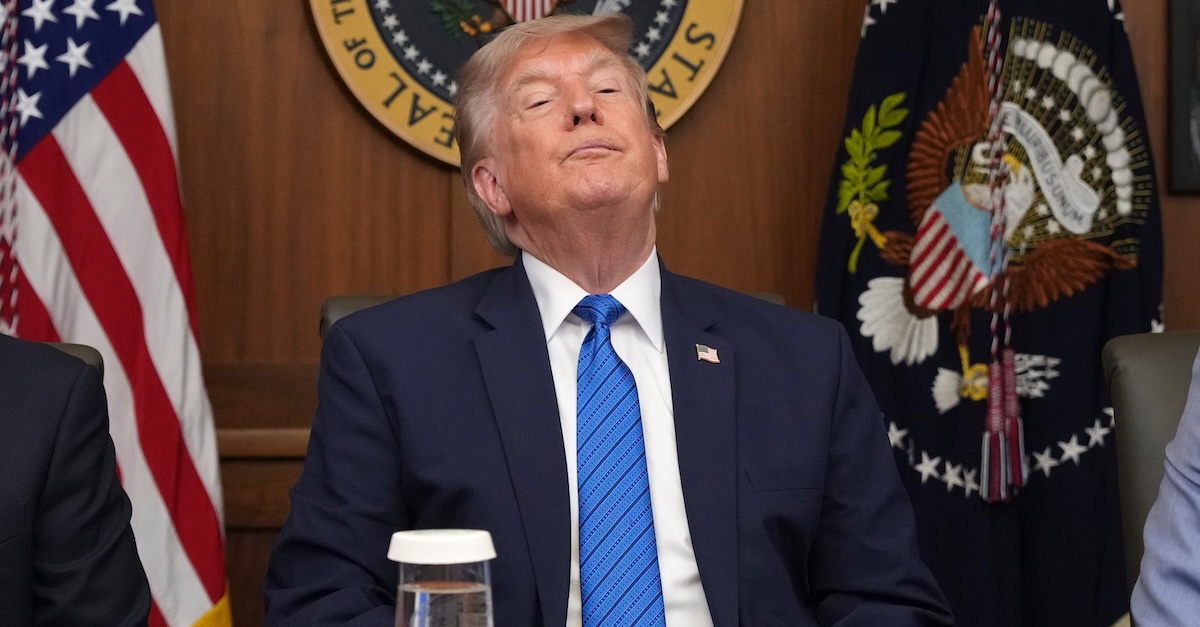
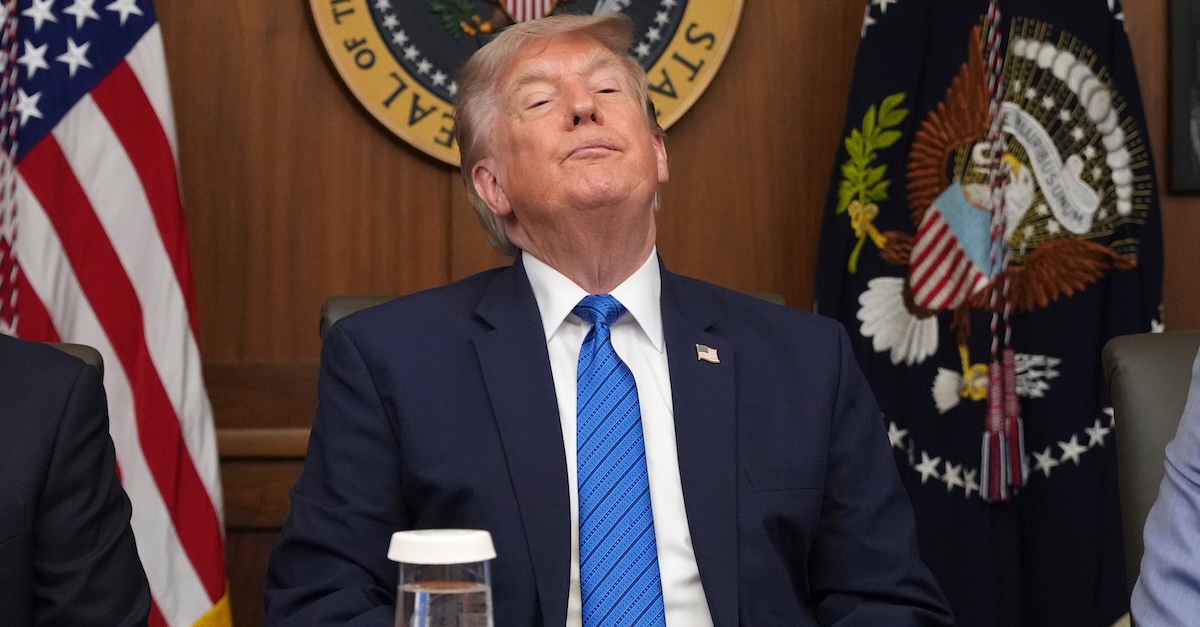
President Donald Trump listens during a cabinet meeting, Friday, July 31, 2026, at Camp David, the presidential retreat, near Thurmont, Md. (AP Photo/Jacquelyn Martin).
Human rights groups are suing to stop the Trump administration‘s efforts to sanction and punish international lawyers, judges, legal support staff, and officials investigating the United States and its allies over allegations of genocide, war crimes, and crimes against humanity.
On Tuesday, the American Friends Service Committee, the Center for Constitutional Rights, Human Rights Watch, and the Open Society Institute filed a 102-page lawsuit in Manhattan federal court challenging the sanctions regime against the International Criminal Court (ICC).
While anti-ICC actions are nothing new from the U.S. government – both the first Trump administration and the Biden administration targeted and worked to undermine the ICC’s work in various ways – the lawsuit challenges a February 2025 executive order issued by President Donald Trump that authorized sanctions against ICC officials over “arrest warrants targeting Israeli Prime Minister Benjamin Netanyahu and Former Minister of Defense Yoav Gallant.”
Love true crime? Sign up for our newsletter, The Law&Crime Docket, to get the latest real-life crime stories delivered right to your inbox.
Since the order was issued, Secretary of State Marco Rubio expanded the reach to include several ICC judges who were once involved in a since-shelved investigation into U.S. war crimes in Afghanistan.
Trump’s latest round of ICC sanctions was issued under the International Emergency Economic Powers Act (IEEPA), the National Emergencies Act (NEA) and the Immigration and Nationality Act (INA).
At the outset of the lawsuit, the plaintiffs say Trump’s sanctions regime is an invalid act beyond his powers.
“First and foremost, the Sanctions Regime is ultra vires because there is no national emergency under its governing statute, IEEPA,” the filing reads. “The national emergency provisions of that statute are intended to allow the President to act in response to a national emergency where there is no time for Congress to authorize such action through legislation. There is no such emergency in relation to the work of the ICC.”
The latest round of sanctions purport to impound property interests owned by covered persons and groups, bar certain donations to those persons or groups, bar the “contribution or provision of funds, goods, or services” to those persons or groups, and bar the covered persons, as well as their immediate family, from entering the country.
Those restrictions violate numerous federal laws as well as various provisions of the First Amendment and the Fifth Amendment, according to the plaintiffs.
“The fact that so many leading human rights and humanitarian organizations have come together to challenge Trump’s unlawful executive order demonstrates the widespread harm it is causing across civil society groups,” lead counsel Andrew Loewenstein, of Foley Hoag LLP, said in a press release. “The plaintiffs are seeking an end to this sanctions regime, which transgresses the president’s authority and violates international and U.S. law, including the rights to freedom of expression and religion.”
To hear the plaintiffs tell it, the basic authority cited by Trump does not allow what the executive order asserts.
The lawsuit notes two separate amendments to the IEEPA that bar using the statute to put “prohibitions” on “information or informational materials if their circulation is protected by the First Amendment.”
“Plaintiffs have each been forced to stop, alter, or cease to consider engaging in speech and expressive conduct that they otherwise would have undertaken, either independently or jointly with others,” the lawsuit goes on. “Both on its face and as applied, the regime reflects unlawful content and viewpoint discrimination that unconstitutionally burdens the rights to speech and association.”
The aforementioned internal inconsistency also means the sanctions run afoul of the Administrative Procedure Act (APA), the lawsuit argues, referring to the broad statute governing agency actions.
“[T]hey are arbitrary and capricious, contrary to law, and an abuse of discretion,” the lawsuit argues — citing three separate prongs of the APA, which align with three out of 12 causes of action in the complaint.
The filing elaborates:
The designations are arbitrary and capricious because they rest on factors Congress did not intend the Executive to consider. They are an abuse of discretion because their evident purpose is to target the personal and financial interests of judges, prosecutors, and U.N. officials to pressure them into disregarding their oaths of office and to punish civil society groups and lawyers for helping victims of grave international crimes access justice.
The lawsuit goes on to accuse the Trump administration of interfering with Fifth Amendment rights of access to counsel and due process — because of the grave penalties the sanctions place on lawyers for doing their jobs by conferring with “clients or potential clients.”
The plaintiffs also say Trump’s sanctions clash with federal law specifically aimed at the ICC in the event of U.S. officials or military service members being swept up by the court’s jurisdiction. That law, the American Servicemembers’ Protection Act, outlines a valid response.
“Congress specified the particular measures to be taken, having regard to this possibility,” the lawsuit reads. “Sanctions are not one of them.”
The post ‘Unlawful executive order’: Human rights groups challenge Trump ‘unconstitutional’ sanctions regime against International Criminal Court in new lawsuit first appeared on Law & Crime.


