
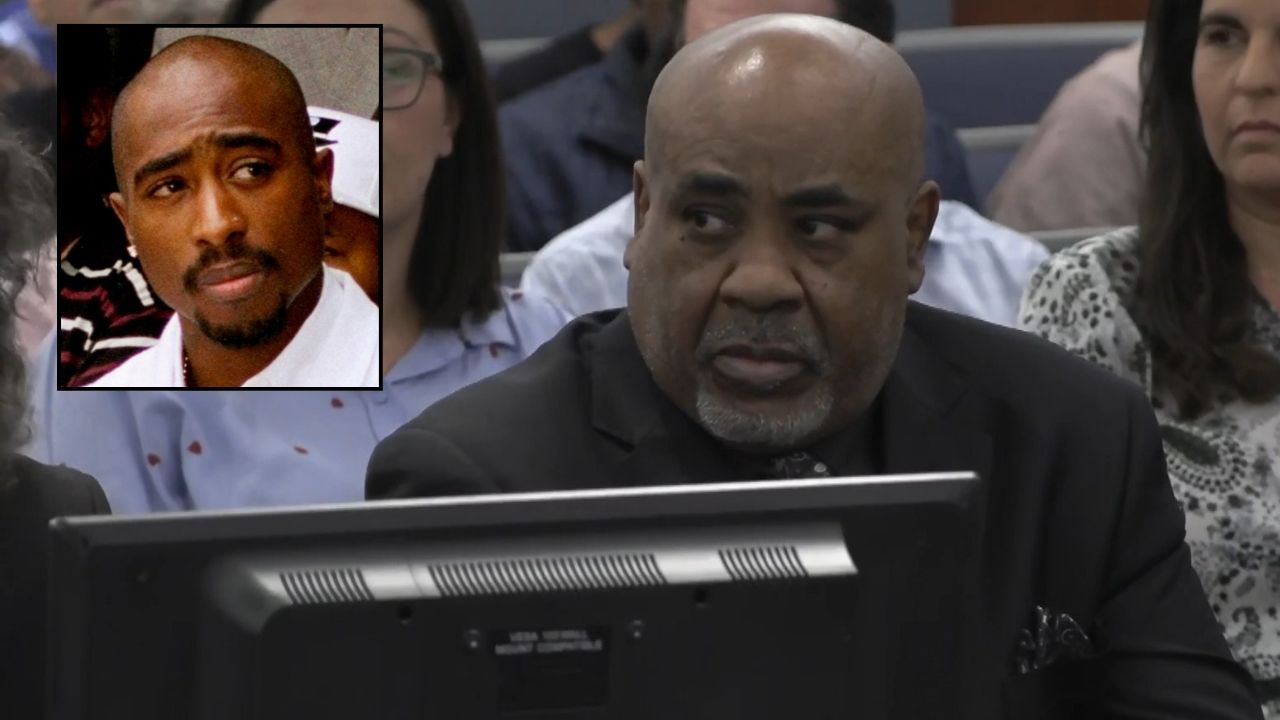
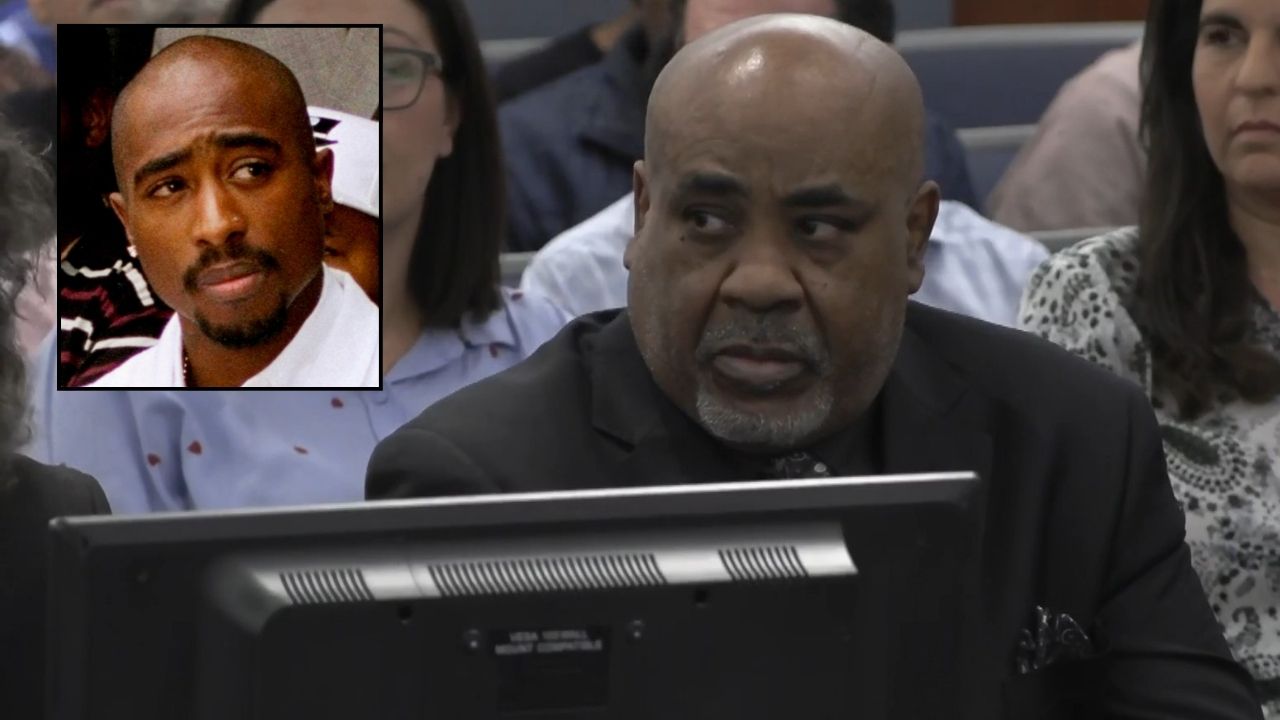
Background: Duane “Keffe D” Davis appears in court as the verdict is read on Aug. 31, 2026 (Court TV). Inset: Rapper Tupac Shakur attends a voter registration event in South Central Los Angeles, Aug. 15, 1996 (AP Photo/Frank Wiese).
In “Twelve Angry Men,” we saw those criminal trial jurors considering things during deliberations that could have been better hashed out by the trial lawyers.
Maybe they didn’t do so because those (fictitious) lawyers simply weren’t good enough. Or maybe they deliberately didn’t pursue areas of attack that the jurors later wondered about, knowing that pursuing them would have been harmful to their side of the case. After all, competent trial lawyers simply try to win. They’re certainly not trying to ensure that “all relevant facts” up or down are fully aired before the jury. That’s not their job.
In the vast majority of state courts jurors must simply sit on their hands when they’re troubled that a certain line of attack hasn’t been pursued. In federal and some state trial courts allowing questions from jurors is within the discretion of the presiding judge. Even where this is permitted, it’s actual use is very limited. Thus, in most trials jurors have no ability recognized by the court to ask a witness, or even the judge, about a particular issue in the case that they’re curious about in real time. And they’re unable until deliberations to raise it with anyone — in that case, their fellow jurors. By that time, there’s nothing to do about it except complain, or vote in a manner consistent with their dissatisfaction over the absence of proof on an issue that, they feel, wasn’t properly explored.
Love true crime? Sign up for our newsletter, The Law&Crime Docket, to get the latest real-life crime stories delivered right to your inbox.
Duane “Keffe D” Davis, the man who faced trial for killing Tupac Shakur 30 years ago, was convicted on Monday. And, frankly, it’s largely irrelevant to this discussion. More important is that his Nevada jury was allowed by the judge, in conformity with Nevada law, to ask questions when jurors weren’t not satisfied that the lawyers have asked relevant questions designed to bring out certain facts of interest to them.
This is how it works under Nevada law: Jurors write down their questions, if any, after the attorneys complete their questioning of a witness; out of the jury’s presence the judge and the attorneys review those questions for admissibility and relevance; the judge or bailiff then reads the accepted question aloud to the witness (without identifying the juror who posed it); and then both attorneys are given the opportunity to ask follow-up questions — questions obviously designed to support the juror’s concern, or to undermine their thrust. Of course, the juror’s question may be a one-off, meaning the thinking of only that juror. Or it may represent the thinking of a number of jurors who are simply concerned about what has not been presented to the jury by one or both of the lawyers.
Interestingly — one of the authors being a former federal trial judge, and the other a criminal lawyer who has tried cases both as a prosecutor and defense lawyer — we both believe that despite the innovative aspects and laudable goals of allowing juror questions, it is largely an ill-advised practice. In our experience, having met with countless juries after they’ve rendered verdicts, the post-trial questions they typically ask us involve either inadmissible or irrelevant evidence — frequently both. Moreover, jurors are constantly instructed by the judge that they should not commence deliberations prior to hearing all the evidence in the case. Allowing jurors to pose questions may unwittingly prompt them to violate that instruction by encouraging random, premature theories prior to the presentation of all the evidence.
Trials are carefully structured by judges and lawyers in a fashion that permits the orderly presentation of the admissible evidence that each side seeks to introduce, as well as giving them ample ability to probe the opposing side’s case. The law does not and should allow not jurors, no matter how earnest their questions may be, to introduce evidence outside that ambit. While unforeseen events such as novel evidentiary issues will sometimes disrupt a trial’s flow, we believe that there are few practices more prone to derail a trial than to constantly interrupt the conduct of a trial by considering juror questions that in the end will likely never be allowed by the judge. And even if they are, in our experience they end up being of marginal utility at best, and as noted at worst may prejudice one or more of the parties.
The right to trial by a jury of one’s peers is enshrined in the federal as well as state constitutions. In our long experience, jurors typically take their oaths most seriously and work incredibly hard to reach what they consider to be appropriate verdicts. This is a time-tested facet of our system of justice, and one that does not need to be augmented by giving those jurors the ability to query witnesses.
Yes, the Nevada practice discussed above may, midway during trial, give the battling trial lawyers some insight into what some jurors might be thinking — but typically at too unwieldly a cost.
John E. Jones III is the former Chief Judge of the United States District Court for the Middle District of Pennsylvania and is the President of Dickinson College. Joel Cohen, a former prosecutor, practices white collar criminal defense law at Ruskin Moscou Faltischek PC and is an adjunct professor at both Fordham and Cardozo Schools.
The post Should sitting jurors be allowed to ask criminal trial witnesses questions? first appeared on Law & Crime.


