
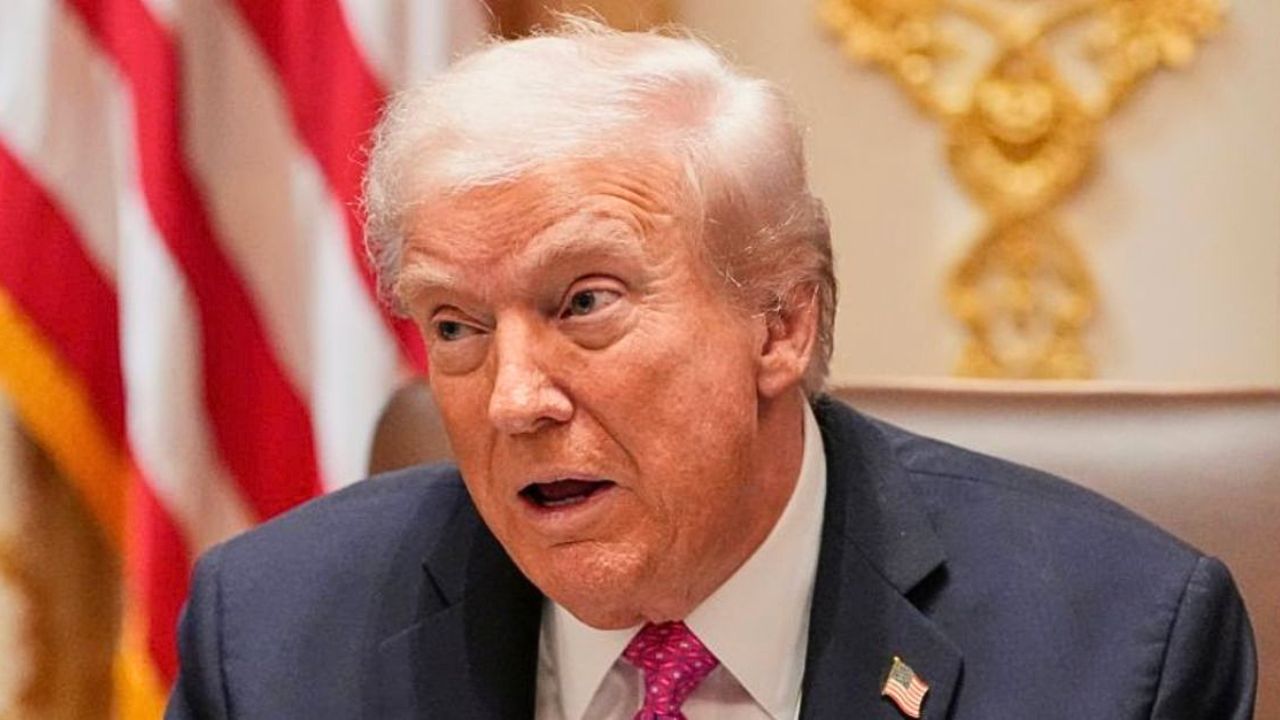
President Donald Trump speaks in the Cabinet Room of the White House, Friday, Oct. 17, 2025, in Washington (AP Photo/Alex Brandon).
The states of the union cannot “feasibly” implement the changes the Trump administration is demanding with regard to mail-in voting before the upcoming midterm elections, a federal judge in Massachusetts ruled on Friday.
In her latest ruling in a long-running series of cases over government plans to federalize vote-by-mail systems, U.S. District Judge Indira Talwani, a Barack Obama appointee, dissolved a temporary restraining order (TRO) and replaced it with a preliminary injunction.
The Trump administration, for its part, immediately filed a notice of appeal to the U.S. Court of Appeals for the First Circuit.
The upshot of both actions will be limited. The Friday night series of events will instead formalize and streamline an ongoing process.
Love true crime? Sign up for our newsletter, The Law&Crime Docket, to get the latest real-life crime stories delivered right to your inbox.
In late August, Talwani’s TRO barred the U.S. Postal Service (USPS) from implementing or enforcing several sections of a recently published final administrative rule for mail-in ballots for 14 days.
Without running directly into that timeline, the preliminary injunction operates on the same footing but extends the kibosh indefinitely.
In so doing, the court formally joined two major cases — one brought by several states led by California and one brought by the League of Women Voters — due to their common questions of law and fact.
In ruling for the plaintiffs, the court was not moved by a collection of pro-Donald Trump states who argued in favor of the rule.
“Intervenor-Defendants’ assurance that compliance will be feasible in their States seems implausible given the practical implications of the Final Rule,” the opinion reads. “As assessed by an expert in election administration, as to all States, ‘[n]one of the Rule’s requirements can feasibly be implemented before the November 3, 2026 General Election.’ The budgets for election administration have already been set [and] State election training and procedures have largely already been finalized.”
The court elaborates here:
Now, 60 days before the November 3, 2026 midterms, the Final Rule would require 10,000 different election jurisdictions to conform to new ballot design requirements (requiring many to re-design their ballots), have a wave of new designs undergo Mail Design Analyst review, print new designs from their vendors (typically ranging from four to sixteen weeks in lead time, and then, contingent on technological capabilities, collate and submit voter information to a portal that does not yet exist and has not been proven to work.
“Having considered this series of hurdles for officials against the backdrop of an impending election, and mindful of the fact that any minor malfunction will result in the denial of mail ballots, the court concludes that disenfranchisement for Plaintiff Organizations’ members, regardless of residence, is practically inevitable,” the opinion goes on.
To that end, the court determined the final rule is unconstitutional.
“[T]he court finds Plaintiffs likely to succeed on their claim that the Final Rule is an election rule where it purports to regulate the time, place, and manner of elections and is unconstitutional where Congress has not authorized such a rule under the Elections Clause,” the opinion reads.
The court also found the final rule violates the originating statute for the USPS itself — a novel development in the case.
“[T]he Final Rule is inconsistent with the USPS’s governing statute, specifically Congress’s scheme to define categories of ‘nonmailable’ material,” Talwani explains. “As a starting point, the USPS’s ‘right to exclude letters, or to refuse to permit their delivery to persons addressed, must depend upon some law of Congress, and if no such law exists, then [the USPS] cannot exclude or refuse to deliver them.'”
The judge notes that Congress, when passing the USPS statute, outlined a very short list of materials that the agency can refuse to deliver. And ballot mail is simply not on that list.
“Congress has specifically identified and delineated those types of nonmailable matter that the USPS is forbidden to transmit,” the opinion continues. “Nowhere in the nonmailability provisions has Congress evidenced any intent to permit the USPS to establish new nonmailable categories by rulemaking. Congress has not delegated this authority under its Postal Clause power.”
The post Judge says Trump’s federal takeover of mail-in voting is unconstitutional and states cannot ‘feasibly’ comply with proposed rule in time for upcoming midterm elections first appeared on Law & Crime.


