
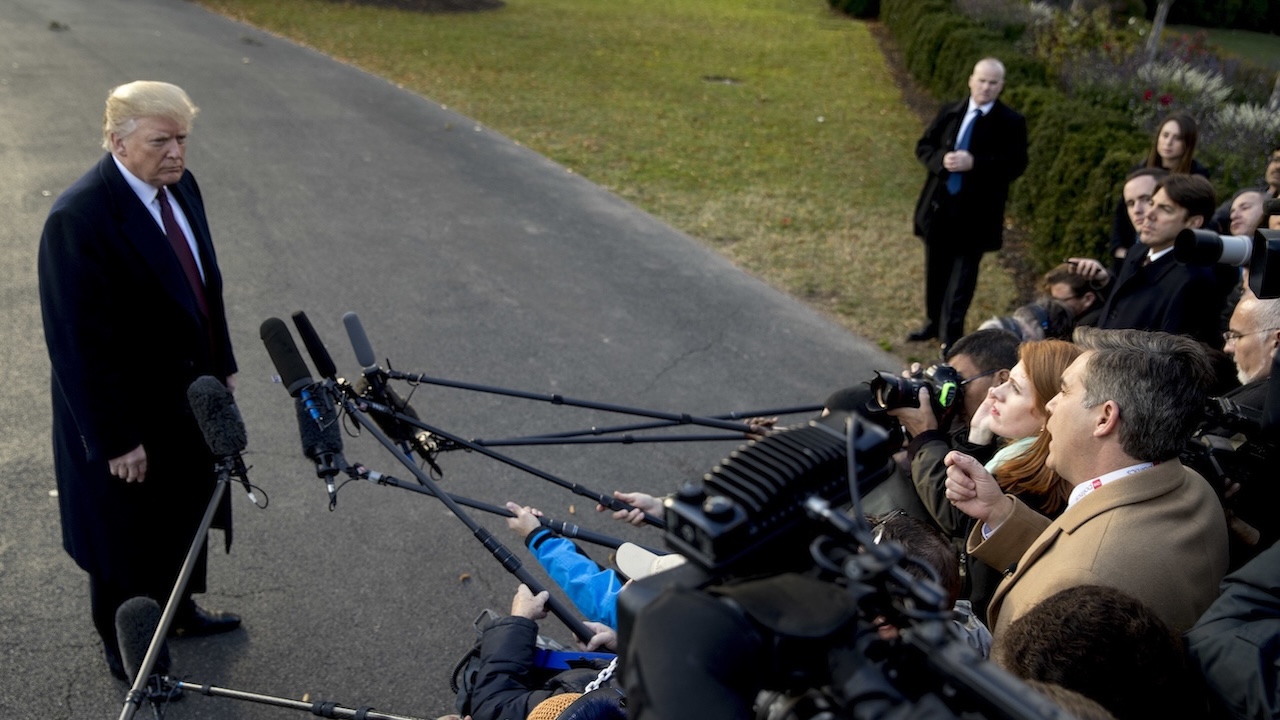
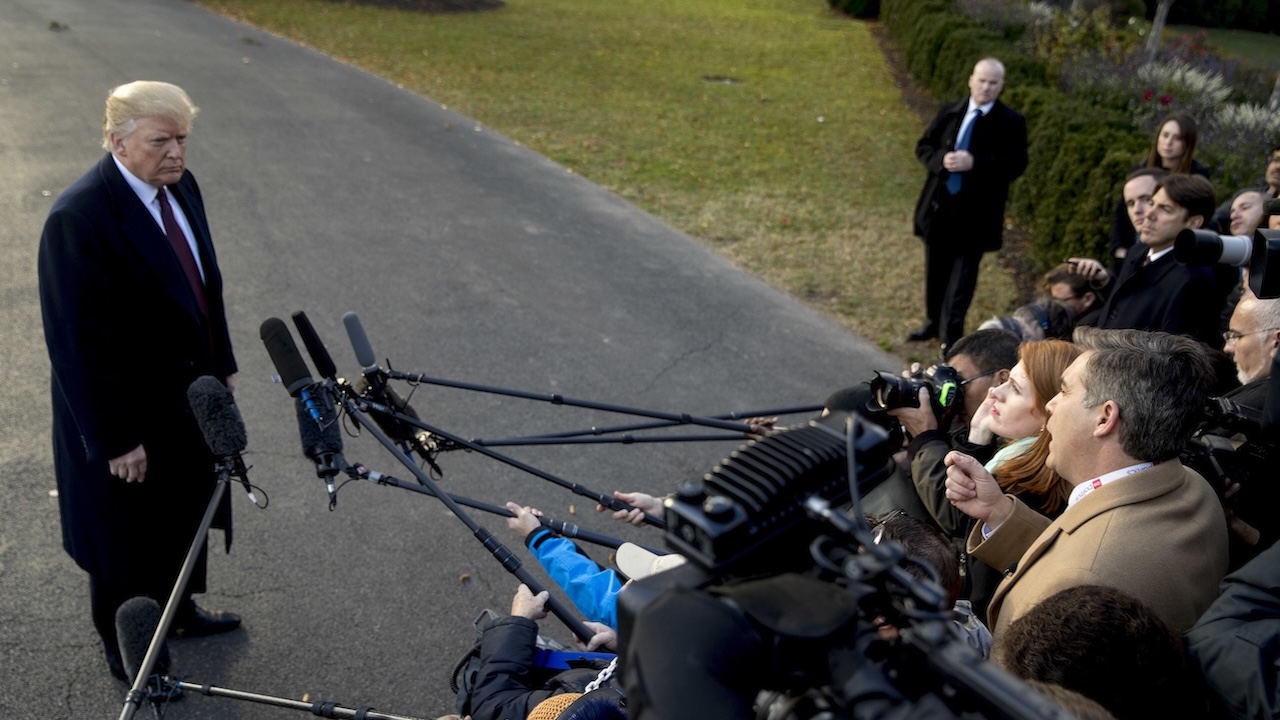
President Donald Trump takes a question from CNN reporter Jim Acosta, right, before boarding Marine One on the South Lawn of the White House in Washington, Tuesday, Nov. 20, 2018, for a short trip to Andrews Air Force Base, Md., and then on to Palm Beach, Fla. (AP Photo/Andrew Harnik).
President Donald Trump reignited his battle against the “free press” on Friday by banning people who “purposely” write “negative stories” about his administration from the White House, but if precedent is any guide, he’s already lost.
Trump himself said he was “proud” to ban CNN, MS NOW (formerly known as MSNBC), and Politico “as a result of their constant ‘reporting’ FAKE NEWS!” — and so it was little surprise that early on Monday the news organizations together filed a lawsuit saying they saw this “no notice, no process, and no warning” movie before, during the president’s first term.
The court filing referenced both the White House suspensions of then-CNN correspondent Jim Acosta and Playboy correspondent Brian Karem, alleging violations of both the First Amendment and the Fifth Amendment’s Due Process Clause.
Love true crime? Sign up for our newsletter, The Law&Crime Docket, to get the latest real-life crime stories delivered right to your inbox.
“Before September 18, 2026, no President had barred CNN as an organization from the White House. But in November 2018, the White House suspended the hard pass of CNN correspondent Jim Acosta following an exchange between President Trump and Mr. Acosta at a news conference,” the complaint said. “CNN and Mr. Acosta filed suit in this Court to challenge the revocation of his hard pass on constitutional grounds. The Court ordered that Mr. Acosta’s credential be restored, and the White House reinstated it. See Karem, 960 F.3d at 661 (describing incident and litigation).”
Longtime Law&Crime readers may recall that the Acosta saga led the Trump White House to establish new rules for press conferences, precisely because courts found the administration had violated Acosta’s due process rights.
I have a feeling this is not going to work out the way he thinks it will. pic.twitter.com/cSxtwDLOE0
— Jim Acosta (@Acosta) September 18, 2026
Karem later persuaded the U.S. Court of Appeals for the D.C. Circuit that he was “likely to succeed on his due process claim because […] he lacked fair notice that the White House might punish his purportedly unprofessional conduct by suspending his hard pass for a month.”
The newest set of plaintiffs again argue that a Trump media ban should fail because those targeted “received no prior notice of [it].”
“Neither the post nor the President’s remarks identified any standard by which the three banned news organizations’ coverage had been judged or would be judged in the future, any official responsible for applying that standard, any procedure by which CNN, MS NOW, or POLITICO could contest the ban, or any date on which the ban would end,” the lawsuit said. “As the D.C. Circuit put it when describing the previous Trump administration’s suspension of a White House reporter’s hard pass, the ban ‘effectuated an unpredictable break with prior policy and practice.’ Karem, 960 F.3d at 667.”
Where did the “ban on the free press,” as Trump put it, come from?
The Wall Street Journal suggested on Sunday that executive aide Natalie Harp sent Trump into a “fever pitch” when she showed the president a video of negative MS NOW coverage hours earlier.
But the Constitution “protects the liberty and property interests that news organizations and White House reporters have in their press credentials and the access those credentials afford them to cover the White House for the benefit of the public,” the lawsuit said.
“No official can deprive Plaintiffs of those interests on a whim—with no notice, no process, and no warning—as the President did here,” the plaintiffs added, again citing the more recent Karem case and the on-point 1977 precedent Sherrill v. Knight.
When Trump was asked Friday whether the ban would “survive a court challenge,” he said success wasn’t necessarily the point.
“Well, we’ll see,” Trump said, according to the lawsuit. “I think it’s good to point it out whether it survives or doesn’t. I mean, I don’t think a court should allow, depends on the judge you get, to be honest with you.”
The post Trump White House’s sudden ‘free press’ ban is a rerun of a legal drama from the president’s 1st term — with a slightly different script first appeared on Law & Crime.


