
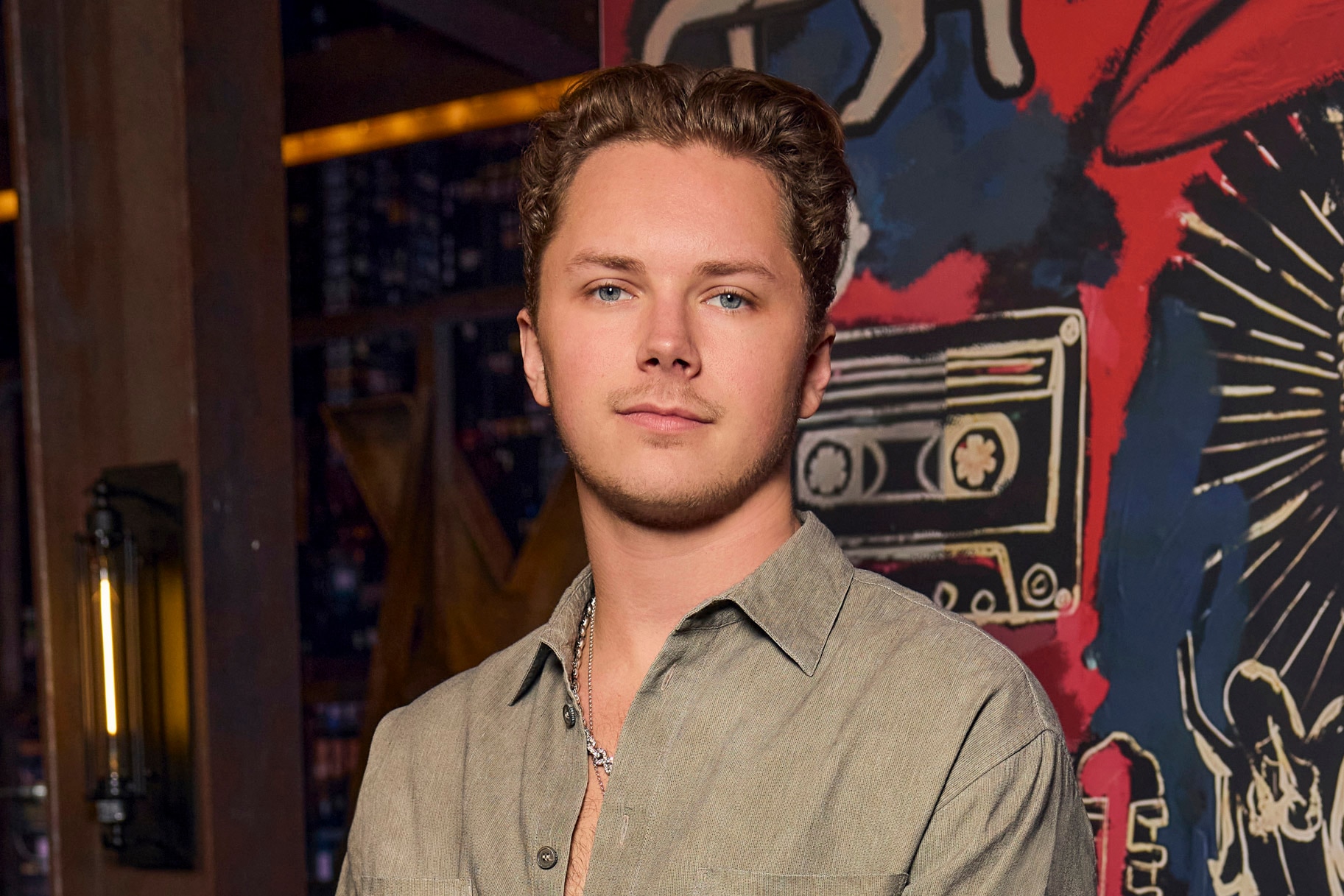
Hudson McLeroy briefly opened up about his addiction issues and how they affected his relationship with Ariana Biermann on Part 2 of the Next Gen NYC Season 2 reunion, but there’s much more to the story.
How to Watch
Next Gen NYC airs on Wednesdays at 9 p.m. ET on Bravo. Episodes stream next day on Peacock.

Read Hudson’s own account of his journey below.
I think to really understand my journey with addiction, you almost have to go back to when I was 13, and I was diagnosed with Type 1 Diabetes, because that’s when my entire world changed. I was angry — I was angry at the world, I was angry at God, and I remember constantly thinking, ‘Why me?’
I was just getting into my teenage years, and I thought I was finally about to start getting some freedom in my life and have my first real relationships and experience high school like a normal teenager and everyone else around me. But instead, I had to grow up almost overnight. At 13 years old, I suddenly constantly had to think about my blood sugar, what I was eating, how I was feeling, whether I had insulin with me, and whether I was safe. There’s not an on-off switch, you know? I can’t just act like this doesn’t exist. And looking back now, it makes me realize there was a lot of anger and emotion attached to that diagnosis that I had absolutely no idea how to process at that age.
Then, by 14 or 15 years old, I started experimenting with different substances. I don’t think I recognized it as a problem then — I was young, I was trying to figure out who I was, and I think in some ways, I was also looking for an escape of how I felt, just to feel normal for a little while.
But around 18 is when things became very different for me. I was living on my own, I had a medical procedure that left me in some of the worst pain I’ve ever experienced, and I started trying to self-medicate because I just wanted the pain to stop. When I woke up without anything left, I experienced withdrawal for the first time in my life. I was 18 years old, I didn’t really realize what addiction was yet, and suddenly I was experiencing it firsthand. And the part that made it even harder was the doctors had told me that the physical pain from the seizure should’ve started getting better around that same time, but it didn’t. The pain continued for almost 3 months — maybe longer — so I was dealing with this intense physical pain while also beginning to understand what my body had become dependent on.
That period changed my relationships with substances forever. And that’s also why I don’t really like to say I’ve overcome addiction. I don’t think that’s how it works for me. I think addiction is something I have to understand and be aware of for the rest of my life. Recovery is something I continuously have to choose.
Over time, I’ve really had to learn what my triggers are — relationships are probably one of my biggest. It doesn’t matter whether it’s with Ariana, my parents, my friends, or someone else I love. When I feel like I’m losing someone, or when something feels unstable, or when I’m emotionally overwhelmed, historically, that’s when I’ve wanted to escape what I’m feeling instead of actually sitting down and dealing with it.
Alcohol is a good example of what I’ve learned about myself. I’ve never considered myself someone who inherently has an alcohol problem, but there are obviously times when I was younger when I drank too much. There were nights I accidentally blacked out and my blood sugar was 300 or 400. And back then, I didn’t really understand what I was putting my body through.
But what I understand now, for me, is that it’s not always about the substance itself, it’s about why I’m reaching for it. There’s a huge difference between me having a drink socially because I’m enjoying myself, and me having a drink because I’m hurt, angry, anxious, or trying not to feel something. And a huge part of my recovery today is understanding those patterns before they become something bigger. It’s knowing what triggers me, being honest with myself when I’m struggling, and learning that I don’t have to escape every uncomfortable emotion. I can’t control everything that’s going on around me. I can’t control every relationship, every disappointment, or everything life throws at me, but I am learning that I do have to control how I respond to those things. I think that’s something I’m gonna continue to do for the rest of my life.
Hudson McLeroy explains the drama surrounding his business in Atlanta
Hudson acknowledged his absence on Season 2 of Next Gen NYC at the reunion, explaining that in addition to battling addiction issues, he had started a business in Atlanta and ran into “speed bumps.”
I do have a business out of Atlanta, and everything was going really well in the beginning — we’ve got a couple of clients that we still work with right now — but when I started to spiral, I trusted people that I shouldn’t have. These people betrayed my trust and stole from my business.
I’m in a legal battle right now, so I can’t really speak much on it. The most I can say is that somebody betrayed my trust severely, and kind of put me in a position where the entire business is on pause. But I’m working on something out of New York, so I will be spending more time there. I’m really excited for this because it’s a whole new venture that I’m doing entirely by myself, so nobody can betray my trust.
Where Hudson McLeroy and Ariana Biermann stand now
Ariana revealed at the reunion that she and Hudson briefly got back together before splitting again earlier this year. “Hudson had just gotten out of rehab and I was kind of going through a very traumatic point in my life, and we kind of found our comfort in each other again,” she said. “We’re family. We really are. And when push comes to shove, if Hudson needs me, no matter where I am in the world, I always want to be able to help him.”
Ariana has always been a huge support system for me, but after our most recent breakup and everything that happened throughout Season 2 and the 10 years of history we have together, I realized I can’t rely on her to carry me through my sobriety, or expect her to drop everything in her life to take care of me. That isn’t fair to put on anyone, and looking back, I can see how selfish that pressure became.
Right now, we aren’t on talking terms. We both decided that no contact is the healthiest way for us to move forward and give each other the space that we needed. I mean, it’s not the kind of thing where if we’re in public, we’re not gonna say ‘hi’ to each other, but it’s not gonna be like Emira [D’Spain]’s birthday party when I walk up, grab her, and do that whole thing.
I think everyone’s journey with addiction is different, and my journey with addiction has always been very different from anybody that I’ve seen, or anybody that I’ve been around, because when I’m with Ariana, I don’t have any need to feel like I wanna do drugs. Like, that doesn’t exist in my life. My anxiety doesn’t exist. It’s like I have so much comfort with her. She’s able to take away all my worries. But if her giving me that kind of comfort is causing her the kind of pain that she feels, then it’s not worth it.
How Hudson McLeroy’s doing today
Filming on Next Gen NYC Season 2 wrapped after the reunion taped on July 30.
I mean, as much as I want to sit here and say I’m doing great and everything is okay, I’m not. I’ve struggled with anxiety, depression, and severe insomnia from a very young age, and after watching Season 2, it has brought back up a lot of that for me. It’s hard watching the love of my life spiral because of the pain I caused, especially knowing that some of the hardest parts of our lives are now playing out on camera. What people also didn’t see was me spiraling too. I started going back down the path of addiction and eventually I had to make the decision to send myself back to treatment, because I recognized where I was heading.
I also think people need to understand recovery isn’t linear. You don’t go to treatment once and suddenly you’re better. I’ve slipped up. The difference is, now, I’m much better at recognizing the signs. I can feel when I’m starting to spiral, and instead of letting it get completely out of control, I’m learning how to reach for my support system and remove myself from the situation. So no, I’m not perfect and everything isn’t okay, but I’m more aware of myself than I ever have been, and I continue to choose recovery every day.
I hope that by sharing my experience I can help others feel less alone. I’m always open to speaking more about this experience in greater detail.
This interview has been edited for length and clarity.
— Reporting by Stephanie Gomulka


