
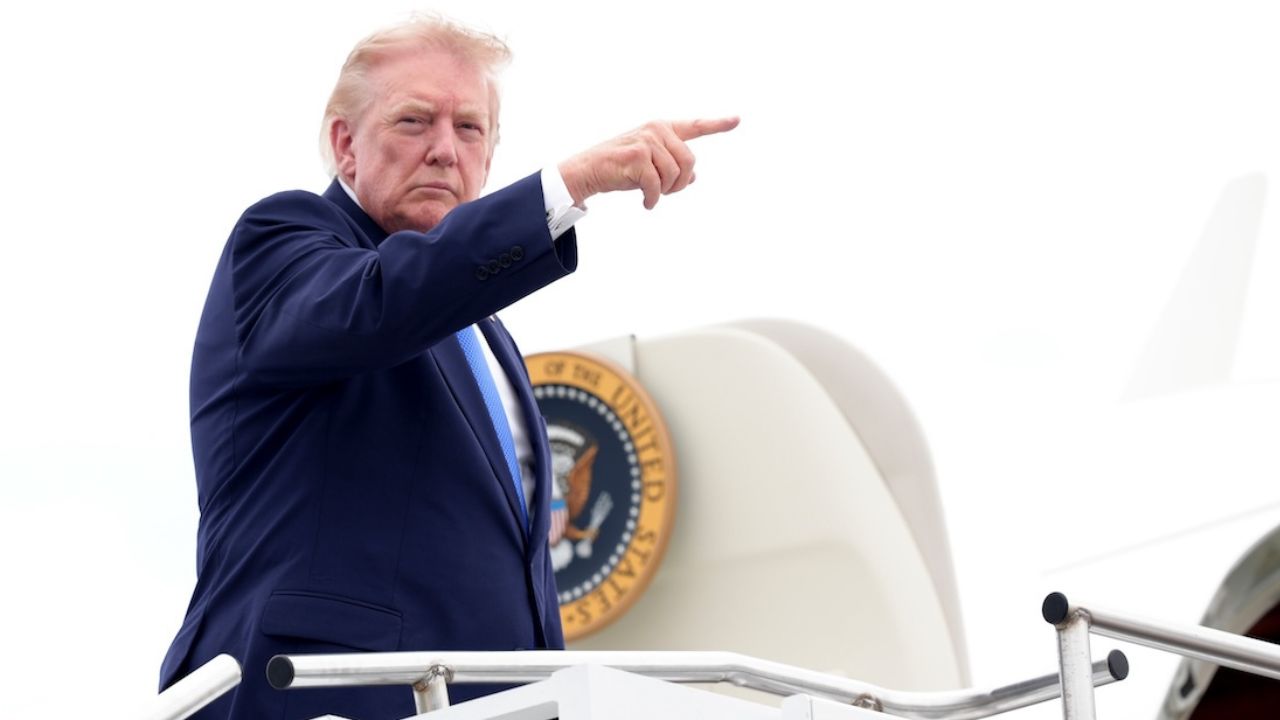
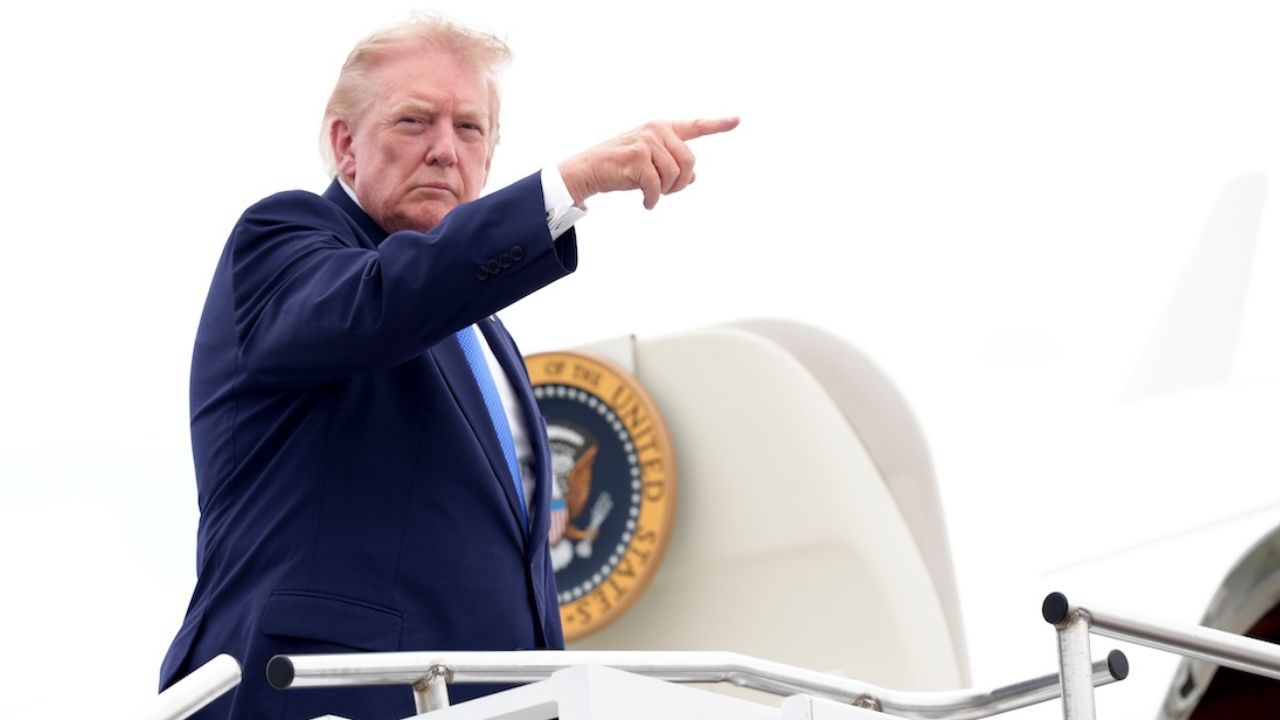
President Donald Trump gestures as he boards Air Force One at Morristown Municipal Airport, in Morristown, N.J., Sunday, Aug. 2, 2026, en route to Washington (AP Photo/Jacquelyn Martin).
The Trump administration won a significant appellate court victory in a case over a California law requiring federal law enforcement officers to identify themselves.
In the underlying litigation, the U.S. Department of Justice challenged statutes passed last year by the California Legislature and signed into law by Gov. Gavin Newsom. The “No Secret Police Act” barred federal agents and local law enforcement from wearing masks. The “No Vigilantes Act” also required local, state and federal law enforcement to display their name and badge number while on duty.
California passed the laws in response to outrage over the actions of Immigration and Customs Enforcement (ICE) agents and other agencies as the government ramped up deportations alongside mobilizations of National Guard troops used to quell protests.
Love true crime? Sign up for our newsletter, The Law&Crime Docket, to get the latest real-life crime stories delivered right to your inbox.
In February of this year, U.S. District Judge Christina A. Snyder, a Bill Clinton appointee, split the difference by nixing the mask law while allowing the name and badge number requirement to take effect.
The DOJ appealed and quickly won an injunction pending appeal — with a panel on the U.S. Court of Appeals for the 9th Circuit instructing California not to apply or enforce the “No Vigilantes Act.”
Now, the panel has fully considered the merits and again sided with the Trump administration.
“As before, we conclude that the United States is likely to succeed on the merits of its Supremacy Clause claim because §10 of the No Vigilantes Act attempts to directly regulate the United States in its performance of governmental functions, and Congress has not authorized such regulation,” the unanimous 21-page opinion reads. “Indeed, we conclude that the United States is certain to succeed.”
That certainty sharply rebukes the lower court’s analysis.
In the district court ruling for California, Snyder said the law was “analogous to traffic laws that, in a similar sense, dictate how a federal officer may operate a vehicle on state roads but are nonetheless enforceable against federal officers, subject to immunities.”
The appellate court expressly rubbished the traffic law example.
“[U]nlike traffic laws which, for example, might require a full stop before a right turn, and which regulate conduct that any ordinary citizen could engage in, [the No Vigilantes Act] applies exclusively to law enforcement officials and exclusively to their performance of law enforcement operations,” the panel observed. “Thus, [the No Vigilantes Act] does not just ‘incidentally’ sweep up the conduct of federal officers carrying out their duties.”
The 9th Circuit ultimately found the law runs afoul of the intergovernmental immunity doctrine, which bars state or local rules that regulate the federal government or discriminate against it.
“In sum, if a state law directly regulates the governmental conduct of the United States without congressional authorization, it is void irrespective of whether the regulated activities are essential to federal functions or operations, and irrespective of the degree to which the state law interferes with such functions or operations,” the opinion goes on. “[The No Vigilantes Act] thus directly regulates inherently sovereign functions. Because Congress has not authorized such legislation, it is barred by intergovernmental immunity.”
In harshly rejecting the state law, the 9th Circuit concluded that “no set of circumstances exists under which the Act would be valid.”
“For these reasons, we REVERSE the district court’s denial of a preliminary injunction and REMAND with instructions to enter a preliminary injunction enjoining the State of California, its Governor, and its Attorney General from applying or enforcing § 10 of the No Vigilantes Act, against the United States, federal agencies, and federal officers,” the opinion concludes.
U.S. Circuit Judge Mark J. Bennett, a Trump appointee, authored the ruling, joined by Circuit Judge Daniel P. Collins, another Trump appointee, and Circuit Judge Jacqueline H. Nguyen, an Obama appointee.
The post ‘It is void’: 9th Circuit reverses district court and blocks California law that forces ICE agents to display names and badge numbers first appeared on Law & Crime.


