
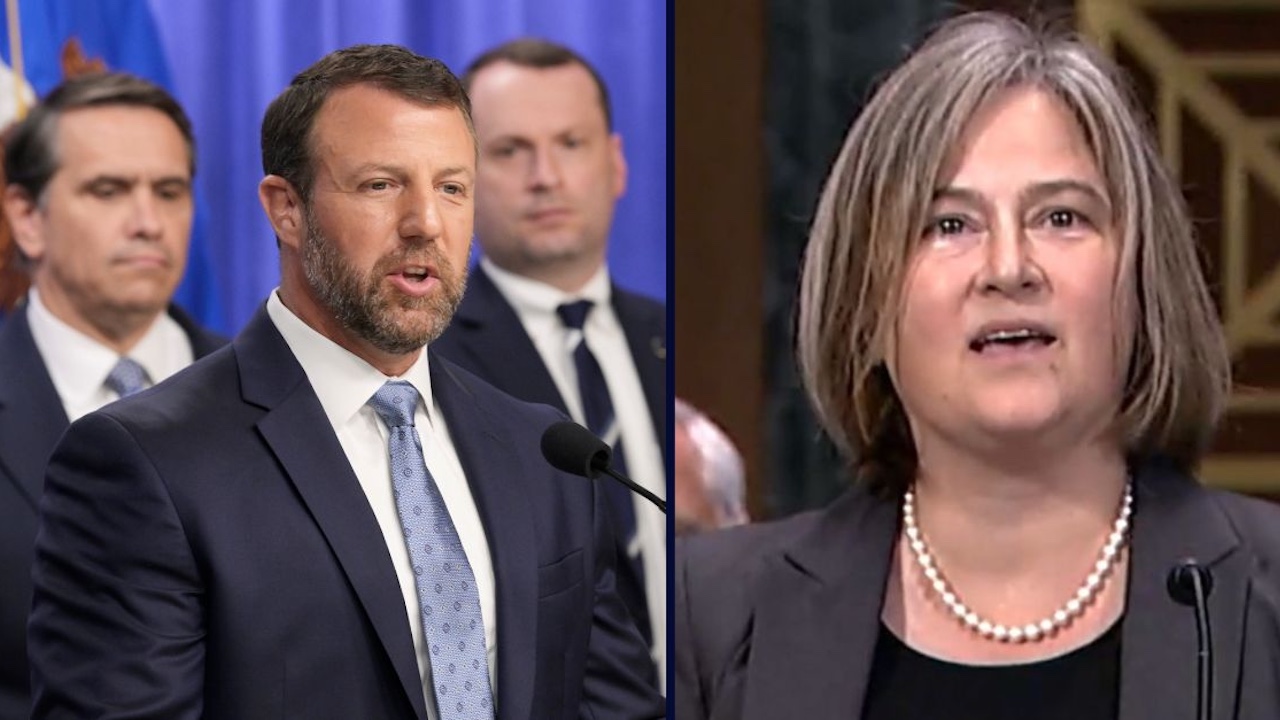
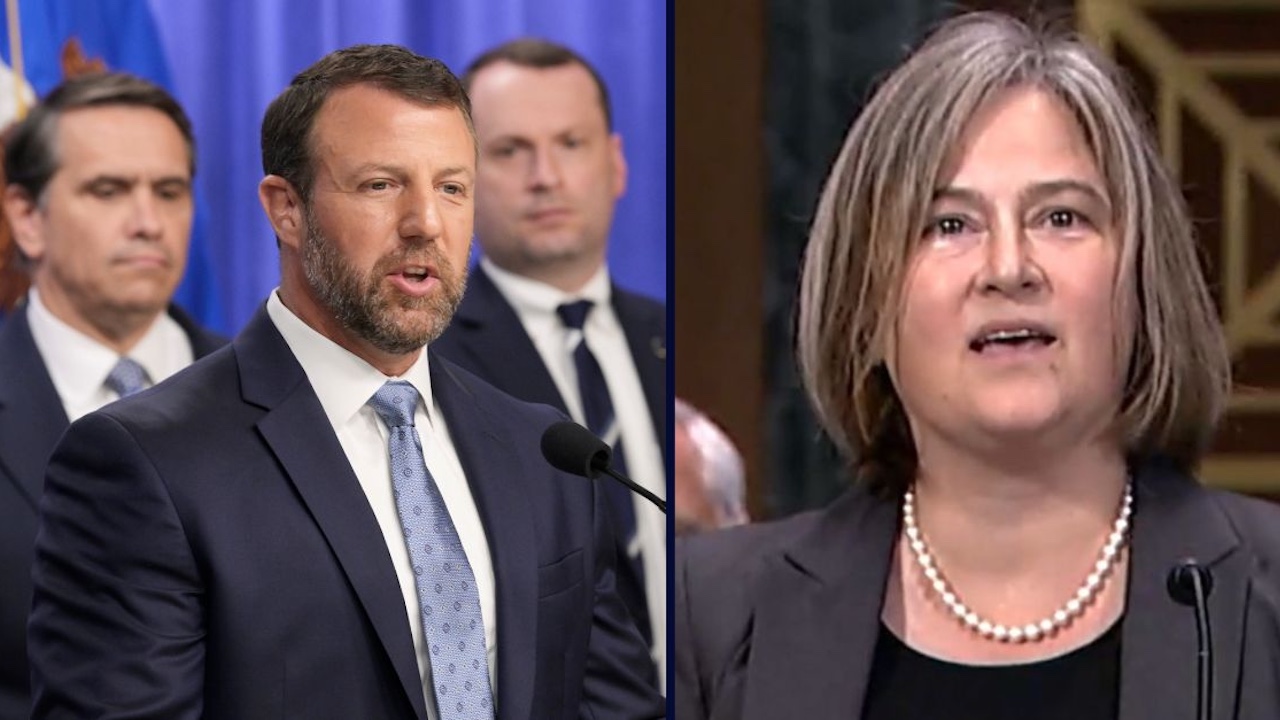
Left: DHS Secretary Markwayne Mullin speaks about government efforts to locate and safeguard unaccompanied children during a press conference at the Department of Justice in Washington, United States, on June 11, 2026 (Photo by Lenin Nolly/NurPhoto via AP). Right: Judge Laura Provinzino appears before the Senate Judiciary Committee on July 10, 2024, following her nomination (Senate Judiciary Committee).
A military lawyer tasked with assisting the DOJ in Minnesota amid “Operation Metro Surge” and mass turnover in the U.S. attorney’s office asked an appeals court to rule that a judge wrongly held him in “personal contempt” in an effort to force ICE to return a driver’s license to an “unlawfully detained” man.
Chief U.S. Circuit Judge Steven M. Colloton, U.S. Circuit Judge Bobby E. Shepherd and U.S. Circuit Judge James B. Loken — two George W. Bush appointees and one George H.W. Bush appointee — formed the panel at the 8th U.S. Circuit Court of Appeals on Wednesday morning.
There, special assistant U.S. attorney (SAUSA) Matthew Isihara — a Judge Advocate General’s Corps of the Army (JAG) lawyer — and DOJ attorney Daniel Tenny made the case that U.S. District Judge Laura Provinzino’s “wholly improper use of coercive civil contempt” in February “stained the reputation of a hardworking career federal attorney who was placed in a difficult situation.”
Love true crime? Sign up for our newsletter, The Law&Crime Docket, to get the latest real-life crime stories delivered right to your inbox.
At the time, Provinzino ordered the release of Rigoberto Soto Jimenez, a Mexican man living in Minnesota who was “unlawfully detained.” She also ordered the government to return his identification documents. But when Jimenez was let out of an El Paso, Texas, facility, he didn’t have his Minnesota driver’s license or Mexican Consulate ID, and he wasn’t returned to Minnesota.
Provinzino, a Joe Biden appointee, responded by slapping Isihara with a $500 daily “coercive fine” until his client, ICE, returned Jimenez’s property as ordered — which ICE did the next day, so Isihara paid no penalty and purged the contempt. Later that same month, the then-chief judge of the district court separately said that hundreds of violations of court orders could put criminal contempt on the table to “force the United States government to comply” in various cases.
Tenny kicked off arguments Wednesday morning, even though the court appeared to have called on amicus curiae Jeffrey Justman first. Justman was appointed by the court to argue in support of the contempt order that the DOJ and Isihara opposed.
According to Tenny, Provinzino “inappropriately” used her contempt power with “no advance notice” and “drove a wedge” between DOJ attorneys and their agency clients following a sanctions hearing. Isihara, new to the habeas case at issue, was subjected to an “entirely improper” order that punished him for his client’s noncompliance, the DOJ said.
“The district court just said, ‘I’m not sure that it’s actually going to happen, so I feel like I need to hold you in contempt in order to make sure that the client does what the client says that it’s going to do and intends to do,’ and that’s entirely improper,” Tenny said. “There’s really not a legal dispute here.”
Shepherd jumped in to ask if Isihara has standing to appeal, considering that the lower court “later purged the contempt finding or entered an order lifting any sanction.”
“What would we do even to redress any injury that had been inflicted here, even if it did occur?” he asked, also wondering why the case isn’t “moot.”
“The district court issued an order saying that fines wouldn’t accrue because ICE had complied with the underlying order, and in that sense purged the contempt,” Tenny answered. “It did not reverse its order holding in contempt.”
It “would be an extraordinary holding” to say Isihara has no standing to defend his reputation just because there was no monetary penalty, Tenny added.
Justman countered that the panel should affirm or toss the appeal for lack of jurisdiction, “either because the case is moot because the contempt has been purged, or because before the appeal was initiated, the contempt had been purged and therefore there was no injury.”
He mentioned the case of a pilot whose license was temporarily suspended and whose “conclusory, breezy declarations of reputational harm were not enough” to establish standing in a case at the 8th Circuit.
“I think the same could be said here,” Justman said, rejecting the “notion that Mr. Isihara had done everything he possibly could have done before the hearing, and therefore there was no contempt possible to coerce.”
That “is just not supported by the record,” the amicus went on.
Rather, Isihara admitted he “personally dropped the ball” and never forwarded the order to ICE, which Provinzino construed as a violation, Justman said.
Shepherd noted the judge’s order to the government to show why it should not be held in contempt referred to the government, not to attorneys.
“I’m not sure your argument that all the lawyers that represent the government are included within that term really holds water here when you’ve got an order that, to me, gives notice that the court is considering holding the government in contempt, not an attorney that represents the government,” he said.
Justman said the case history showed Provinzino couldn’t have known Isihara might be to blame before the show cause hearing.
“There’s nothing more the district court could have done before the hearing because Mr. Isihara was an unknown to the district court. He had entered no appearance. He had filed no papers. He was responsible for the case since its beginning, but hadn’t ever told the court. He had never filed a response to the habeas petition. He had never done anything in the case,” Justman said. “Literally, it is impossible for the district court before the hearing to have said, ‘Matthew Isihara, I think you might personally be in contempt.'”
On rebuttal, Tenny said that “all we’re asking for” is for the 8th Circuit to wipe the order away.
“The lawyers for the government were apologetic that things had gone wrong in this case, were doing everything within their power, and it was clear had already started to do everything in their power and gotten the wheels turning on getting on getting this issue resolved,” he said.
The post DOJ lawyer insists there’s ‘really not a legal dispute here’ while asking appeals court to reverse ‘entirely improper’ contempt order against ‘apologetic’ JAG lawyer first appeared on Law & Crime.


