
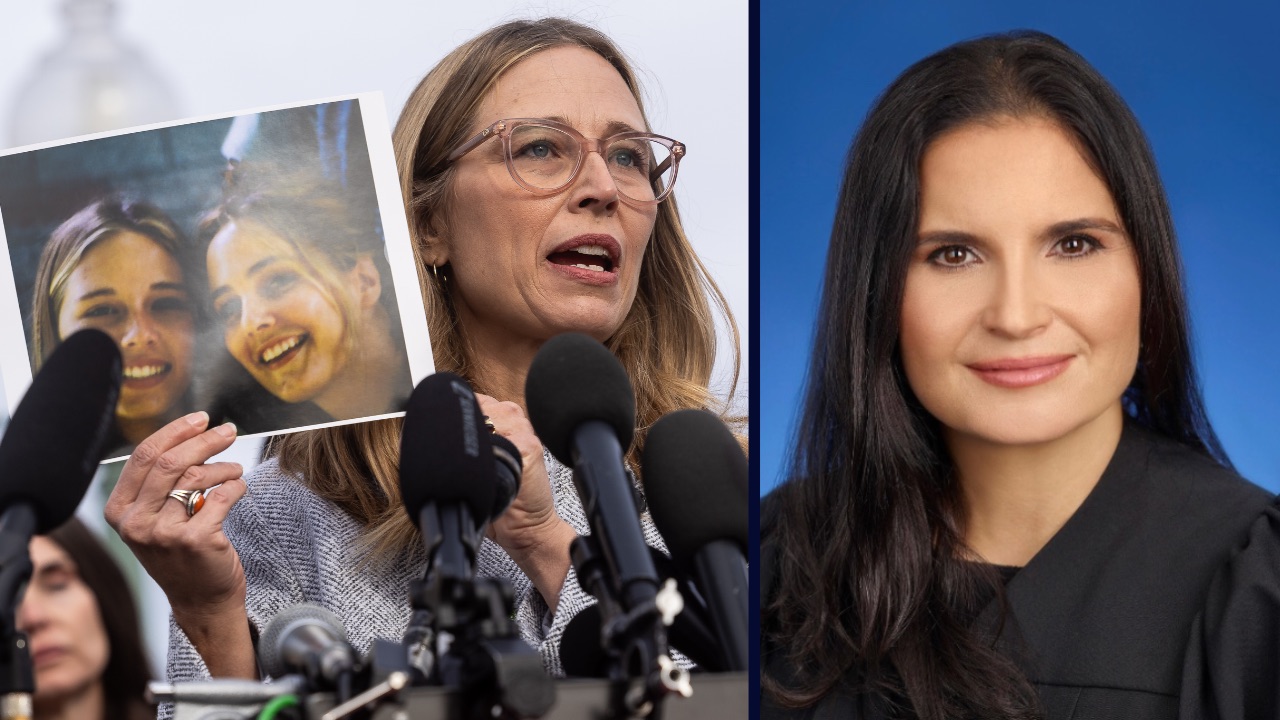
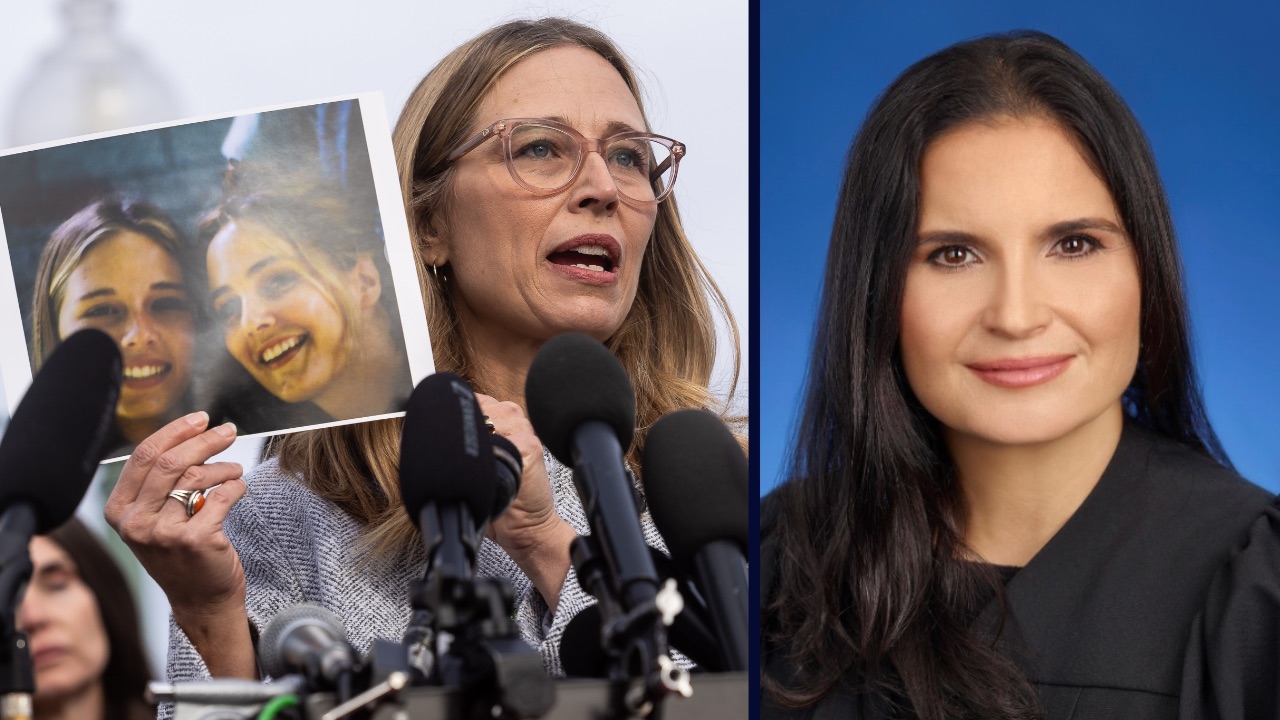
Main: Annie Farmer holds a photo of herself and her sister, Maria Farmer, when they were victims of convicted sex offender Jeffrey Epstein during a press conference on the Epstein Files Transparency Act outside the U.S. Capitol Nov. 18, 2025. (Francis Chung/POLITICO via AP Images). Inset right: Judge Aileen Cannon (U.S. District Court).
A federal lawsuit filed by several Jeffrey Epstein victims in Florida, where Attorney General Todd Blanche is fighting a subpoena to testify, may be consolidated for discovery purposes with another high-profile civil negligence case — thanks to U.S. District Judge Aileen Cannon.
Maria Farmer and her younger sister, Annie Farmer, are two of the earliest known and most widely recognized victims of Epstein and Ghislaine Maxwell’s sex-trafficking crimes, with Annie playing a prominent role in testifying at Maxwell’s trial.
In May 2025, Maria Farmer filed a lawsuit in Washington, D.C., alleging that she reported Epstein and Maxwell to the FBI in 1996 — and yet, “the FBI, in violation of its mandatory obligations under regulations and DOJ policies, chose to do absolutely nothing,” according to the lawsuit.
Love true crime? Sign up for our newsletter, The Law&Crime Docket, to get the latest real-life crime stories delivered right to your inbox.
But on Sept. 25, Senior U.S. District Judge Reggie B. Walton ruled that the case didn’t belong in Washington and should be transferred to the Southern District of Florida — because it was “substantially the same as another case” that was transferred there: Jane Doe 1 et al. v. United States of America.
Five days later, the Farmer docket shows, the case was assigned to Cannon, a Donald Trump appointee. And one day after that, Cannon found “good cause” to transfer the matter to U.S. District Judge David Leibowitz, “subject to the consent” of the Joe Biden-appointed jurist.
Leibowitz accepted the related assignment the same day. A week after that, he ordered Farmer, the Doe plaintiffs and the DOJ to explain why the two lawsuits “should or should not be consolidated.”
That has led to a situation in which Epstein victims Laura Newman, Sandra Ward and 32 Jane Does are hailing Cannon’s reasoning as correct and the DOJ is opposing potential consolidation as “not appropriate.”
“Upon a sua sponte review of the record, Judge Cannon determined that the present action and the Farmer action were ‘of the same subject matter and arising out of the same circumstances’ such that a transfer was warranted by good cause,” the Doe plaintiffs said.
“As such, in response to the Court’s inquiry to show cause why this action should or should not be joined with Farmer v. USA, all plaintiffs agree that these actions should be consolidated exclusively for discovery and pretrial issues,” the filing added.
Farmer likewise supported consolidating the cases but “only” for the “limited purpose of procedural issues, discovery and other pretrial purposes.”
To hear the DOJ tell it, “consolidation is not appropriate under the Federal Rules as the two cases, though arguably arising from similar circumstances, do not share sufficient factual or legal issues to justify consolidation.”
“Further, the cases involve distinct legal theories, and are in materially different procedural postures, such that consolidation would prejudice both Parties and impede the fair and efficient resolution of both matters,” the government argued.
The parties now await a ruling.
The DOJ at the start of the week filed a motion to quash a subpoena for Blanche’s testimony, claiming that forcing the AG to sit for a deposition in the Doe case would “threaten the separation of powers, chill agency decision making, discourage public service, and create potential for abuse or harassment.”
A motion hearing on that issue has been set for 2 p.m. on Nov. 4, according to a Wednesday order from U.S. Magistrate Judge Ryon McCabe.
The post Judge Cannon quietly found ‘good cause’ to take Epstein victim’s lawsuit off her plate, and the DOJ isn’t thrilled first appeared on Law & Crime.


