
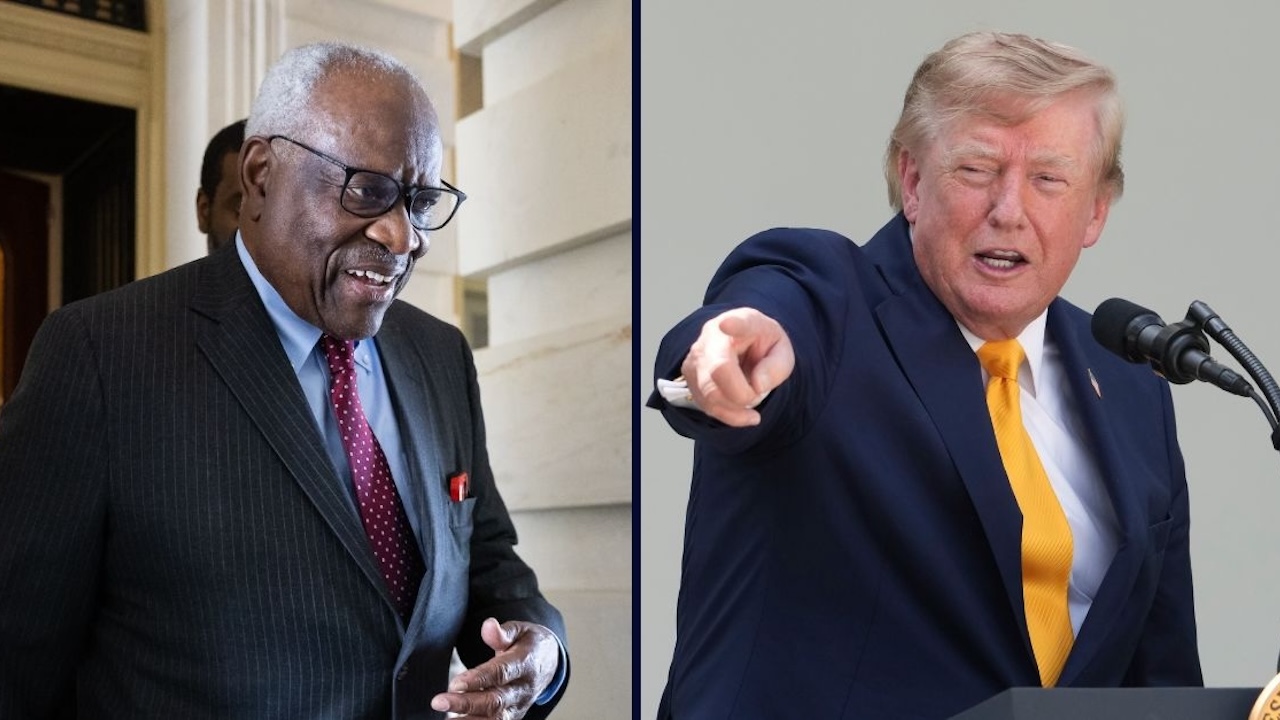

Left: Supreme Court Justice Clarence Thomas departs the U.S. Capitol on June 29, 2026 (Francis Chung/POLITICO via AP Images). Right: President Donald Trump speaks during a back-to-school event in the Rose Garden of the White House, Monday, Aug. 24, 2026, in Washington (AP Photo/Alex Brandon).
A Florida judge appointed by Donald Trump has allowed the president’s defamation lawsuit against the British Broadcasting Corporation (BBC) to move forward — denying a motion to dismiss filed by the world’s oldest national public broadcaster.
The decision has raised eyebrows in the legal community.
The 45th and 47th president filed the lawsuit in December 2025, alleging that edits to a “Panorama” documentary about Trump gave the impression he directly incited the Jan. 6 riot at the U.S. Capitol — by splicing together different portions of his “Stop the Steal” speech.
Love true crime? Sign up for our newsletter, The Law&Crime Docket, to get the latest real-life crime stories delivered right to your inbox.
Over the summer, the BBC moved to dismiss the case, arguing the complaint “fails to plausibly allege … that Defendant published the Documentary with actual malice—that is, knowing the Documentary was false or while entertaining serious doubts as to its truth.”
On Tuesday, U.S. District Judge Jeffrey T. Kuntz — who was assigned to take over the case from another Trump appointee, U.S. District Judge Roy K. Altman, in early August — denied the BBC’s motion to dismiss.
In that order, the judge made some notable comments about the genesis of the actual malice standard, established by the landmark 1964 U.S. Supreme Court case of New York Times Co. v. Sullivan.
Actual malice governs disputes when a high-profile person claims they have been defamed. Proving actual malice is difficult, and when a judge rules that a plaintiff must meet the standard, dismissal often follows.
But not always.
Kuntz opined that Trump might satisfy the exacting standard while questioning the staying power of the case that created it.
“The Court acknowledges several recent criticisms levied against Sullivan,” the court’s 40-page order reads.
Those criticisms, it turns out, come from a concurrence and a dissent by Supreme Court Justice Clarence Thomas.
A First Amendment expert told Law&Crime this reliance was out of place.
“I find it a bit troubling that the judge here is applying the Sullivan standard through a heavy emphasis on Justice Thomas’s dissent to a cert denial,” Professor Roy Gutterman, the director of the Tully Center for Free Speech at Syracuse University, said in an email.
Kuntz also leveled other criticisms toward the precedential case.
“It cannot be said that Sullivan is grounded in the original meaning of the Constitution, at least not in any meaningful sense,” the order goes on. “Nor is Sullivan grounded in the history and tradition of the common law.”
This line of attack was also off-base, the professor said, particularly considering the facts of the case between Trump and the BBC.
“In the decades since the Supreme Court laid down the actual malice standard, I do not think anyone has been making an originalist argument,” Gutterman went on. “Even though actual malice is not an originalist theory, it has become an important protection for the press in our democracy. This is exactly the kind of case that justifies the legal standard for public officials and public figures. The sitting president suing a media outlet for defamation is exactly why we have actual malice in the first place.”
Later in the order, however, Kuntz says “Sullivan remains good law and inferior courts are bound by vertical precedent.”
The court said the standard augurs well for Trump.
“Trump may plausibly allege actual malice through factual allegations of circumstantial evidence, such as ill-will, improper motive, or personal animosity, when such circumstantial evidence is probative of BBC’s state of mind regarding their knowledge of falsity or reckless disregard for the truth,” the order continues.
To satisfy the standard, the judge relies on the BBC’s historical Trump coverage — or, rather, how Trump views that past coverage.
“Trump alleges that BBC has a history of unfair or improper coverage toward him,” the order goes on. “Trump has plausibly alleged a comprehensive framework of actual malice by alleging the context in which the speech was edited along with a long list of circumstantial evidence to support a showing of actual malice with respect to the edit.”
The court also looks askance at how the footage was edited and says this would likely work in Trump’s favor as well.
From the order:
Editing is often required. However, given the time disparity between the two statements, the distance itself tends toward a plausible inference that BBC knew or should have known that the segment they were creating would not and could not have been a truthful statement. This was not trimming around the edges but creating something different than what was stated in the speech.
In a statement provided to Politico, the BBC said it was “surprised” by the court’s decision but “respect[s] the Court’s authority and note[s] the case will now proceed to the next stage.”
The post ‘Why we have actual malice’: First Amendment expert says decision allowing Trump lawsuit against BBC to go forward has ‘troubling’ reliance on a Clarence Thomas dissent first appeared on Law & Crime.


