
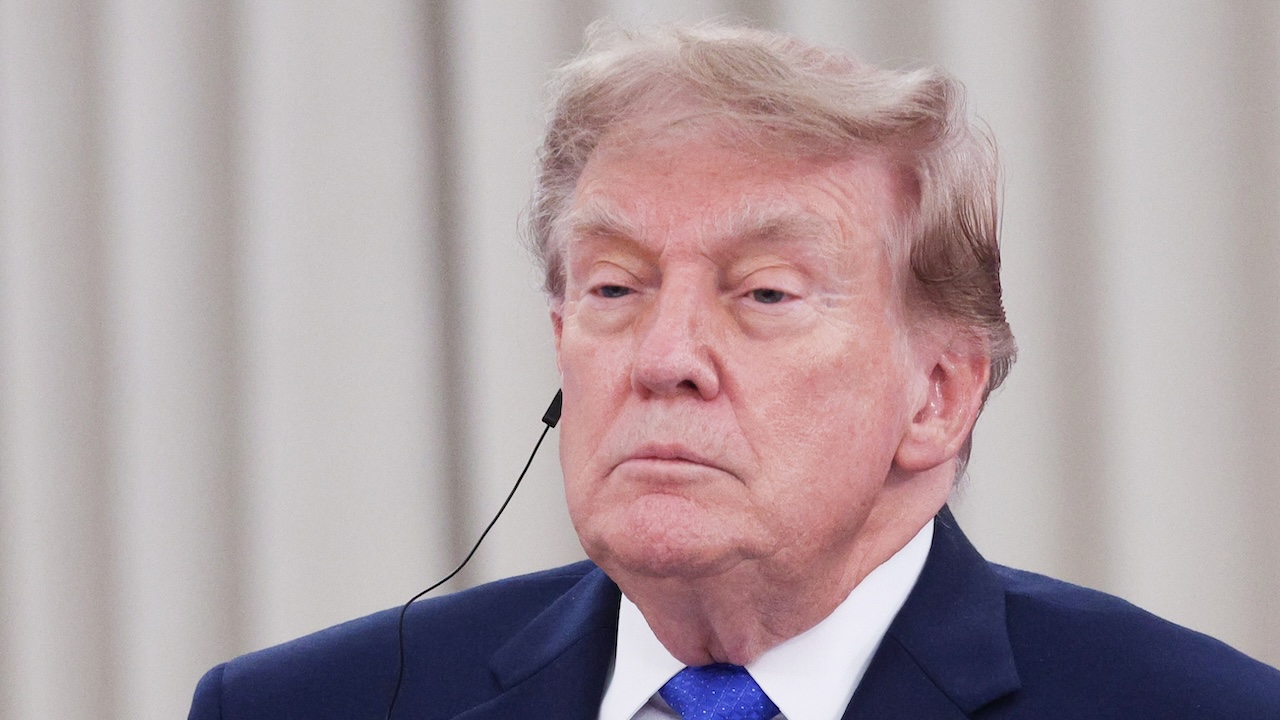

U.S. President Donald Trump attends a trilateral meeting with Russian President Vladimir Putin and Chinese President Xi Jinping at Kylin Villa in Shenzhen, southern China’s Guangdong province, Thursday, Nov. 19, 2026. (Vyacheslav Prokofyev/Kremlin Pool Photo via AP).
For the second time in recent weeks, a federal judge has allowed President Donald Trump to continue a defamation action against a major media defendant, prompting legal experts to question whether Florida courts are properly applying the “actual malice” standard.
Shortly after Trump launched his $15 billion lawsuit against the New York Times, journalists Susanne Craig, Russ Buettner, Peter Baker and Michael Schmidt and Penguin Random House, Senior U.S. District Judge Steven Merryday dismissed the case for filing a complaint the judge called “decidedly improper and impermissible.”
But the George H.W. Bush appointee allowed the president to amend his complaint, which Trump did.
While the Times defendants argued that Trump’s lawsuit was meant to harass journalists for exercising freedom of the press, the president’s lawyers alleged that false statements in the book “Lucky Loser” and two New York Times articles defamed him and were “particularly damaging to him” in the state of Florida.
Love true crime? Sign up for our newsletter, The Law&Crime Docket, to get the latest real-life crime stories delivered right to your inbox.
“In the Book, Penguin, Craig, and Buettner published many false, malicious, and defamatory statements about President Trump,” the amended complaint said. “The first false, malicious, and defamatory statement from the Book is ‘Donald Trump had received the equivalent of more than $400 million from his father, much of it through fraudulent tax evasion schemes.'”
“This statement is false because neither President Trump nor his father has ever been charged with—much less convicted of—any tax crime,” the lawsuit said.
On Thursday, Merryday said that statement was one of seven that “quite plausibly and reasonably create an inference that the authors and the publishers knew that these statements, accusing the plaintiff of planning and perpetrating complex crimes and knowingly receiving the proceeds and other benefits of these crimes, were ‘based on incomplete, minimal information[.]'”
“No party disagrees that New York Times Co. v. Sullivan, 376 U.S. 254 (1964), is the source of the law that governs the pleading standard a plaintiff must overcome to state a claim for defamation against a public official, such as the plaintiff,” Merryday said. “Times v. Sullivan states that the First Amendment ‘prohibits a public official’s recovering damages for a defamatory falsehood relating to his official conduct unless he proves that the statement was made with ‘actual malice’ — that is, with knowledge that it was false or with reckless disregard of whether it was false or not.'”
Still, the judge concluded that, at this stage, Trump has “at least a plausible inference that the authors and the publishers knew that no reliable conclusion about violations of the tax laws” was “possible without reliance on qualified opinion formulated after the necessary factual and legal research and analysis, which they knowingly failed to obtain.”
In short, Merryday said the Times defendants knew they needed “an explicit opinion from a qualified source after a thorough examination of pertinent facts” and in “failing to procure that opinion” purposefully avoided the truth — “a knowing failure that remains actionable, even after Times v. Sullivan.”
But that “second-guessing” exercise from Merryday is “precisely the kind of inquiry that courts are supposed to avoid, so that officials can’t use defamation lawsuits to make investigating them prohibitively risky and expensive,” according to the Freedom of the Press Foundation’s (FPF) Chief of Advocacy Seth Stern.
“Judge Merryday’s ruling completely misconstrues the Supreme Court’s ‘actual malice’ standard for defamation lawsuits by public officials. The whole point of that standard — which requires proof that reporters either knew their reporting was false or recklessly disregarded the truth — is to give the press breathing room to do its job and prevent judges from micromanaging journalists’ reporting processes,” Stern said in a statement to Law&Crime.
Professor Roy Gutterman, the director of the Tully Center for Free Speech at Syracuse University, also told Law&Crime that he’s “not sure the opinion entirely understands or properly applies the actual malice standard.”
“The underlying content was based on thousands and thousands of pages of documents and interviews. I cannot imagine that the newspaper or book publishers had any serious doubt or should have had any doubt about what they published,” he said of the Times’ reporting. “Just because the president does not like the content or the tone is not proof of actual malice.”
While Merryday did dismiss the “bulk of the complaint,” letting the “rest of the counts to go forward is a serious concern under the First Amendment,” Gutterman said, calling Trump’s damages request “outrageous.”
The professor was similarly critical of U.S. District Judge Jeffrey Kuntz’s Nov. 10 decision allowing the president’s lawsuit against the British Broadcasting Corporation to survive.
Gutterman found it “troubling” that the judge was applying Sullivan with a “heavy emphasis on Justice Thomas’s dissent to a cert denial.”
The post Judge’s ‘second-guessing’ exercise to let Trump seek ‘outrageous’ damages from NYT raises ‘serious concern’: Legal experts first appeared on Law & Crime.


