
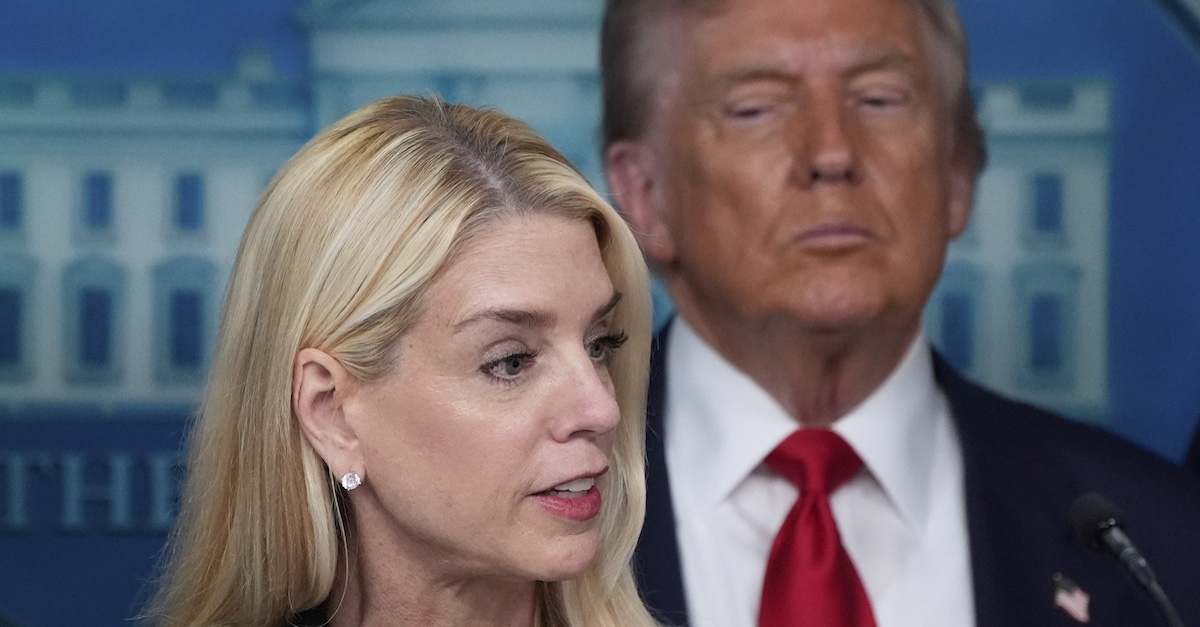
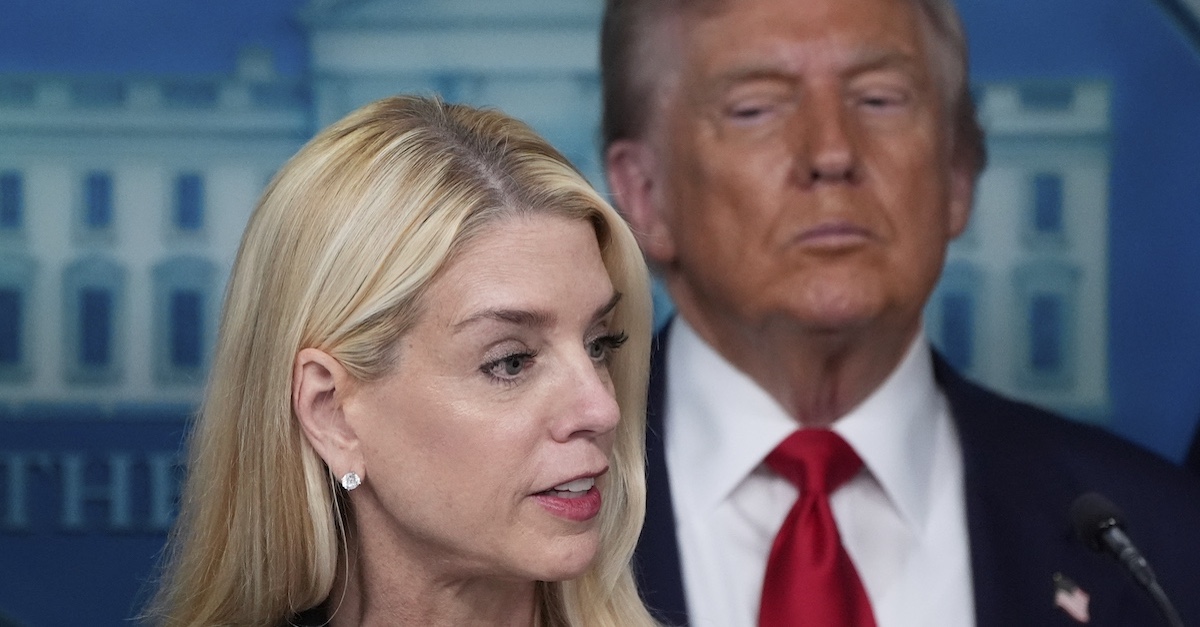
Attorney General Pam Bondi speaks with reporters in the James Brady Press Briefing Room at the White House, Monday, Aug. 11, 2025, in Washington, as President Donald Trump looks on (AP Photo/Alex Brandon).
The DOJ on Friday asked a federal judge to halt a civil lawsuit against an Atlanta-area court clerk “until criminal proceedings have been resolved,” citing the FBI”s raid of the Fulton County Elections Hub in Georgia.
In a court filing, headlined by Assistant Attorney General Harmeet Dhillon of the DOJ’s Civil Rights Division, the Trump administration asked Senior U.S. District Judge Thomas Thrash, Jr., to immediately halt a civil case to obtain 2020 election records from Fulton County that the FBI has already seized.
“[T]he records at issue appear to have been removed from Defendant’s possession pursuant to a criminal search warrant executed by the Federal Bureau of Investigation,” the DOJ told the judge, a 1997 Bill Clinton appointee.
“On January 28, 2026, federal law enforcement executed a search warrant for documents that are generally understood to be the responsive documents in this case,” the Trump administration added, pointing to Fulton County’s recently filed but sealed motion for a return of property.
In December, the DOJ sued Fulton County Clerk of Courts Ché Alexander over a “refusal to provide the election records upon a demand by the Attorney General,” in alleged violation of the Civil Rights Act.
“On October 30, 2025, the Attorney General sent a demand letter to the Fulton County Board of Registration and Elections demanding ‘all records in your possession responsive to the recent subpoena issued to your office by the State Election Board,'” the suit said. “The subpoena, dated October 6, 2025, requested all used and void ballots, stubs of all ballots, signature envelopes, and corresponding envelope digital files from the 2020 General Election in Fulton County.”
But the DOJ evidently does not see a reason to push forward with the civil case as it already possesses, through a criminal search warrant, the ballots and other documents U.S. Attorney General Pam Bondi demanded.
“Here, the criminal proceedings and the civil case appear to almost completely overlap. At issue are likely the same records, reflecting similar questions about the same transaction or event,” the DOJ said. “The records seized are the object of the litigation. Thus, this factor weighs in favor of [a] stay.”
In addition, the DOJ said “hypothetical criminal exposure” on the part of the clerk is another reason for a stay.
“The Civil Rights Division does not wish to interfere in a separate criminal proceeding of which it is not involved,” the filing said, stating that Alexander “will also be protected from having to answer in civil litigation what potentially would not be in her interest to answer as part of hypothetical criminal exposure.”
As reported by Law&Crime two days ago, Fulton County filed a motion under seal in federal court demanding the return of “all” seized files, including 2020 election ballots, tabulators, and voter rolls, following the FBI’s raid of a warehouse last week.
County Chairman Robb Pitts said Wednesday that the motion also “seeks the unsealing of the affidavit that was filed in support of the search warrant that the FBI used to raid our warehouse.”
The DOJ addressed the warrant and probable cause in its motion to stay.
“The records at issue in this litigation have already been found to a probable cause standard by a Magistrate of this Court to either be (1) evidence of a crime; (2) contraband, fruits of crime, or other items illegally possessed; or (3) property designed for use, intended for use, or used in committing a crime,” the government said.
Pitts, remarking that DNI Tulsi Gabbard’s presence at the raid signified “something sinister” is “going on,” told a reporter that he agreed Fulton County is “in fact the epicenter” of President Donald Trump’s recent calls to nationalize elections.
“They’re fixated on 2020,” Pitts said, seeing the raids as the “first step of whatever they’re going to do to suppress voters” in 2026.


