
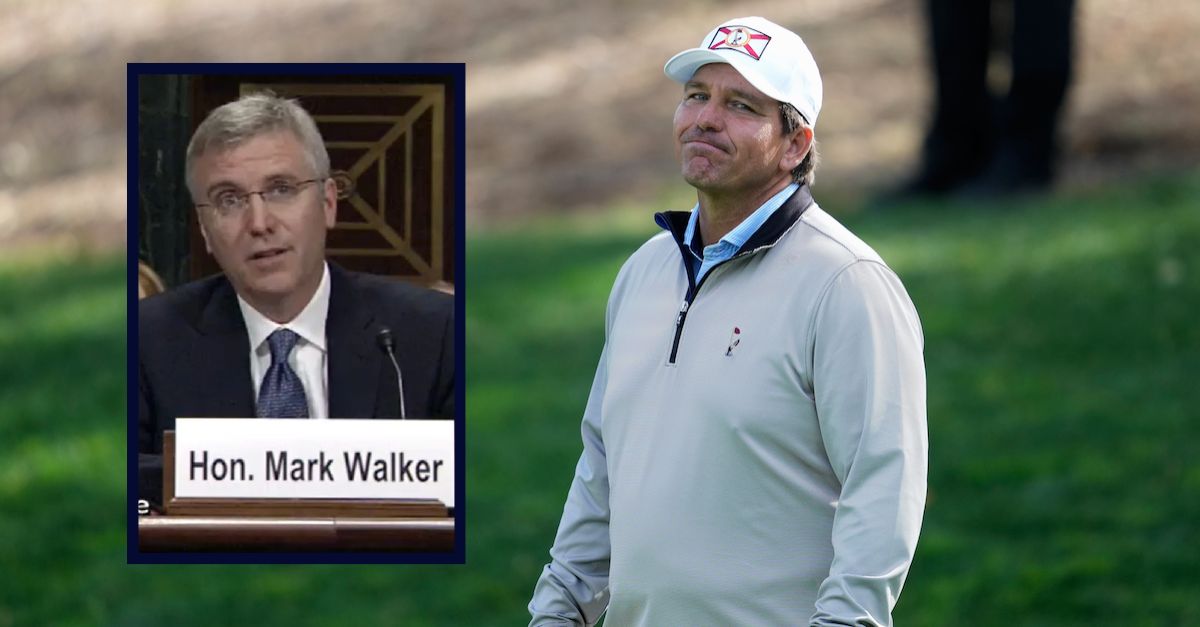
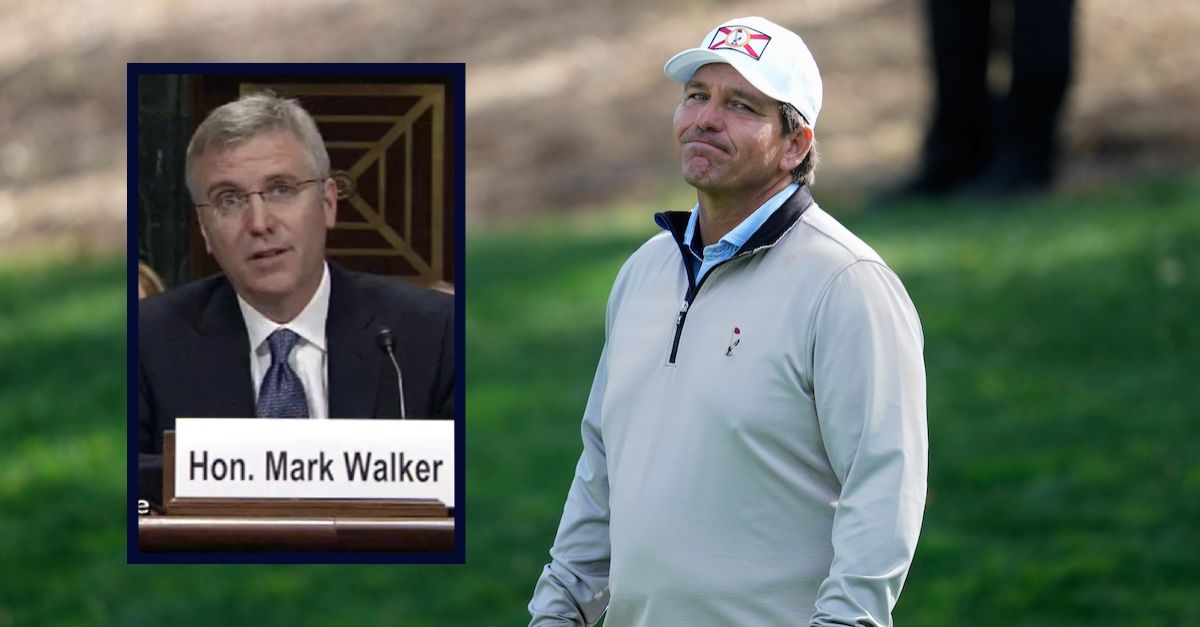
Left inset: Judge Mark Walker testifies before Senate Judiciary Committee in 2012 (U.S. Senate). Main: Florida Gov. Ron DeSantis stands on the 16th fairway at Spyglass Hill Golf Course during the second round of the AT&T Pebble Beach Pro-Am golf tournament in Pebble Beach, Calif., Friday, Feb. 13, 2026 (AP Photo/Godofredo A. Vásquez).
A federal judge blocked Florida”s Republican Gov. Ron DeSantis from enforcing his executive “decree” against the Council on American-Islamic Relations (CAIR), concluding that the order to designate the group a “terrorist organization” violated the First Amendment and “bears all the hallmarks of unconstitutional coercion.”
In a 30-page order on Wednesday, U.S. District Judge Mark Walker issued a preliminary injunction, writing that DeSantis and his agents or employees “must take no steps to enforce” his executive order against CAIR.
“The question before this Court is whether the Governor can, in a non-emergency situation, unilaterally designate one of the largest Muslim civil rights groups in America as a ‘terrorist organization’ and withhold government benefits from anyone providing material support or resources to the group. This Court finds he cannot,” Walker began. “The First Amendment bars the Governor from continuing the troubling trend of using an executive office to make a political statement at the expense of others’ constitutional rights.”
Walker, a Barack Obama appointee with whom DeSantis has clashed on numerous occasions in court, tore into the governor once again for “choosing to be a bully.”
“Unfortunately, in this instance, Defendant is choosing to be a bully—in the familiar sense of the term—from his pulpit. While Defendant certainly has the right to speak for himself and his office, to select the views he wishes to express, and to attempt to persuade the public to share his views, the Supreme Court has drawn a line between permissible persuasion and unconstitutional coercion. As explained in more detail below, Defendant has crossed that line,” the judge said, upbraiding the governor for embracing “political posturing over the First Amendment.”
“Political grandstanding does not an emergency make. Defendant’s EO amounts to unconstitutional First Amendment coercion and Defendant has provided nothing to overcome the presumption of unconstitutionality,” the judge said.
CAIR, which states that its mission is to “protect civil rights, enhance understanding of Islam, promote justice, and empower American Muslims,” sued in December over the designation. The court filing claimed that executive order 25-244, “Protecting Floridians from Radical Islamic Terrorist Organizations,” was a “punitive, discriminatory action” and that the state governor “usurped the exclusive authority of the federal government to identify and designate terrorist organizations by baselessly declaring CAIR a terrorist organization.”
In the order, DeSantis made like Sen. Tom Cotton, R-Ark., and declared that CAIR’s “ties to Islamic extremist groups,” mentioning Hamas and the Muslim Brotherhood by name, made it, and those who provide the organization with “material support” or “expert advice or assistance,” ineligible for “any contract, employment, funds, or other benefit or privilege from such Executive or Cabinet Agency or any entity regulated by such Executive or Cabinet Agency or from any County or Municipality of the State.”
Ultimately, Walker found the plaintiff had standing to sue over the order’s “coercion of third parties to cut ties” with CAIR, a form of “indirect censorship” and a prior restraint. Citing a “Florida-based production company[‘s] withdr[awal] from an agreement to produce a podcast with Plaintiff because of the EO,” the judge said the “speech injury is concrete and neither speculative nor conjectural” and that an injunction was “substantially likely” to “redress” that harm.
“Defendant offers no evidence to show how cutting off benefits to third parties who engage with Plaintiff in any way furthers an interest in protecting public health and safety,” Walker wrote. “By threatening the production company—indeed, by broadly threatening anyone who wishes to do business in Florida—Defendant stifles Plaintiff’s speech.”
In a parting shot buried in a footnote, the judge said it “pains” him to “have to point out that not all Muslims are terrorists.”
“It should be lost on no one that Defendant’s EO targets one of America’s largest Muslim civil rights organization for indirect suppression of speech. But, as we all know, it is easy for those in power to target minority groups with little pushback. Sadly, history teaches that it is often minority religious groups who find themselves in the crosshairs. And here, the Muslim community presents an especially easy target for Defendant, inasmuch as they make up less than 1% of Florida’s population,” the order said.
While DeSantis’ office didn’t immediately react to the adverse ruling, and with the possibility of an appeal, CAIR litigation director and general counsel Lena Masri and CAIR-Florida executive director Hiba Rahim said enforcement of DeSantis’ “lawless proclamation” has been rightly blocked.
“[N]o governor has the right to violate the Constitution by unilaterally declaring an American organization whose speech he dislikes a ‘terrorist’ group and then punish them and their supporters, all without due process,” the statement said. “The right to free speech is one of the Constitution’s most fundamental guarantees. CAIR and CAIR-Florida will, God willing, continue to stand as a shield for the American Muslim community and defend free speech, religious freedom and due process for everyone in our nation.”


