
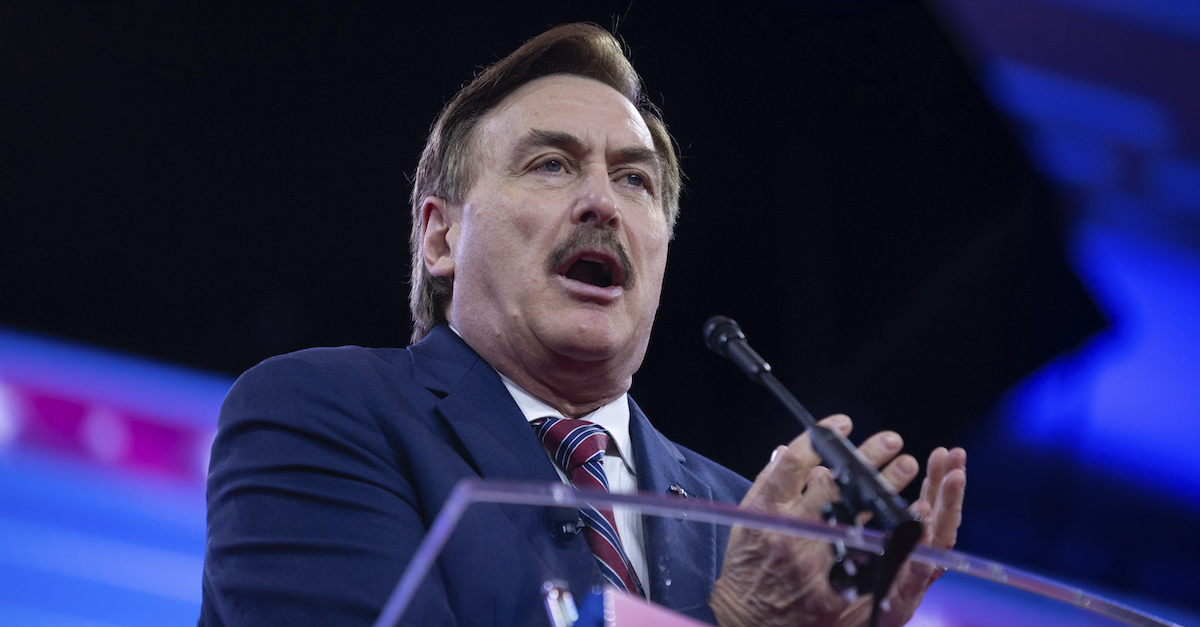
Mike Lindell, CEO Of MyPillow Speaks At CPAC On The Final Day Of The Conservative Conference, February 24, 2024, in National Harbor, USA (Photo by Zach D Roberts/NurPhoto via AP).
MyPillow CEO Mike Lindell has refused for over a year to pay more than $56,000 in sanctions after making “frivolous” claims against Smartmatic and the 2020 election. Now the voting machine company is urging a judge to hold Lindell in civil contempt and “coerce his compliance” by issuing a “daily penalty” until he pays in full.
The 14-page filing rips Lindell”s “claimed indigence” and nonpayment as nonsensical, given that he is running for governor in Minnesota, has raised hundreds of thousands of dollars in legal defense funds, flew business class last month to the “luxury ski resort town” of Aspen, and continues to boost claims of “confidential whistleblowers” connected to failed “Kraken” election lawsuits of 2020.
“His filing represents the latest iteration of a delay tactic spanning nearly five years. This is not an inability to pay. It is a calculated refusal to pay. Only the threat of contempt will move him to comply,” Smartmatic told U.S. District Judge Carl Nichols on Monday.
Nichols, a Donald Trump appointee, threatened in recent weeks “further contempt sanctions” beyond the $56,369 sum he ordered Lindell to pay more than a year ago. In doing so, the judge ordered Lindell and his counsel Chris Kachouroff to explain “why he has not complied.”
Lindell submitted a filing under seal on Jan. 19, apparently repeating claims that he is unable to pay the sanctions. According to Smartmatic’s telling, however, Lindell veered from the questions about his finances into a retelling of stolen election conspiracy theories.
In 2020, Smartmatic’s technology was used only in Los Angeles County, a county then-candidate Joe Biden easily won. Nonetheless, President Donald Trump’s allies pushed the notion that the company was tied to deceased Venezuelan president Hugo Chavez and could have played a role in stealing the election, leading to defamation lawsuits.
Lindell’s latest filing not only waded back into those waters, but also attempted to claim the DOJ’s October indictment of the company for alleged bribery and money laundering in the Philippines in 2016 was relevant to the discussion of his noncompliance with a court order, Smartmatic said.
“Unable to establish financial inability to pay, Mr. Lindell attempts distraction with inflammatory allegations — an unrelated indictment of Smartmatic executives and wild, unsubstantiated ‘confidential witness’ statements — neither of which bears on his obligation to comply with this Court’s order,” the filing continued.
While Lindell claimed the “confidential witness” or “whistleblower” statements were court “testimony” supporting his allegations about the 2020 election, the record shows that’s “misleading at best, and at worst, a deliberate fabrication,” Smartmatic said, connecting one person to incarcerated Lindell ally Tina Peters and the other to indicted Michigan “Kraken” attorney Stefanie Lambert and election-denying Barry County Sheriff Dar Leaf.
“First, these ‘confidential whistleblowers’ did not ‘testify’ in any federal district court cases. Rather, to the extent they exist, these individuals were interviewed ex parte outside the presence of a Court or opposing counsel. The first ‘whistleblower’ was interviewed by John Case, attorney for former Mesa County, Colorado Clerk Tina Peters, with no opposing counsel or court reporter present,” the filing stated. “The second ‘whistleblower’ was interviewed by Michigan attorney Stefanie Lambert, and Sheriff Dar Leaf of the Barry County Sheriff’s Office in Michigan. This interview too, was taken outside the presence of a court or opposing counsel.”
Smartmatic said the second “whistleblower” cited an affidavit that was used as part of Sidney Powell’s failed Georgia, Arizona, and Michigan “Kraken” cases. Lambert served as local counsel in the Michigan case King v. Whitmer and was initially sanctioned for her involvement, though that was later reversed.
“Each of these suits was dismissed. In fact, in its initial Motion to Sanctions, Smartmatic cited these cases as examples of frivolous lawsuits challenging the results of the 2020 election without any evidence,” the filing continued, directly pointing to King v. Whitmer.
Tired of “blatant disregard” and vague claims of “financial distress,” Smartmatic asked Nichols to ensure that Lindell’s “pattern of routinely ignoring this Court’s orders” be put to an end.
“Mr. Lindell’s instant response demonstrates precisely what Smartmatic foresaw: a claim of inability to pay born of disregard for this Court’s orders, rather than genuine financial hardship. Mr. Lindell will not pay unless and until the Court compels him to do so through contempt,” Smartmatic said. “Without meaningful enforcement, a litigant who files frivolous claims faces no real consequences: dismissal, yes, but no financial accountability if he simply refuses to pay sanctions and forces his opponent to shoulder the burden of collection.”
Accusing Lindell of “weaponiz[ing] the civil litigation process” while “claiming poverty,” the company slammed his “inflammatory accusations and baseless claims as distraction” and encouraged Nichols to hold Lindell in contempt and make him face a “daily penalty” until he pays.
“Mr. Lindell offers no evidence but rather provides merely an unsupported statement of insufficient funds. He provides neither documentation nor explanation for failing to deposit the funds into escrow as directed. In the year since the Court set the sanctions amount, Mr. Lindell has raised hundreds of thousands of dollars for his legal defense,” Smartmatic said. “He continues to solicit donations for his various causes, and as recently as January 2026, he was observed traveling business class to a luxury ski resort town. His filing represents the latest iteration of a delay tactic spanning nearly five years.”


