
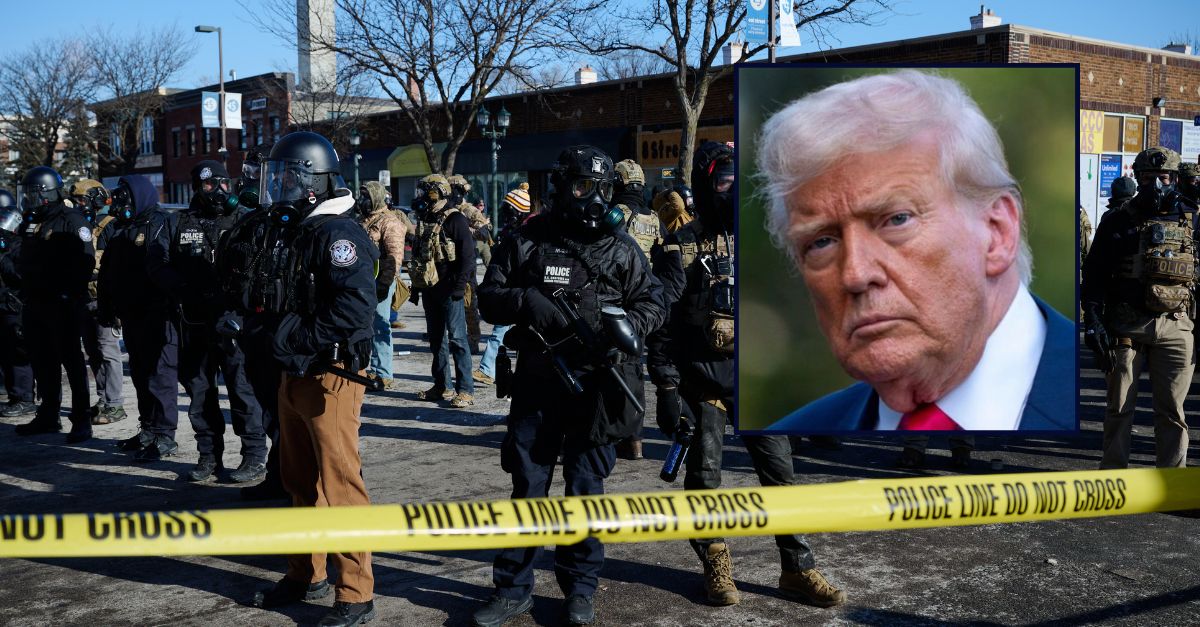
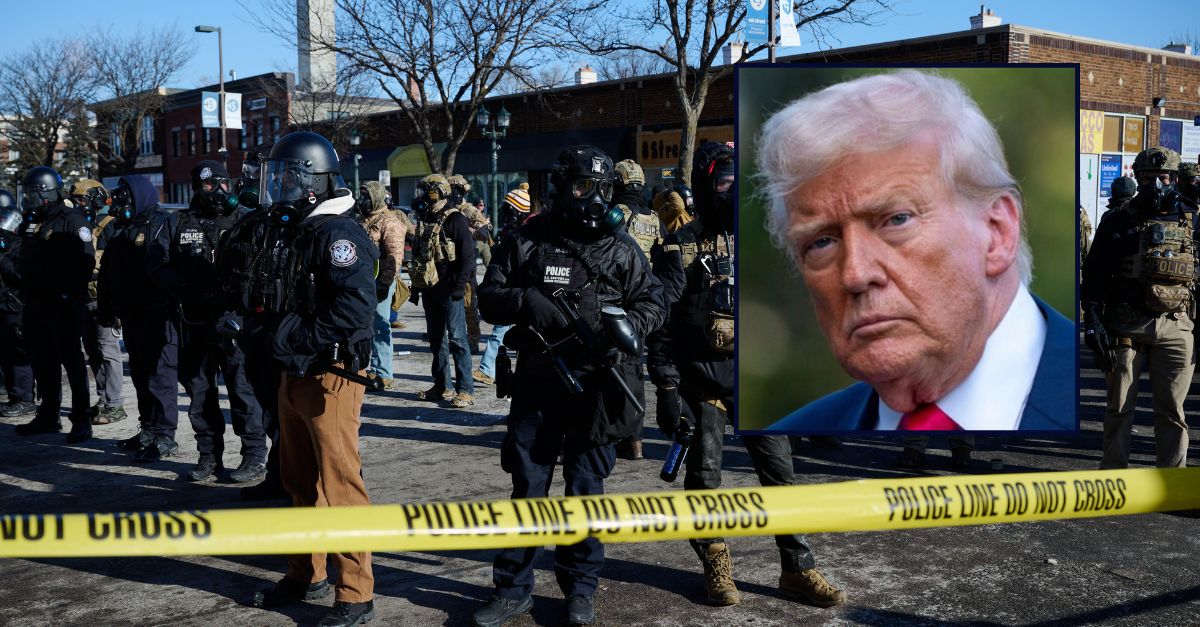
Inset: President Donald Trump walks from Marine One after arriving on the South Lawn of the White House, Tuesday, July 15, 2025, in Washington (AP Photo/Alex Brandon, File). Background: Demonstrators gather in south Minneapolis, Minnesota, on January 24, 2026, after a man is shot and killed by U.S. Immigration and Customs Enforcement agents earlier that morning, according to officials. (Christian Zander/NurPhoto via AP).
A federal judge in Utah dealt the Trump administration a loss after immigration agents attempted to deport a man who was arrested for an alleged drug crime that turned out to be nothing of the sort.
The nine-page order offers a novel variation on a recent theme of numerous district court judges rejecting controversial efforts to reshape how Immigration and Customs Enforcement (ICE) classifies immigrants in order to detain them.
The petitioner, Lorenzo Chavez Rascon, won a temporary restraining order in a habeas corpus case by convincing U.S. District Judge Robert J. Shelby, a Barack Obama appointee, that “emergency relief” was necessary “to ensure” that his “due process rights are not violated.”
In 2017, Chavez – then a minor – entered the country with his family and immediately applied for asylum. Then, during the litigation of the asylum case, Chavez applied for a U-visa, which the court refers to as “a type of temporary visa available to certain undocumented persons within the United States who cooperate with law enforcement.”
In early February, U.S. Customs and Immigration Services (USCIS) determined his visa petition was “bona fide,” the judge notes. During the waiting period when such a determination is made, the government is allowed to grant deferred action status – a form of status that will put a halt on any deportation proceedings.
In late February, Chavez was arrested by authorities in Utah over a suspected drug sale. That arrest proved unnecessary.
“However, the narcotics involved in the suspected sale were later determined to be dried pinto beans,” the court explains.
Still, ICE learned of the arrest and used the opportunity to issue an immigration detainer “for the jail to continue detaining Chavez so ICE could take custody,” according to the order.
On March 3, attorneys representing Chavez simultaneously filed a petition for a writ of habeas corpus – to secure his release – and a motion for a temporary restraining order – to keep ICE from deporting him and to secure his access to legal counsel.
Then, ICE detained him.
“While the court was reviewing the Original Petition, the state dismissed the charges against Chavez, and ICE took custody of Chavez from the Salt Lake County Jail,” the order notes.
The court makes short work of the underlying arrest.
“While Chavez was arrested by state police on charges related to selling narcotics (in and of itself grounds for detention and removal), Chavez was not charged by the State of Utah with any crime,” Shelby goes on. “The alleged narcotic proved to be pinto beans.”
To that end, because the initially alleged crime literally amounted to a pile of beans, the court says the government does not really have any actual reason to suggest that Chavez”s deferred action status “has been revoked or is expected to be revoked.” And that means his deportation is far from happening – if it ever comes at all.
From the order, at length:
Here, it appears that Chavez’s deferred action status makes removal unforeseeable, and therefore unreasonable. Chavez appears to have deferred action status from his February 2026 USCIS determination finding he presented a bona fide U-visa petition. Because there is currently a severe backlog of U-visa petitions, it is likely that he will remain in deferred action for many years to come. As such, his immigration proceedings and removal would certainly not be considered foreseeable.
In light of the faulty arrest and intact status, the “government has not yet identified a removable federal offense,” the judge notes.
“Deferred action may not be rescinded arbitrarily,” Shelby goes on. “Absent any such reasonable grounds for revocation, based on the record before the court, Chavez has met his burden to show a likelihood of success on the merits that the government is detaining him indefinitely while keeping him in deferred action status in violation of 8 U.S.C. § 1226(a) and the Constitution.”
The court goes on to explain why, at least for now, Chavez wins:
Chavez’s continued detention—if indeed unlawful—constitutes an irreparable harm…Here, Chavez alleges that his detention violates his rights of due process under the Fifth Amendment. “Freedom from imprisonment—from government custody, detention, or other forms of physical restraint—lies at the heart of the liberty that [the Due Process] Clause protects.” Chavez’s detention thus concerns a fundamental constitutional right, and he is also likely to prevail on the merits of his claim against the asserted constitutional violation. And throughout this process, he has been denied access to communications with his lawyer. Altogether, these injuries satisfy the requirement for irreparable harm necessary to obtain emergency relief
Ultimately, the court ruled on the temporary restraining order while setting tight deadlines to dispense with the habeas petition.
First, the judge issued a show cause order directing the DOJ to respond to the petition by the end of the day on Thursday. This means the government is being put on the back foot and must explain why the writ should not be issued. Then, the petitioner will have a chance to file a reply by Friday evening. Finally, if the judge has any remaining concerns after those responses are filed, a hearing will be scheduled.
In the meantime, ICE is prohibited from trying to deport Chavez and must provide “meaningful and timely access to communicate with his counsel within 24 hours of providing counsel notice of his location.”


