
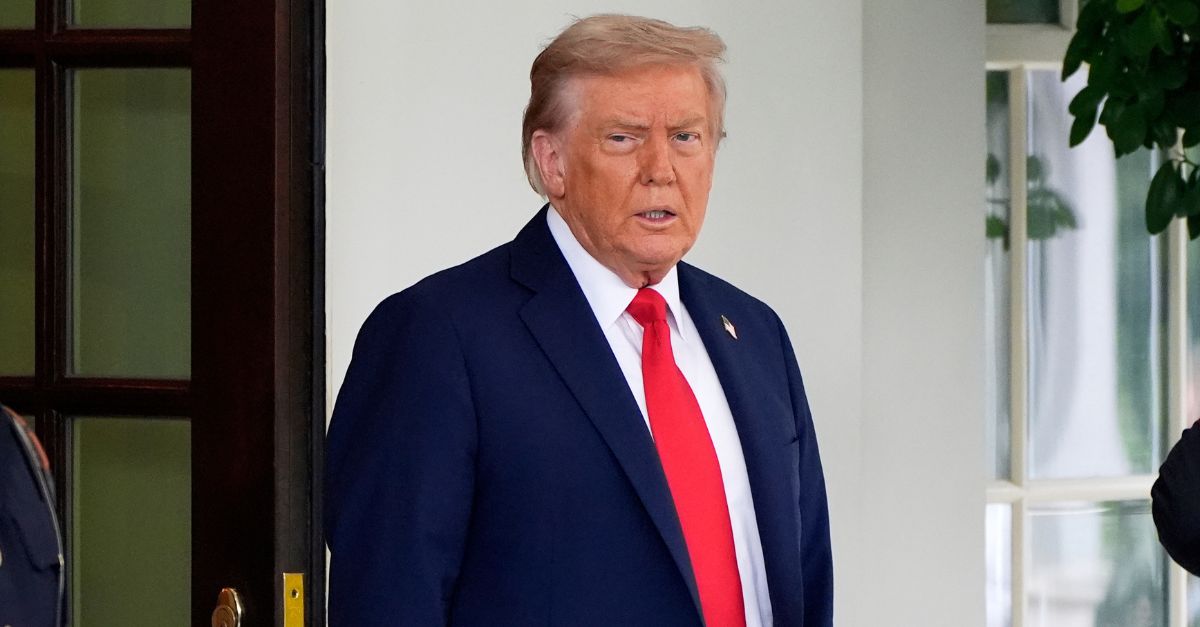
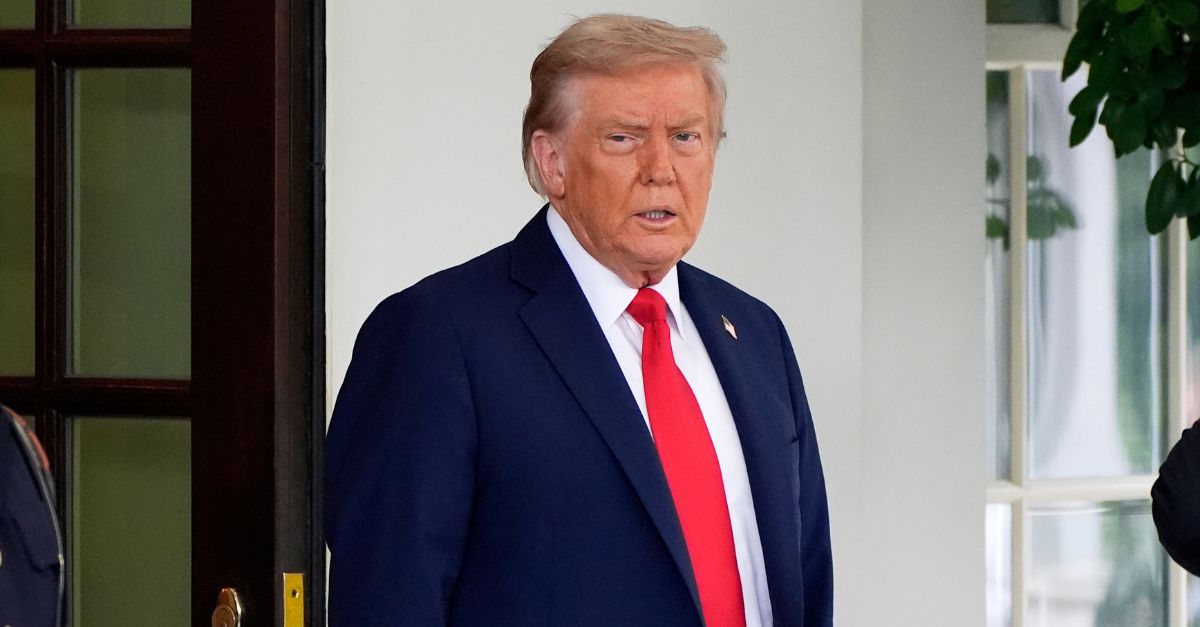
President Donald Trump stands outside the White House, Monday, Aug. 18, 2025, in Washington. (AP Photo/Alex Brandon).
A federal judge in Florida on Monday issued a forceful criticism of the Trump administration“s immigration detention policy – and an equally trenchant condemnation of how the U.S. Department of Justice is arguing in favor of such policies in court. To that end, the judge threatens sanctions over the DOJ’s lawyering in the Middle District.
The ruling comes in a case about the Trump administration’s often-litigated efforts to reshape how Immigration and Customs Enforcement (ICE) classifies certain immigrants in its custody.
The petitioner won habeas corpus release in relatively short order after U.S. District Judge Roy B. Dalton Jr., a Barack Obama appointee, took stock of the facts and the legal issues at stake.
On Jan. 7, Javier Gimenez Rivero, a high school student, was arrested and detained in the Orange County Jail. On Jan. 13, the petition for writ of habeas corpus was submitted by his attorneys. On Jan. 21, Dalton issued a bench ruling ordering the Venezuelan man’s release. Now, the court is taking the opportunity to memorialize the release order.
And then some.
While the 16-page order is putatively about showing the court’s work, Dalton also takes the opportunity to upbraid the Sunshine State’s highest-placed DOJ officials — U.S. Attorney Gregory W. Kehoe and Assistant U.S. Attorney Joy Warner — and orders them to show cause for why they should not be sanctioned.
The judge quickly dispenses with the upshot of the order.
“This Order resolves one of many cases flooding the courts in which the Government unlawfully detained a noncitizen who has been present in this country for years,” Dalton begins. “This Court does not have the power to impede removal proceedings, but it does have the power to ensure that the Government follows the law when it detains people. It did not, so the Court ordered Petitioner’s immediate release. In this country, we don’t enforce the law by breaking the law.”
To hear the judge tell it, the Trump administration has more or less confused the relevant laws at issue — in terms of both jurisdiction and on the merits of the case itself.
After Gimenez Rivero was arrested, he contested his detention. But in a recent court filing, the DOJ said the court had no jurisdiction to hear the case because Gimenez Rivero was contesting his removal.
The court notes that those are entirely different notions — and suggests the government intentionally conflated the two notions.
From the order, at length (emphasis in original):
This argument beggars belief and appears to deliberately mislead the Court about the law and the record … Here, Gimenez Rivero explicitly challenges the basis for his detention, not the decision to commence removal proceedings. The Government’s argument to the contrary is, in a word, inexplicable. As a factual matter, challenging the decision to commence removal proceedings would have been a rather difficult thing for Gimenez Rivero to do in the Petition…given that removal proceedings were not actually commenced until days after he filed the Petition.
Dalton goes on to describe the DOJ’s merits arguments as “similarly ill-informed.”
The government claims ICE has the authority to subject Gimenez Rivero to mandatory detention under 8 U.S.C. § 1225(b).
Not so, the judge noted.
That statute only applies to “aliens seeking entry into the United States.” And, the judge pointed out, Gimenez Rivero has been living in the country for several years. Rather, the court explains, the relevant statute for such an immigrant would be 8 U.S.C. § 1226(a), which applies to “aliens already present in the United States.”
In essence, the Trump administration prefers the detention authority under § 1225(b) because of its indefinite nature — and has largely eschewed arguing for detention authority under § 1226(a) because immigrants are subject to parole while their cases move forward under that statute.
Notably, and Dalton himself does note, the former statute has been the consistent locus of Trump administration arguments in favor of detention but has been swatted down by judges time and time again.
“Judges across the country—the vast majority who have considered this question—have told the Government many times in the past few months that its interpretation of the law is wrong,” the order goes on. “This is no partisan stance: judges appointed by every President from Ronald Reagan through Donald Trump have said so.”
Indeed, Dalton notes, in the present case, the DOJ did not even bother to argue for keeping Gimenez Rivero under § 1226(a).
That decision made the case an easy call.
“The Government had an opportunity to argue in the alternative that Petitioner was subject to detention under § 1226; it did not,” the order continues. “With the Government having asserted no lawful basis for his detainer, this Court could only conclude that Gimenez Rivero was entitled to immediate release.”
But the court said the petitioner’s release was not the only problem to deal with.
“Gimenez Rivero’s immediate release provides him with the remedy he deserves,” Dalton bristles in the order. “But it does not remedy everything that happened in this Court.”
Here, the judge is unsparing of the DOJ’s arguments.
Again, the order, at length:
Every attorney who presents a filing to the Court represents that the factual contentions have evidentiary support and the legal contentions are warranted, If the Government is going to argue for expanding the interpretation of a law or maintain a widely rejected position to preserve its appellate rights, it may do so. But its lawyers must make those arguments in a way that comports with their professional obligations, as lawyers have done since time immemorial: Cite the contrary binding authority and argue why it’s wrong. Don’t hide the ball. Don’t ignore the overwhelming weight of persuasive authority as if it won’t be found. And don’t send a sacrificial lamb to stand before this Court with a fistful of cases that don’t apply and no cogent argument for why they should.
“Members of this Bar have a duty of candor to the Court,” the order concludes. “The Government’s response does not meet that standard. So [Kehoe and Warner], must show cause why they should not be sanctioned.”


