
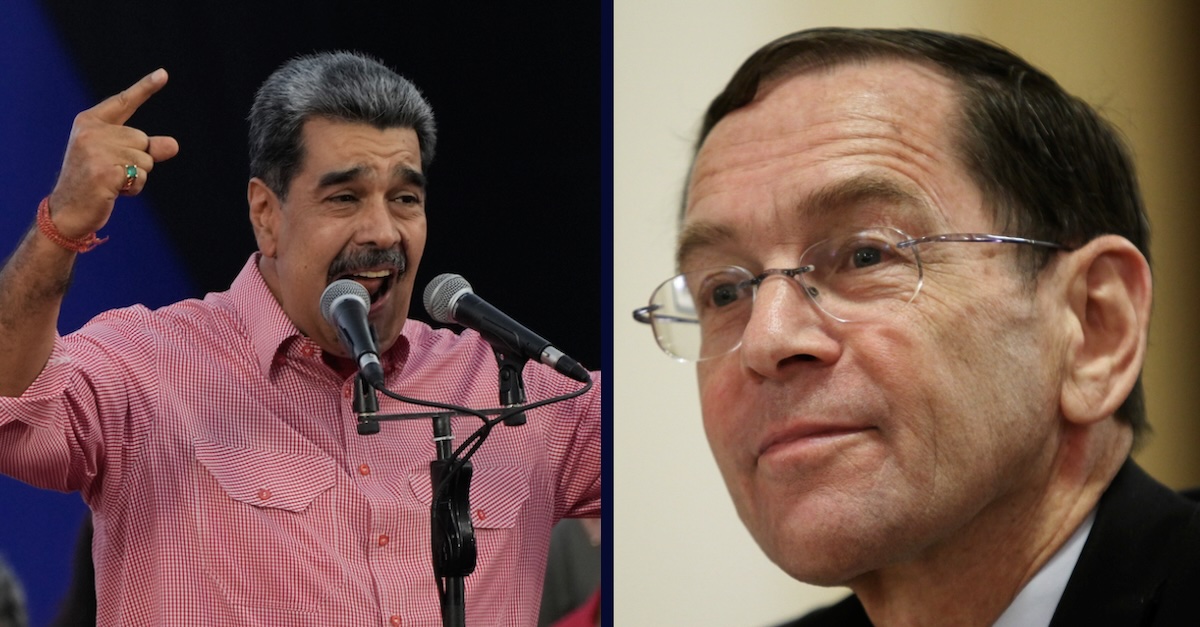
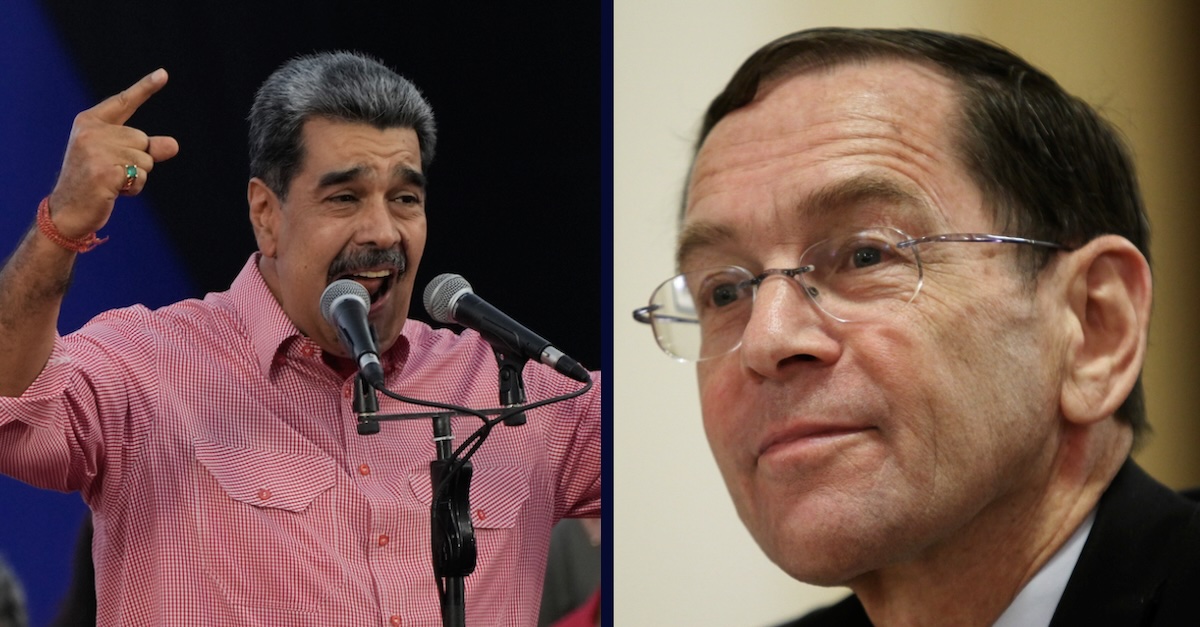
Left: Venezuelan President Nicolas Maduro addresses civilians taking an oath to join a state-organized defense network in the Petare neighborhood of Caracas, Venezuela, Saturday, Nov. 15, 2025 (AP Photo/Ariana Cubillos). Right: Bruce Fein testifies on Capitol Hill in Washington, April 1, 2009. (AP Photo/Manuel Balce Ceneta, File).
Just days into the Trump administration”s narco-terrorism case against captured and deposed Venezuelan leader Nicolas Maduro, two high-profile additions have been made to his legal team. Oddly, one of those lawyers, who famously represented WikiLeaks’ Julian Assange, is now saying the other has no business being involved at all.
It all started on Tuesday, when Bruce Fein, once the associate deputy attorney general and FCC general counsel during the Ronald Reagan administration, filed a motion to be added to the case pro hac vice, meaning for this occasion only. Such an application, for permission to practice in a jurisdiction where one is not licensed, is generally a yawner, provided that the attorney is in “good standing.”
Federal judges routinely grant pro hac vice admissions, and that’s what Senior Judge Alvin Hellerstein did the next day for Fein, writing, “It is hereby ordered that Applicant is admitted to practice pro hac vice in the above-captioned case in the United States District Court for the Southern District of New York.”
Then came the headlines — “Maduro hires Reagan-era DOJ attorney in narco-terrorism case,” “Venezuela’s Maduro Adds Ex-Reagan Era DOJ Lawyer to Legal Team” — and then came the posts on X about the addition of a “constitutional law mastermind.”
Fein was also quoted at length in Turkish media, which described him as “Maduro’s lawyer,” on the U.S. raid in Venezuela to capture and arrest Maduro.
“If you allow courts to benefit from an unlawful kidnapping, you are granting states a license to commit crimes and then claim that the end justifies the means,” he reportedly said. “At that point, no one will be safe.”
But there was just one problem, according to Maduro attorney Barry Pollack, a prominent criminal defense lawyer who reached the plea deal that brought Assange’s long-running Espionage Act case to an end.
Fein was not “authorized” to “hold himself out as” Maduro’s lawyer but did so anyway, Pollack told the judge Thursday in a motion to strike Fein’s appearance from the record.
“I did not authorize Mr. Fein to communicate with Mr. Maduro, a represented party; nor did I authorize him to file a notice of appearance on behalf of Mr. Maduro,” Pollack said in his declaration. Pollack noted that he, not Fein, appeared for Maduro in court Monday when the defendant and his wife Cilia Flores pleaded not guilty. Nonetheless, the attorney said, Fein attempted to enter the case the next day even though no one, including Maduro, “authorized” that action.
“[N]either undersigned counsel, nor anyone acting on his behalf, has authorized Mr. Fein to appear on behalf of Mr. Maduro,” the motion said. “Mr. Maduro has not retained Mr. Fein nor authorized him to hold himself out as Mr. Maduro’s counsel. Mr. Maduro has authorized undersigned counsel to move to strike Mr. Fein’s appearance.”
In a declaration submitted under penalty of perjury, Pollack added that he attempted to contact Fein by phone and email about the “basis on which he entered an appearance” but received no response.
During a “legal call” with Maduro himself on Thursday, the declaration detailed, Pollack confirmed that the high-profile defendant clarified “that he does not know Mr. Fein and has not communicated with Mr. Fein, much less retained him, authorized him to enter an appearance, or otherwise hold himself out as representing Mr. Maduro.”
Instead, Maduro “authorized” Pollack to file the motion to strike, the declaration concluded.
CNN’s Evan Perez reported Thursday, however, that Fein responded by saying of the situation, “It’s a mess,” and that a court filing would follow.
Asked if there was a misunderstanding, Bruce Fein tells me: “It’s a mess.” Fein says he will be filing a response to Pollack’s claim that he didn’t authorize Fein to file a notice to represent Nicolas Maduro. https://t.co/q5UO9tqMmn
— Evan Pérez (@evanperez) January 9, 2026
Law&Crime separately reached out to both Pollack and Fein for comment about this confusing turn of events in the early stages of the Maduro prosecution, but no response was forthcoming by the time of publication.


