
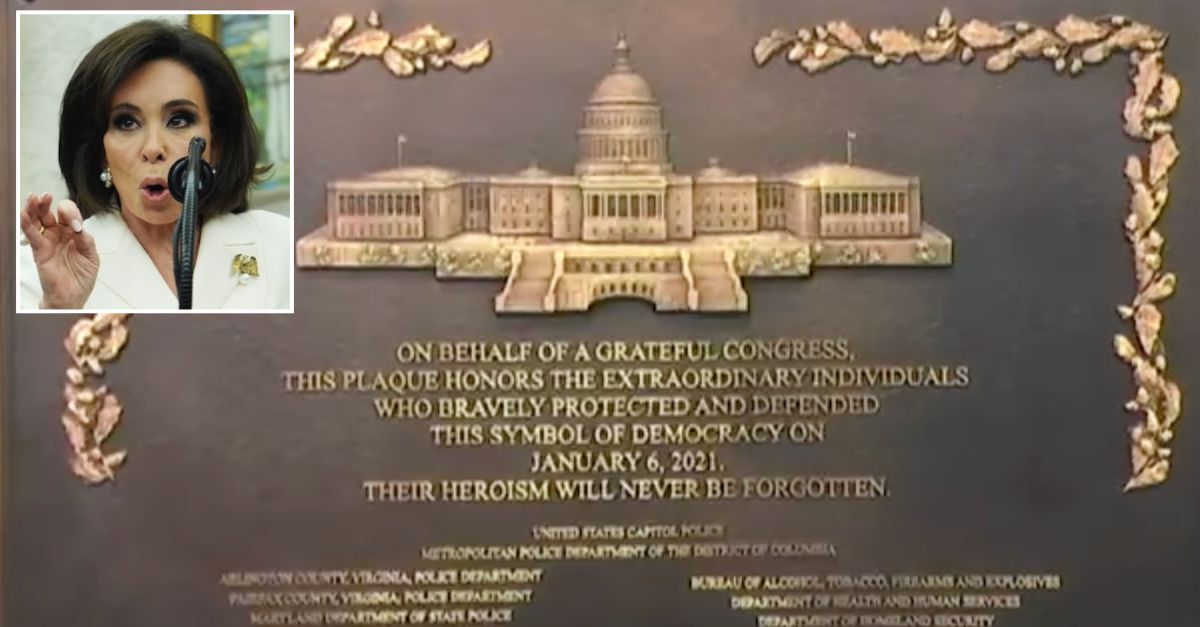
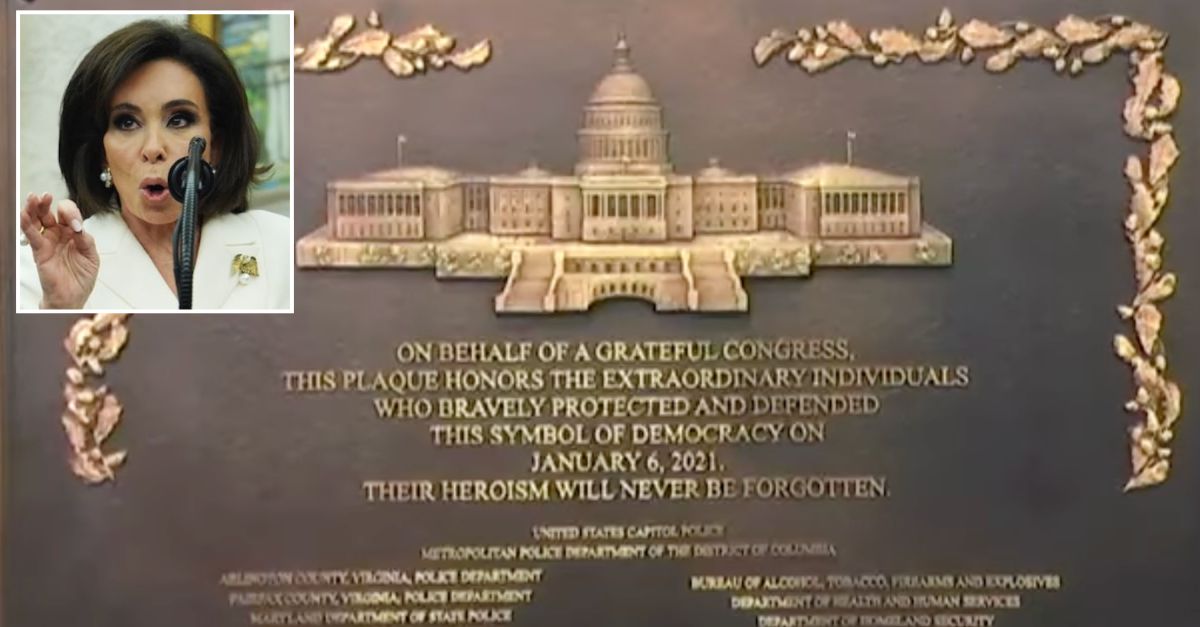
Background: The plaque designed to commemorate the law enforcement officers who protected the Capitol and those inside during the Jan. 6, 2021, insurrection (House Homeland Security Committee). Inset: Then-Interim U.S. Attorney for the District of Columbia Jeanine Pirro, right, speaks during her swearing in ceremony, Wednesday, May 28, 2025, in Washington (AP Photo/Evan Vucci).
The plaque created to honor the law enforcement officers who protected the Capitol and the representatives inside it on Jan. 6 is defective, the Trump administration contends, and the lawsuit filed to force it to be hung should be thrown out.
U.S. Capitol Police officer Harry Dunn and Metropolitan Police officer Daniel Hodges cannot prove they have been harmed due to the memorial not being hung, and even if they could, its installation would not resolve any of their injuries, the Department of Justice (DOJ) argued in a 12-page motion to dismiss filed Tuesday.
Love true crime? Sign up for our newsletter, The Law&Crime Docket, to get the latest real-life crime stories delivered right to your inbox.
In March 2022, Congress enacted legislation to create a plaque to honor the officers “who valiantly protected the United States Capitol, Members of Congress, and staff on January 6, 2021,” as the filing recounts. The marker was to be provided to the Architect of the Capitol and then “place[d]” at a “permanent location on the western front of the United States Capitol.”
However, now more than three years on, it has been created — but not yet hung. Dunn and Hodges filed their lawsuit in June, seeking to compel its installation and arguing they have suffered harms “compounded by the government”s refusal to recognize their service,” including death threats.
However, the DOJ holds that there are several problems with the men’s case.
“Plaintiffs contend that the Architect has failed to comply with the Act because it has been several years since the Act’s enactment and a plaque has not yet been placed on the western wall of the Capitol within the period required by the statute,” the DOJ writes. “But even were the Court to assume noncompliance with the statute for purposes of evaluating standing, Plaintiffs still must plausibly plead facts establishing that they have experienced concrete harm, that their harm is fairly traceable to the alleged non-compliance, and that their alleged harm would be redressable by compliance with the statute.”
“Here, Plaintiffs have failed to plausibly plead concrete harm to them due to the Architect’s alleged non-compliance with the statute,” U.S. Attorney Jeanine Pirro writes in the motion.
Even if the court were able to find standing that the alleged harms were real, it would not be able to tie them to the Architect’s actions, Pirro continues. “Plaintiffs have not alleged facts that could raise a plausible inference that these alleged harms would cease or be materially reduced were an honorific plaque installed.”
Furthermore, the men have shown nothing “that would allow the Court to plausibly infer that the further act of installing an honorific plaque would ameliorate any of their alleged harms which either arose from the events of January 6, 2021, or flow from the subsequent independent acts of parties not before the Court,” the filing states.
Not only have Dunn and Hodges not shown signs of having suffered harm due to the memorial not being hung, but the commemorative marker itself is not in line with what Congress directed, the DOJ maintains. “As stated in the Complaint, the Architect testified before the House Appropriations subcommittee on April 8, 2025, and during this testimony the status of the plaque was raised,” the department recounts.
The plaque lists roughly 20 law enforcement entities instead of the approximately 3,648 “individual names of law enforcement personnel” given to the Architect of the Capitol, according to the filing. “Thus, the plaque referenced in that testimony is not the plaque directed by the statute.”
The memorial has become a source of contention between various groups in and around Washington, D.C. Dunn and Hodges accused the Trump administration of purposefully declining to hang the plaque, arguing that by doing so, it is encouraging “this rewriting of history.”
Roughly two weeks later, multiple Jan. 6 defendants asked that the honorary plaque also “recognize the experiences” of the over 1,500 defendants in the insurrection. Dunn and Hodges’ lawyers promptly responded by arguing these defendants “have no plausible claim” and that their intervention would be a legally baseless sideshow that would only tend to “cause unnecessary delay and prejudice.”


