
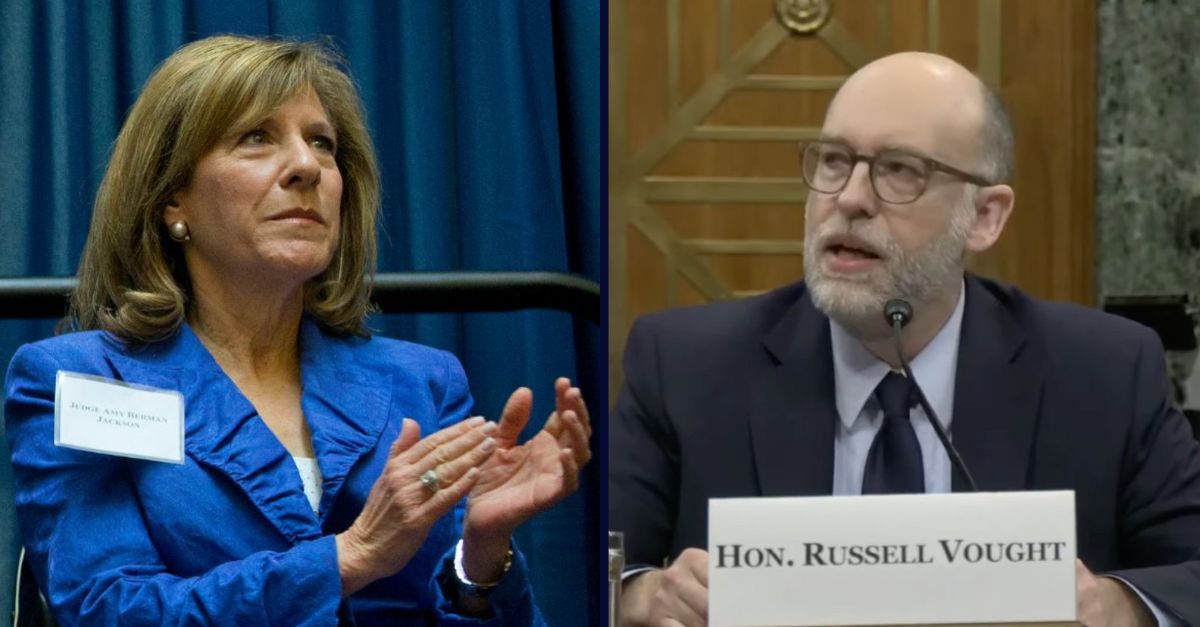
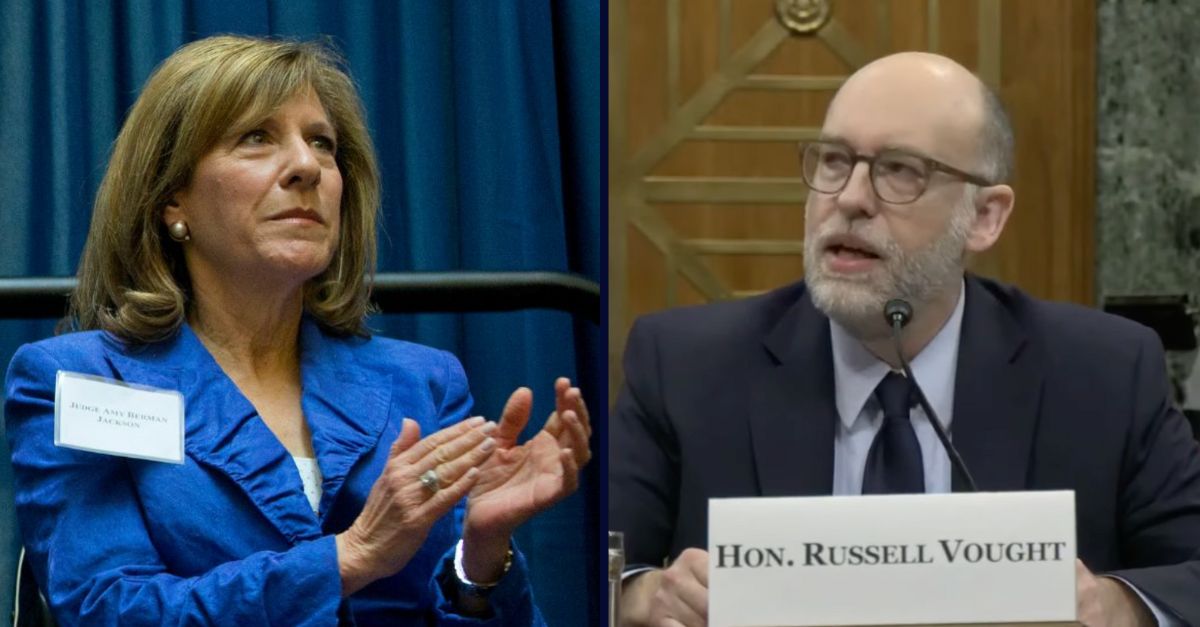
Left: Judge Amy Berman Jackson at an awards breakfast for pro bono counsel at the E. Barrett Prettyman Courthouse in Washington, Thursday, April 21, 2016. (AP Photo/Pablo Martinez Monsivais). Right: Russell Vought testifies before the Senate in January 2025 at OMB director confirmation hearings (PBS NewsHour/YouTube).
A federal judge cut right to the chase on Tuesday, using Russell “Russ” Vought”s words against him while seeing through his reliance on a DOJ Office of Legal Counsel (OLC) memo as a way to “starve” what’s left of the Consumer Financial Protection Bureau (CFPB) funding.
Vought, the director of the Office of Management and Budget (OMB), the acting director of USAID, a central figure in Trump’s Ukraine aid impoundment impeachment, and a Project 2025 luminary, has been open about his intentions for the CFPB agency he also heads as acting director — an agency Congress created by statute, in the Dodd-Frank Act, in the wake of the 2008 financial crisis.
If there was any question about where Senior U.S. District Judge Amy Berman Jackson’s ruling would go, the jurist remembered for presiding over Roger Stone’s trial provided a preview at the very top of her opinion, quoting October comments Vought made on the Charlie Kirk Show, one month after Turning Point USA co-founder Charlie Kirk was murdered while speaking at Utah Valley University.
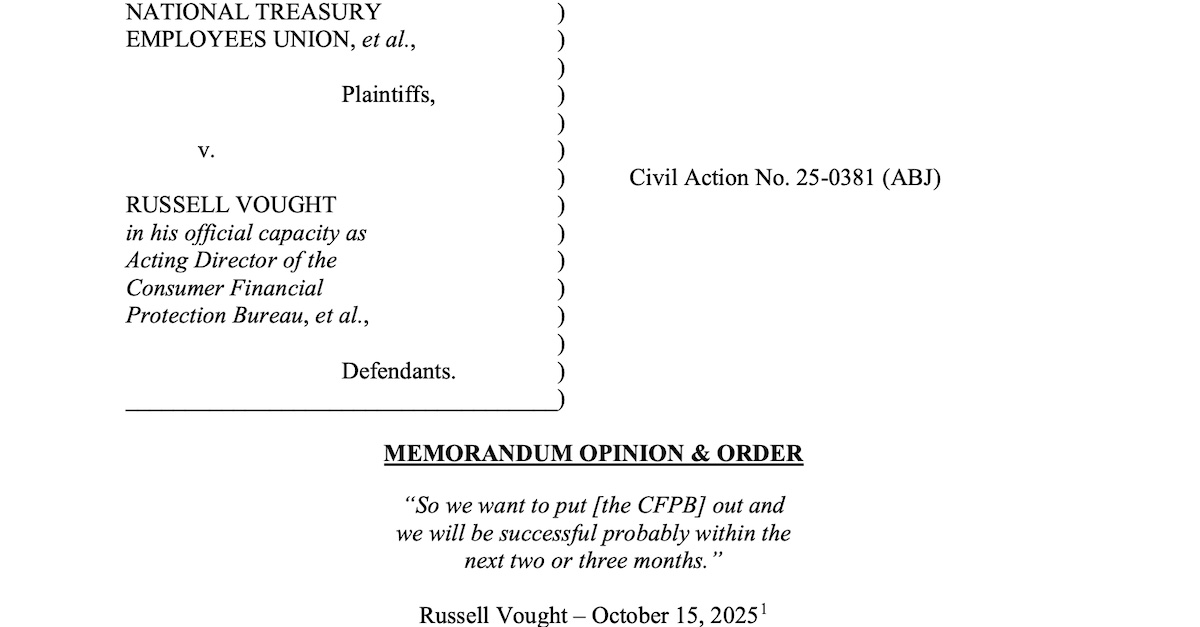
Judge Jackson immediately quotes Russ Vought’s stated intentions on the fate of the CFPB while ruling against him (court documents).
Before we get to Vought’s remarks, it’s worth recapping how the case at hand has gotten to this point.
In February, as the Trump administration sought to carry out mass firings and gut CFPB contracts, the National Treasury Employees Union (NTEU) filed a lawsuit, one which led Jackson the next month to worry out loud that the agency could be “choked out of its very existence” before she could rule on the merits.
Later in March, Jackson, a Barack Obama appointee, issued a preliminary injunction that the D.C. Circuit Court of Appeals would modify. The modification said the Trump administration could continue with reductions in force, or RIFs, provided that it made a “particularized assessment to be unnecessary to the performance” of the CFPB’s statutorily mandated duties.
Roughly one week later, after OMB swiftly moved to fire approximately “90 percent” of CFPB employees, Jackson issued another injunction to stop the firings — and the D.C. Circuit, in turn, moved to prevent the mass layoffs.
A majority panel consisting of President Donald Trump appointees in August vacated Jackson’s injunction for lack of jurisdiction, a decision the NTEU then sought to undo through a petition for a rehearing by the full — en banc — appellate court. As recently as Dec. 17, the D.C. Circuit granted that petition and vacated the three-judge panel’s ruling.
Before the en banc rehearing was granted, the NTEU plaintiffs asked Jackson to issue a key clarification, due to a notice Vought filed on Nov. 10.
In that notice, Vought warned of a “Potential Lapse in Appropriations to Pay the Expenses of the Bureau” and attached a DOJ OLC opinion that said he had “no statutory obligation” to seek funds from the Federal Reserve when it is operating “at a loss,” citing the lack of “combined earnings from which the CFPB can draw.”
The plaintiffs wanted the judge to say the Vought defendants “may not justify a violation of the preliminary injunction by refusing to request” funding from the Fed, and now Jackson has said as much.
Jackson concluded that the “flawed” memo not only “constitutes a sharp departure from the Bureau’s longstanding interpretation of its statutory funding procedure,” but also is “tantamount to closing what is left of the Bureau, bringing any performance of statutory functions and any remaining ongoing compliance with the terms of the preliminary injunction to a halt, even though the case has not yet been resolved on the merits” — the choking out of existence she feared from the get-go.
“[The memo] takes the position that the CFPB’s funding mechanism under 12 U.S.C. § 5947(a)(1), which establishes quarterly transfers from the ‘combined earnings of the Federal Reserve System,’ is unavailable when the Federal Reserve operates at a loss,” the judge explained. “Over the last few years, the Federal Reserve has raised interest rates to combat inflation, so while it has continued to earn billions of dollars, its interest expenses have exceeded its earnings since 2022. Notwithstanding the fact that the Federal Reserve has been consistently funding the CFPB throughout that period, the OLC opined that the Federal Reserve has no ‘earnings’ at all and cannot fund the CFPB, and the CFPB Director has ‘no statutory obligation’ to request funds from the Fed when it is not profitable.”
Jackson emphasized Tuesday that Vought couldn’t have been clearer in October about his intentions and what staffing at CFPB actually looks like, realities the judge said would be “foolhardy” to ignore.
“The instant motion was filed because Acting CFPB Director Vought, who is also the Secretary of the Office of Management and Budget, has docketed a notice informing the Court that, notwithstanding all of those protestations and orders, he has no intention of asking the Federal Reserve for the funding Congress determined the agency was legally entitled to receive,” Jackson said. “The reasons behind this are clear.”
The judge then quoted Vought’s remarks on the Charlie Kirk Show that she highlighted at the outset.
“We don’t have anyone working there except our Republican appointees and a few career [employees] that are doing statutory responsibilities while we close down the agency … We want to put it out – and we will be successful probably within the next two, three months,” Vought said.
Calling that a “candid statement” and adding that it “would be foolhardy not to take Russell Vought at his word,” the judge stated the DOJ OLC’s “new understanding of ‘combined earnings'” as a justification for Vought not to request Fed funds “contravenes the preliminary injunction.”
The CFPB, created by Congress, cannot be eliminated by the executive “with the stroke of pen,” the judge said, as that would allow the Trump administration to make the “unilateral decision” to “starve” the agency through an “unsupported interpretation” of the Dodd-Frank Act — and all while an appeal lives on.
“Neither the statute, the injunction, nor the Fed’s willingness to pay has changed; the only new circumstance is the administration’s determination to eliminate an agency created by Congress with the stroke of pen, even while the matter is before the Court of Appeals,” Jackson summed up.
Colin Kalmbacher contributed to this report.


