
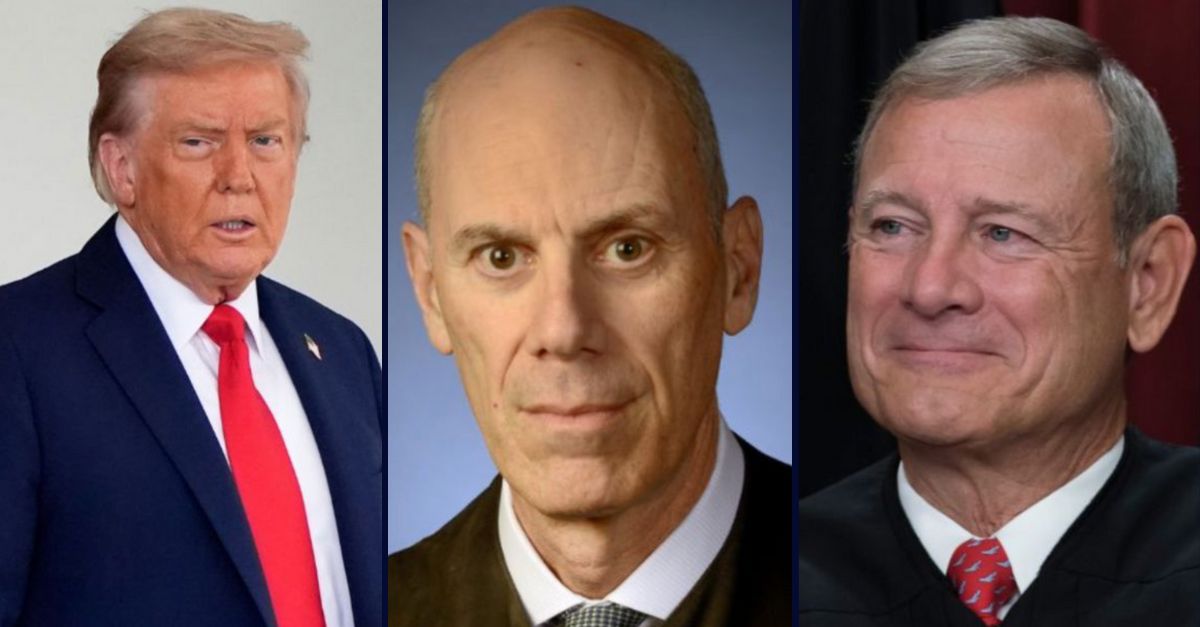
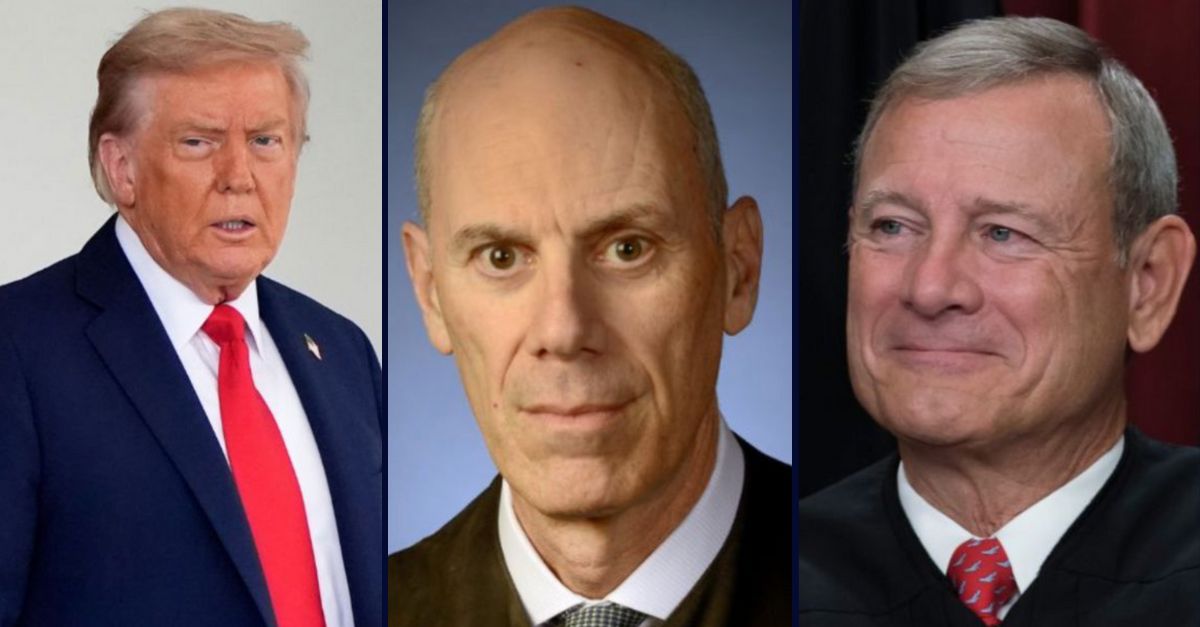
Left: President Donald Trump stands outside the White House, Monday, Aug. 18, 2025, in Washington. (AP Photo/Alex Brandon). Center: Chief U.S. District Judge James Boasberg (U.S. District Courts). Right: Chief Justice John Roberts joins other members of the Supreme Court as they pose for a new group portrait, at the Supreme Court building in Washington, Oct. 7, 2022 (AP Photo/J. Scott Applewhite, File).
After U.S. Attorney General Pam Bondi”s DOJ over the summer submitted a judicial misconduct complaint against a powerful federal judge in Washington, D.C., not even attaching evidence in support of claims GOP lawmakers nevertheless used to push for an impeachment, a George W. Bush-appointed appellate jurist has tossed out the matter transferred to his court by Chief Justice John Roberts.
Chief Judge Jeffrey Sutton of the 6th U.S. Circuit Court of Appeals, in a decision made a week before Christmas but not made public until this weekend, jettisoned the DOJ’s complaint against Chief U.S. District Judge James Boasberg for doing little more than bringing “repetition of uncorroborated statements” to the table.
As Law&Crime reported in July, with a legal ethics expert panning the complaint as “simply not credible” and doomed to be dismissed, the Trump administration insisted Boasberg should face discipline and be removed from presiding over a high-profile case.
The judicial misconduct complaint came after the conservative website The Federalist cited a memo of a non-public March 11 conference in which Boasberg “raised his colleagues’ concerns that the Administration would disregard rulings of federal courts leading to a constitutional crisis.”
The complaint, signed by Bondi’s then-chief of staff Chad Mizelle and submitted to Chief U.S. Circuit Judge Sri Srinivasan, of the District of Columbia Circuit, demanded “corrective measures,” including the reassignment of the Alien Enemies Act (AEA) case J.G.G. v. Trump to another judge, a public reprimand, and “referral to the Judicial Conference for consideration of impeachment-related recommendations, if the committee finds willful misconduct.”
In J.G.G. v. Trump, Boasberg has been searching for answers for nearly a year about whether the Trump administration and various officials willfully violated his March 15 temporary restraining order (TRO), which was issued orally four days after his alleged remarks. That day, a Saturday, the government pushed ahead with AEA removals of 137 Venezuelan men whom the government alleged were affiliated with the Tren de Aragua gang despite Boasberg’s order to turn around any planes that were in the air.
While the DOJ argued that the planes were already out of U.S. airspace and the judge lacked jurisdiction, Boasberg, in April, determined there was probable cause to find the Trump administration in criminal contempt for defying his TRO — an order the U.S. Supreme Court would later vacate.
By August, the DOJ successfully persuaded two D.C. Circuit judges appointed by President Donald Trump to grant rare mandamus relief vacating Boasberg’s “contempt-related order.”
After a petition was filed with the D.C. Circuit seeking the full — en banc — court’s review, the court declined to grant the petition but made clear that Boasberg could continue his contempt inquiry. Boasberg responded by attempting to do just that, going so far as to schedule witness testimony.
The DOJ, however, resisted with an appeal, and Boasberg has made no meaningful progress in his inquiry since.
As recently as early January, Republican lawmakers cited the existence of the DOJ’s complaint as relevant to the question of Boasberg’s impeachment and a trial, even though Sutton dismissed the misconduct complaint on Dec. 19.
Sen. Eric Schmitt, R-Mo., when calling for an impeachment trial on Jan. 7, made a point to enter the complaint “into the record.”
“That’s right,” Schmitt said, “Judge Boasberg issued the ‘turn the planes around’ order just a few days after that. Within the next week, Judge Boasberg was acting on his preconceived belief that the Trump administration would not follow court orders.”
However, the very complaint Schmitt cited to support his conclusions was already thrown out.
The dismissal order confirmed that Roberts, at Srinivasan’s request, transferred the matter out of Washington, D.C., in early December, leaving the 6th Circuit to resolve the complaint. And that’s what Sutton did.
“The primary theory of the complaint is that the judge made an improper statement at the Judicial Conference on March 11 about the risk that the Administration would not comply with federal judicial rulings. This claim fails to establish a cognizable basis of misconduct,” Sutton said. “First, it lacks ‘sufficient evidence’ to support the allegations.”
The judge noted that the complaint was submitted with an “Attachment A” — the “one source of evidence” — which the DOJ “did not supply.”
“In the absence of the attachment, the complaint offers no source for what, if anything, the subject judge said during the Conference, when he said it, whether he said it in response to a question, whether he said it during the Conference or at another meeting, and whether he expressed these concerns as his own or as those of other judges,” Sutton summarized.
Nor did the DOJ’s reference to a “Fox News clip” about the allegations amount to sufficient evidence.
“A recycling of unadorned allegations with no reference to a source does not corroborate them. And a repetition of uncorroborated statements rarely supplies a basis for a valid misconduct complaint,” Sutton added, likening the claims to gossip and rumor.
A second glaring issue with the complaint, Sutton said, was that Boasberg’s allegedly impermissible “public comment” was made in a non-public forum — and days before he issued the TRO he later determined the Trump administration violated.
“To the extent the Department claims that the judge’s alleged March 11 remark amounts to a ‘public comment’ with respect to ‘a matter pending or impending in any court’ in violation of Canon 3(A)(6), that theory also falls short,” Sutton continued. “The alleged comment does not refer to a case, and the J.G.G. action was not filed until four days later: March 15, 2025.”
A third problem was that the DOJ sought the reassignment of J.G.G. to another judge as a matter of discipline. That relief, Sutton explained, was not “available” to the DOJ.
“The proper forum for these allegations is the road already taken: relief in the D.C. Circuit and, if need be, the Supreme Court,” the dismissal concluded. “To the extent the complaint asks that the underlying case be reassigned to another judge, that is not a form of relief available through the complaint process.”
Read the dismissal in full here.


