
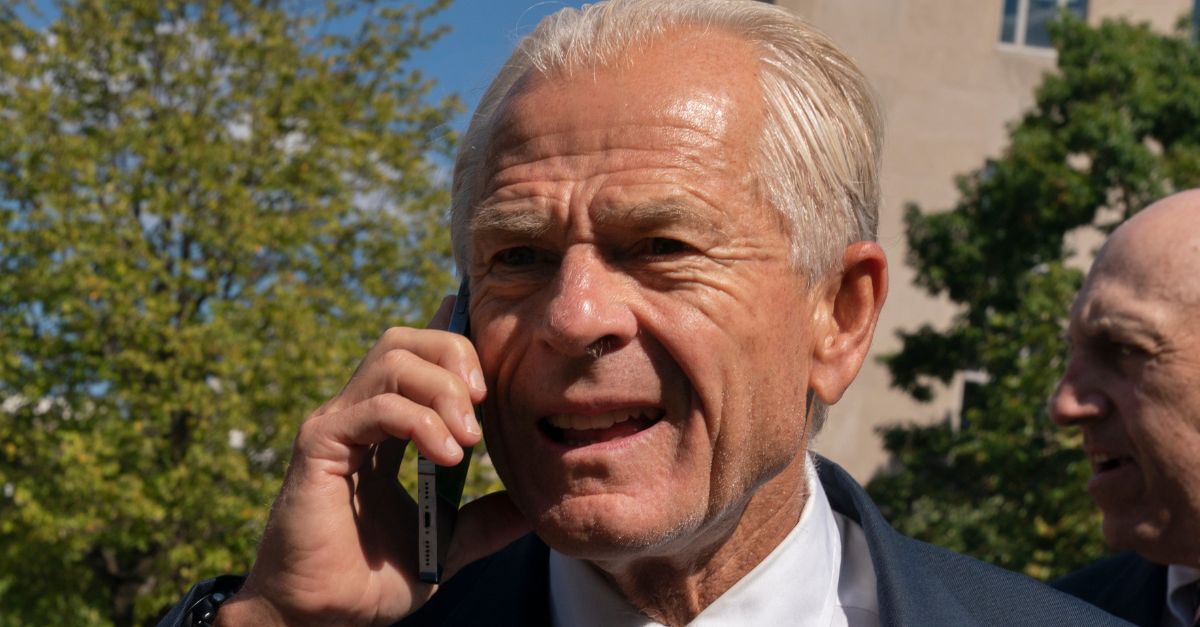
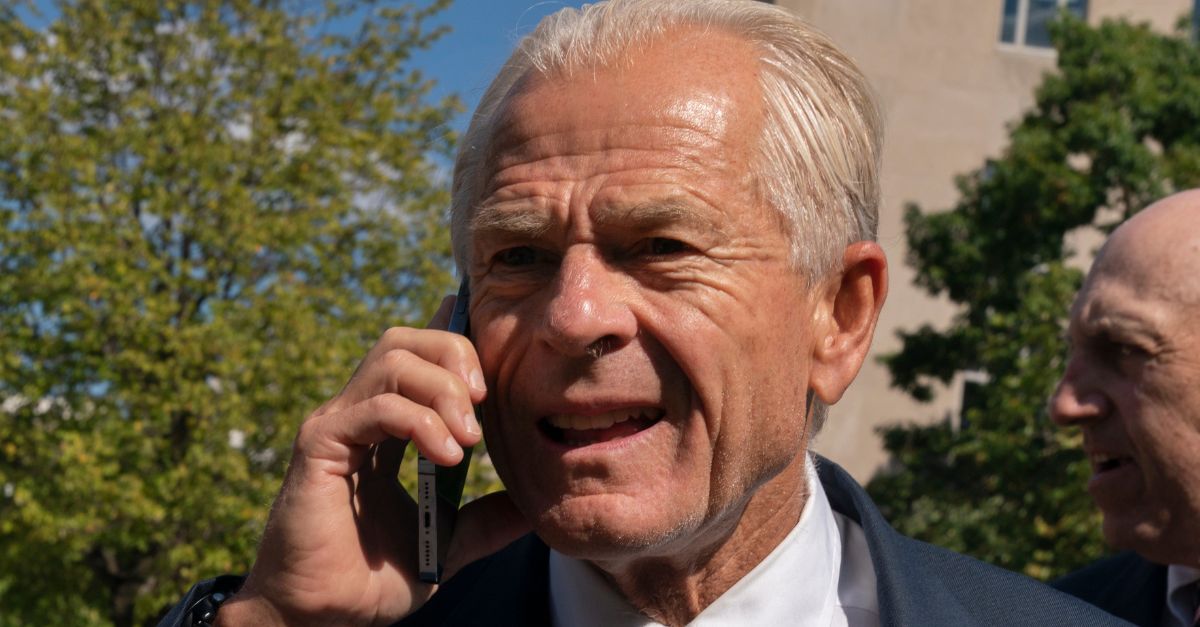
Former White House trade adviser Peter Navarro leaves federal court in Washington, following a status conference on contempt of Congress charges for his refusal to comply with a subpoena issued by the Select Committee to Investigate the January 6th attack on the United States Capitol, Wednesday, Aug. 31, 2022. (AP Photo/Manuel Balce Ceneta)
Peter Navarro, the White House trade adviser during President Donald Trump”s first term who went on to do time in federal prison for contempt of Congress, insists to this day that his incarceration should never have happened and his convictions should be reversed.
During brisk oral arguments on Thursday afternoon before a three-judge panel of D.C. Circuit judges, Navarro’s lawyer Stanley Brand argued, much the same as in briefs, that his client, once again in government as a senior counselor for trade and manufacturing, had real executive privilege claims that were wrongly ignored.
The panel was not a good draw for Navarro, as U.S. Circuit Judges Patricia Millett, Cornelia Pillard, and J. Michelle Childs — two Barack Obama appointees and one Joe Biden appointee — took a dim view from the start.
After roughly one minute of making his case that the Navarro prosecution was the first of its kind, the panel began peppering Brand with questions.
“You have to show up first, right?” Childs asked regarding Navarro’s supposed attempt to resolve his dispute with the Jan. 6 Committee over privilege without court intervention.
“No, he informed the committee staff that he thought he was bound by privilege,” Navarro’s attorney answered.
“But that was before receiving the actual documents or knowing what the testimony was going to be about and that it might have covered broader than what his actual communications or relationships or job duties were with the White House?” Childs followed up.
“Well, based on his instructions or what he believed were his instructions from the president he felt he was duty-bound to assert the privilege from the beginning, as other people in the White House had done,” Brand answered.
Childs didn’t let it go, noting there was no “blanket” privilege for Navarro to assert, and Pillard leaned in heavily on this point a short time later.
“Didn’t Dr. Navarro acknowledge in the district court that a former official serving a former president, the testimonial immunity would at most be qualified and, therefore, there wasn’t this blanket entitlement not to show up,” Pillard asked.
When Brand said the Supreme Court’s immunity decision in Trump v. United States “changed all of that,” the judge immediately clarified: “Not for anybody below the president, only for the president.”
“That’s not clear,” Brand said.
“Well, if it’s not clear you can’t rest on it,” the judge shot back, stating that Navarro didn’t engage in an “accommodation process” at all.
Millet jumped in around the 8-minute mark to make sure that Brand had made “concessions” in the district court that privilege has to be “invoked in each case” — that is, there must be a “subpoena-specific invocation of privilege,” not a “blanket” assertion.
“It sounded like you were now backtracking from that,” the judge said.
“I won’t backtrack, I will say there was other evidence in the record,” Brand replied.
“That’s got nothing to do with my question,” the judge quickly replied, before confirming that Brand still held the same position as he did in the case below — that there was no blanket or “presumptive” assertion of executive privilege available to Navarro.
“I don’t understand how you could have a presumptive privilege and agree that it’s subpoena-specific, as you said in district court,” the judge continued. “I don’t know what the difference between presumptive privilege and a blanket privilege is. Can you tell me what the difference is?”
“I suppose there isn’t one,” Brand said.
The end of the hearing capped off what was a “strange journey” for Navarro.
“Thank you, very much for coming this afternoon. Normally, I would offer you rebuttal, but there’s nothing to rebut,” Millet said with a chuckle.
“Yes, that’s been a very strange journey on that front,” Brand acknowledged.
The strange ending has an easy explanation.
The DOJ did not present an argument in United States of America v. Peter Navarro, as expected. The court docket shows that the government, given the change in administrations in January, moved in August to strike the Biden administration DOJ’s brief, which had argued one year earlier that Navarro’s convictions should be affirmed.
“In response to the Court’s April 8, 2025, order, and following review, the Department of Justice has determined that it is no longer taking the same position as the prior administration in this case. Accordingly, the United States respectfully moves to strike its brief in the above-captioned appeal,” U.S. Attorney Jeanine Pirro’s filing explained. “As appellant intends to continue prosecuting this appeal, the United States submits that the Court should appoint amicus curiae to defend the district court’s judgment and conviction in supplemental briefing and oral argument.”
The panel struck the government’s brief one month later and declined to appoint an amicus curiae or friend of the court to present opposing arguments in place of the Trump administration, leaving only Navarro with 15 minutes to plead his case one more time.
Notably, one of the attorneys on the Navarro brief was Stanley Woodward, Jr., now a top lawyer in the Trump administration’s DOJ.
In that July 2024 filing, Navarro claimed he “implored” the Jan. 6 Committee to “confer with former President Trump concerning the implication of executive privilege, but the Select Committee never made any attempt to confer with former President Trump or any of his aides concerning the subpoena.”
Emphasizing that he is the “only senior presidential advisor ever to have been prosecuted, let alone convicted, for contempt of congress,” Navarro said the “unjust result” was due to a “series of errors.” Navarro did acknowledge, however, that he “in fact did not comply with the subpoena by providing documents or appearing for a scheduled deposition” before the Jan. 6 Committee.
“This Court must hold that senior presidential advisors are immune from prosecution for contempt of congress insofar as the congressional inquiry giving rise to such a prosecution implicates executive privilege,” Navarro asserted. “Failure to reverse Dr. Navarro’s conviction will forever cripple the critical role executive privilege plays in effective presidential decisionmaking; significantly erode the longstanding separation of powers between our coordinate branches; eliminate the necessity of accommodation in interbranch disputes; and enable the constitutional congressional prerogative to serve as a partisan sword without the protective shield our Framers intended the Chief Executive.”
As Law&Crime has reported, Navarro served four months in jail after failing at each level of the federal court system to prevent that outcome following his conviction in January 2024 on two misdemeanor counts of criminally stonewalling the congressional Jan. 6 investigation.
In the district court, prosecutors roasted Navarro’s last-gasp executive privilege assertions as “unfounded” and little more than “fan fiction.”
“As the Court emphasized, the Defendant presented nothing — no words from the former President, no ‘smoke signal’ from any conversation nor anything conveyed by another — that would constitute an actual assertion of the privilege,” the DOJ said. “The Court was left with only the Defendant’s fan fiction version of what the Defendant wished or hoped the former President might have wanted but left unsaid.”
At sentencing, U.S. District Judge Amit Mehta agreed that if Trump had “issued a similar letter” to Navarro, like the ones issued to ex-chief of staff Mark Meadows and deputy chief of staff for communications Dan Scavino, ordering them not to testify about Jan. 6, “the record here would look very different.”
But the record didn’t look different for Navarro as it didn’t look different for ex-White House chief strategist Steve Bannon, although he managed to report to prison several months later than Navarro.
Mehta, an Obama appointee, chided Navarro’s legal team for arguing the prosecution was a creation of top Democrats, former House Speaker Nancy Pelosi and then-President Biden, which the judge saw as an example of just the kind of thinking that makes “our politics […] so corrosive.”
“This was a significant effort by Congress to get to the bottom of a terrible day in American history,” Mehta added.
Navarro went on to appeal to the D.C. Circuit in an attempt to stave off having to report to prison in Miami, but that effort failed, just as two applications to be released pending appeal to the U.S. Supreme Court — one submitted to Chief Justice John Roberts and the other to Justice Neil Gorsuch — ultimately failed.
After Navarro was released from prison in July 2024, he went straight to the Republican National Convention, where he was cheered.
“The J6 committee demanded that I betray Donald John Trump to save my own skin,” Navarro said, according to the Associated Press. “I refused.”


