
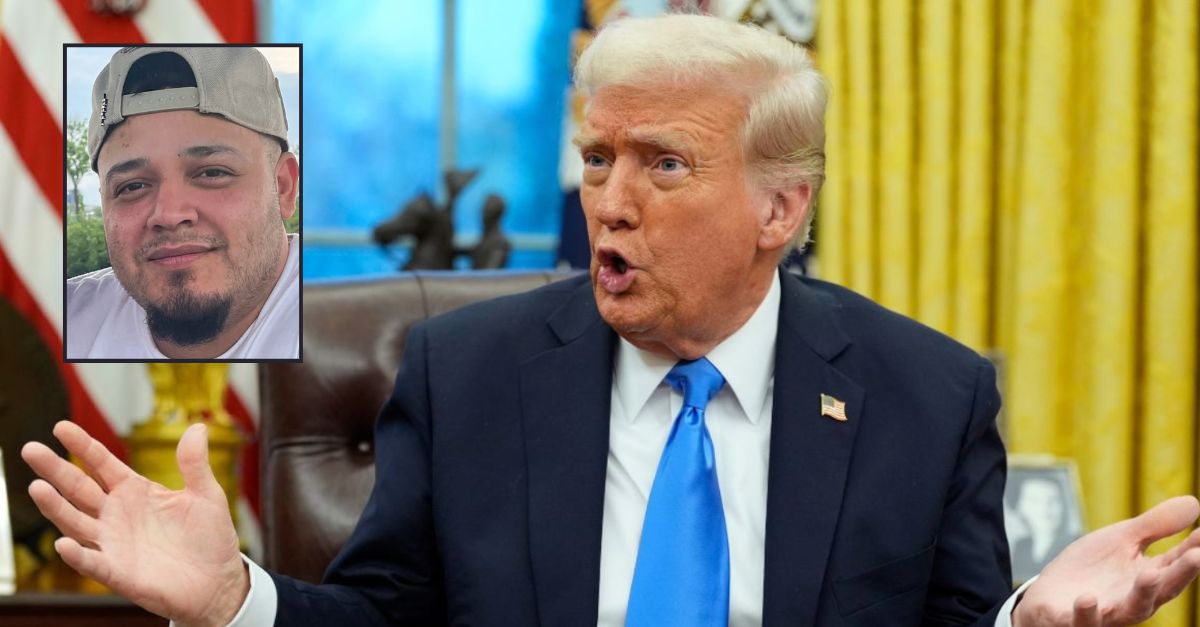
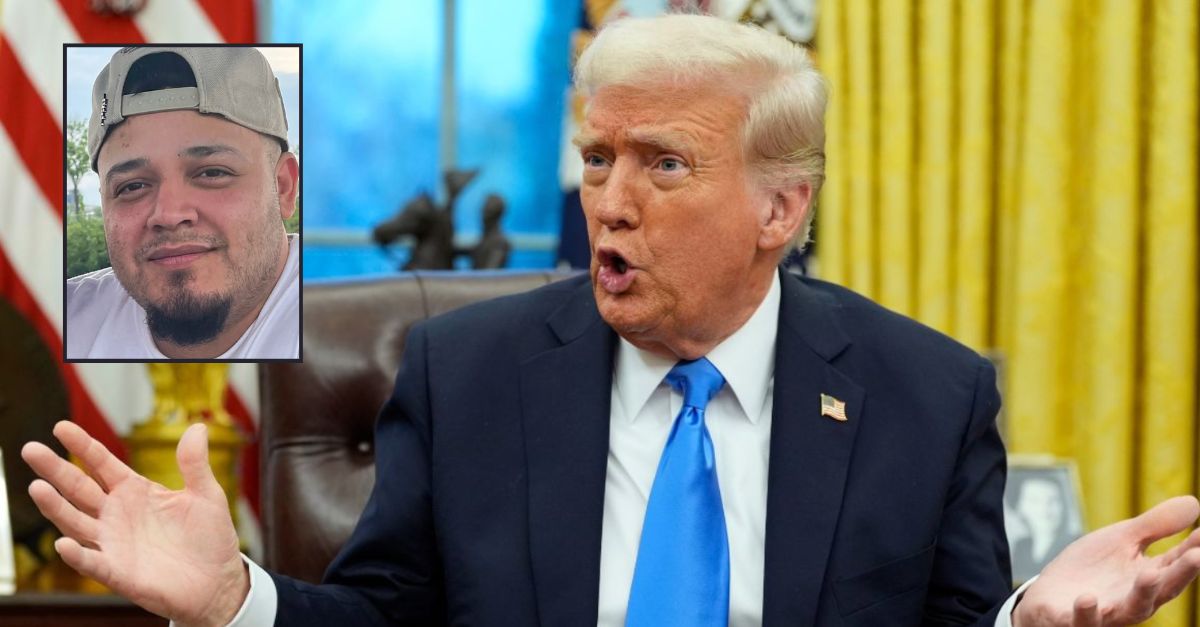
Inset: Kilmar Abrego Garcia in an undated photo (CASA). Background: President Donald Trump speaks with reporters in the Oval Office at the White House, Tuesday, Feb. 11, 2025, in Washington, D.C. (Photo/Alex Brandon).
The federal judge overseeing the human smuggling case against Kilmar Abrego Garcia has canceled an upcoming January trial.
In lieu of that proceeding, the court will hold a one-day evidentiary hearing dedicated to ferreting out whether or not the Maryland man was vindictively and selectively prosecuted by the government.
This week, U.S. District Judge Waverly Crenshaw, a Barack Obama appointee, slammed the brakes on the controversial prosecution in a relatively terse four-page order – a decided victory for the father of three and an equally stinging loss for the Trump administration.
In the ruling, the judge said the evidence provided by the defense had turned the case in Abrego Garcia”s favor long ago – at least on the due process issue of whether the prosecution is vindictive.
“The burden-shifting framework controls the Court’s analysis,” Crenshaw writes. “Specifically, once a defendant establishes a prima facie showing of vindictiveness, ‘a presumption arises in defendant’s favor.’ The Court has already found that Abrego has made such a showing, entitling him to discovery and an evidentiary hearing on why the government is prosecuting him.”
In August, Abrego Garcia filed a motion to dismiss his federal indictment on the basis of a selective and vindictive prosecution.
In October, the court found there was a “realistic likelihood of vindictiveness” behind the federal charges against Abrego Garcia.
The immigration lodestar’s high-profile litigation is a well-known subplot of the story of the second Trump administration. Abrego Garcia was part of a summary deportation flight to a prison notorious for torture in El Salvador, but his deportation violated multiple court orders — both specific to him and general to the flight in question.
A DOJ lawyer was sacked after admitting the Trump administration’s mistakes and, through a seesawing battle that has gone up the legal ladder all the way to the U.S. Supreme Court and back down to various different district courts, Abrego Garcia was returned to the United States, promptly charged with unrelated crimes, and eventually released on bail before being taken into custody by Immigration and Customs Enforcement (ICE) yet again in late September.
Now, the outcome of the case is contingent on whether the government can rebut the presumption in the defense’s favor by producing “objective, on-the-record explanations” for the human smuggling charges, according to the court.
The judge notes the upshot, at length:
Whether the government can produce such evidence is critical, for “[i]f the government fails to present evidence sufficient to rebut the presumption, the presumption stands and the court must find that the prosecutor acted vindictively,” leading to “dismissal of the charges or other appropriate remedies.” However, “[i]f the government produces evidence to rebut the presumption, the defendant must prove that the offered justification is pretextual and that actual vindictiveness has occurred.”
Crenshaw says the next step will be the evidentiary hearing – which will “only” turn on whether or not the government is able to rebut the presumption currently working in Abrego Garcia’s favor.
“If the government can rebut that showing, the Court will revisit the government’s Motion to Quash, as the burden will again shift back to Abrego to establish that the government’s rationale for prosecuting him is pretextual and that his prosecution is actually vindictive,” the order reads.
Notably, the upcoming hearing is particularly high stakes for the Trump administration – and could upend their entire case.
“If the government fails to carry its burden at the evidentiary hearing, however, the Court need not resolve the government’s Motion [to quash] on the merits, as the [defense motion to dismiss] would be granted without need for any further discovery,” the order goes on.
Still, the court explains, the current procedural “landscape” of the case is something of a double-edged sword for the defense.
Again, the ruling, at length:
Because Abrego has already affirmatively satisfied the threshold question of whether he is entitled to a presumption that his prosecution is vindictive, his subpoenas of [DOJ officials] serve to support the third step of the vindictive prosecution inquiry, i.e., whether he can establish pretext and actual vindictiveness. But, as Abrego emphasizes, to get there requires the government to successfully rebut the vindictiveness presumption Abrego is entitled to. According to Abrego, the Government has already shown that it cannot do so, given what Abrego asserts to be troves of evidence in the record indicating that his prosecution is actually vindictive. Based on this record, Abrego argues that the Court could rule on his Motion [to dismiss] without an evidentiary hearing or the testimony of [DOJ officials].
In other words, the current state of motions practice has diminished the need for discovery requested by the defense. But if the government can solicit testimony that works in its favor, the court strongly hints such discovery might very well come into play.
The evidentiary hearing is slated for Jan. 28, 2026.


