
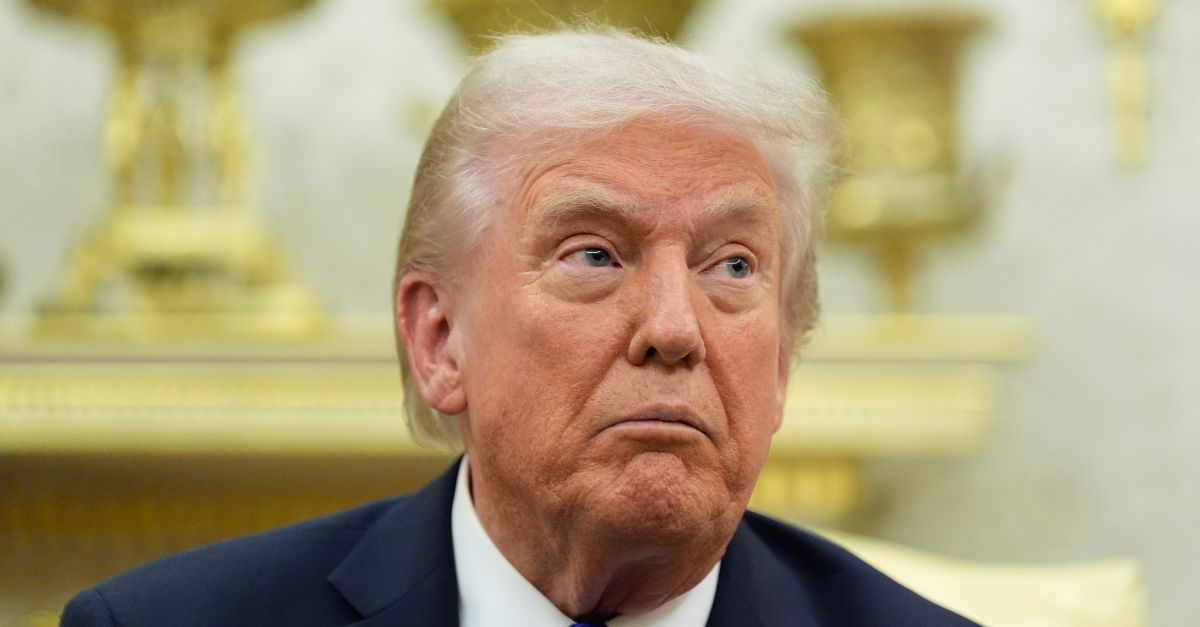
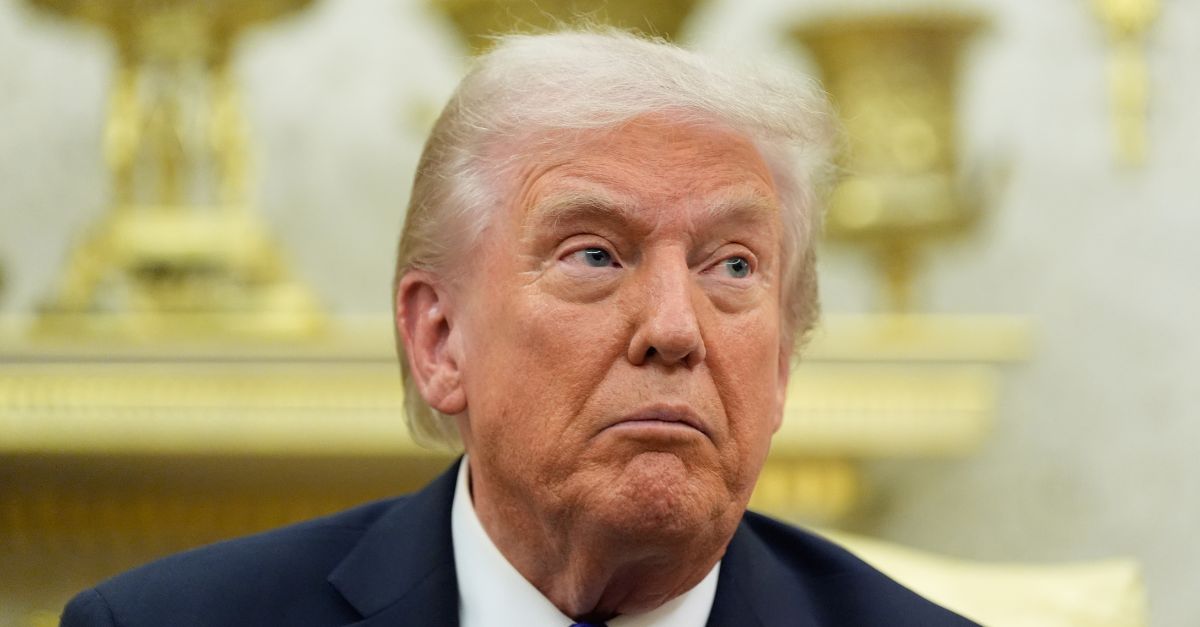
President Donald Trump listens to a question from a reporter as he meets with NATO Secretary General Mark Rutte in the Oval Office of the White House, Wednesday, Oct. 22, 2025, in Washington (AP Photo/Alex Brandon).
Pulitzer Prize Board members filed court documents in Okeechobee County, Florida, on Thursday, containing a litany of broad discovery demands in an attempt to beat back President Donald Trump”s defamation lawsuit over Russia probe reporting awards.
The 12-page document was submitted by the law firms of Ballard Spahr and Atherton Galardi Mullen & Reeder on behalf of 20 defendants.
The defendants include: Andrew W. Mellon Foundation president Elizabeth Alexander, The Atlantic’s Anne Applebaum, longtime Boston Globe editor Nancy Barnes, former Columbia University president Lee C. Bollinger, author and journalist Katherine Boo, Poynter Institute president Neil Brown, former USA Today Editor-in-Chief Nicole Carroll, former Columbia Journalism School dean Steve Coll, New York Times opinion columnist Gail Collins, Vice President and Editor at Large for Standards at the Associated Press John Daniszewski, Editor and Vice President at the Philadelphia Inquirer Gabriel Escobar, UCLA historian and professor Kelly Lytle Hernandez, longtime Pulitzer Prize Deputy Administrator Edward Kliment, New York Times columnist Carlos Lozada, former Los Angeles Times Executive Editor Kevin Merida, Pulitzer Prize Administrator Marjorie Miller, USC professor Viet Thahn Nguyen, CEO and co-founder of The 19th Emily Ramshaw, New Yorker editor David Remnick, and Harvard University philosophy professor Tommie Shelby.
The “first set of requests for production of documents” gives Trump 30 days, as of Dec. 11, to respond and contemplates the plaintiff’s attorneys at Weber, Crabb & Wein, P.A., raising privilege claims.
“With respect to your responses to the following Requests, if any information is withheld because of a claim of privilege, state the basis for your claim of privilege with respect to such information and the specific ground(s) on which the claim of privilege rests,” the filing said.
The board defendants are demanding documentation on subjects ranging from Trump’s demands to rescind the awards, to his threats to sue, to proof that the board statement at issue “had a significant impact on the 2020 presidential election,” and to Trump’s various lawsuits — whether counterclaims and defenses against E. Jean Carroll, a failed defamation case against CNN, a settled suit against ABC, a settled suit against CBS, and an ongoing lawsuit against the Wall Street Journal and Rupert Murdoch over Jeffrey Epstein birthday letter reporting.
The defendants further demanded “all” of Trump’s tax returns — “from all jurisdictions, including all attachments, schedules, and worksheets” — from 2015 to the present day, documents “sufficient to show all sources of Your income” over the same time period, documents “sufficient to show all of Your financial holdings” and his liabilities, and finally his health records and prescription medication history.
“To the extent You seek damages for any physical ailment or mental or emotional injury arising from Counts I-IV of Your Complaint, all Documents (whether held by You or by third parties under Your control or who could produce them at your direction) concerning Your medical and/or psychological health from January 1, 2015, to present, including any prescription medications you have been prescribed or have taken,” the filing concluded. “For the avoidance of doubt, this includes all Documents Concerning Your annual physical examination. To the extent you do not seek such damages in this action, please confirm so in writing.”
Love true crime? Sign up for our newsletter, The Law&Crime Docket, to get the latest real-life crime stories delivered right to your inbox.
A Trump legal spokesperson told Fox News that this “powerhouse lawsuit” will reach a “winning conclusion.”
“This case has always been about correcting the record, revealing the truth, and vindicating the president and his supporters against the lies told to the American people by the Democrats and their PR machine known as ‘legacy media,'” the statement reportedly said.
Trump filed the glacially paced lawsuit in 2022, after the Pulitzer Prize Board released a statement rebuffing his demands to rescind 2018 prizes for the New York Times and the Washington Post, even as the then-former president claimed the board was “perpetuating the absurdly false and defamatory narrative contrived by the President’s political opponents: that he and his campaign somehow colluded with Vladimir Putin and the Russian government to gain advantage in the 2016 U.S. presidential election, and thereafter maintained some nefarious connection with Russian elements during the presidential transition and Trump administration (the ‘Russia Collusion Hoax’).”
The board’s statement cited “two independent reviews” of the Times and Post’s reporting to conclude that the prizes “stand,” as “no” aspects of the award-winning articles on former special counsel Robert Mueller’s Russia probe were “discredited”:
The Pulitzer Prize Board has an established, formal process by which complaints against winning entries are carefully reviewed. In the last three years, the Pulitzer Board has received inquiries, including from former President Donald Trump, about submissions from The New York Times and The Washington Post on Russian interference in the U.S. election and its connections to the Trump campaign—submissions that jointly won the 2018 National Reporting prize.
These inquiries prompted the Pulitzer Board to commission two independent reviews of the work submitted by those organizations to our National Reporting competition. Both reviews were conducted by individuals with no connection to the institutions whose work was under examination, nor any connection to each other. The separate reviews converged in their conclusions: that no passages or headlines, contentions or assertions in any of the winning submissions were discredited by facts that emerged subsequent to the conferral of the prizes.
Trump’s legal team has since moved to depose Stephen J. Adler, the Reporters Committee for Freedom of the Press Steering Committee’s chairman and a former longtime reporter and editor at the Wall Street Journal identified by Semafor in January as a confidential reviewer of the Times and Post articles in question.
When Trump proposed a subpoena of Adler, the defendants sought a protective order to keep “confidential” the Pulitzer Prize Board’s “internal deliberations and review,” making the case that disclosure thereof could “chill the candor of future Board deliberations and independent reviews.” Senior 19th Judicial Circuit Judge Robert Pegg rejected that request in early February, pointing out the Pulitzer Prize Board is “not a legally cognizable entity,” and so the “‘internal deliberations of the Pulitzer Prize Board’ is properly read as the ‘internal deliberations of the co-Defendants’ which are otherwise discoverable […] and not covered by a claim of privilege or statutory protection,” the docket reviewed by Law&Crime showed.
When the judge in the case declined to dismiss, he concluded that the board’s statement standing by the prizes constituted “actionable mixed opinion.”
“Defendants cannot claim the statement is pure opinion when they withheld information from their audience that would have provided an adequate factual foundation for a common reader to decide whether to agree or disagree with Defendants’ decision to let 2018 Pulitzer Prizes in National Reporting stand, and whether the awarded reporting had in fact been discredited by facts that emerged from the Mueller Report or the other government investigations that had been made public since the conferral of those prizes,” Pegg ruled in July 2024, noting that Mueller’s investigation did not ultimately allege conspiracy between the then-45th president’s 2016 campaign and Russia — though the special counsel’s report did identify “numerous links between the Russian government and the Trump campaign.”
After trips to state appellate court and the Florida Supreme Court, the defamation suit returned to Pegg’s court in earnest back in September.


