
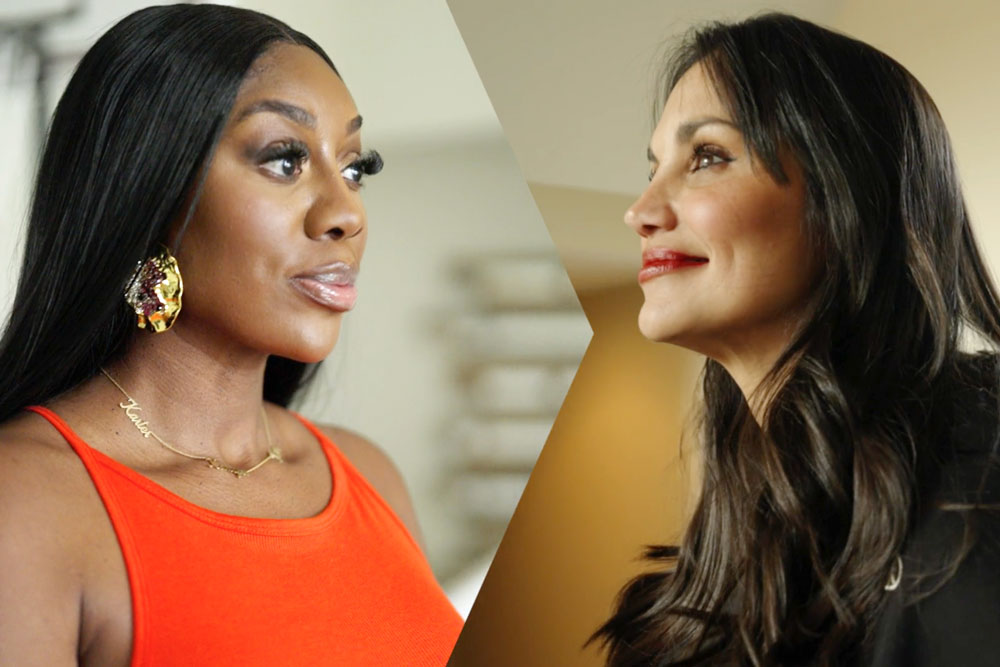
On the Wife Swap: The Real Housewives Edition, Alethea Shapiro introduced The Real Housewives of Potomac‘s Wendy Osefo and her family to her “low-demand parenting” philosophy — but, post-filming, there were still some important details that the stay-at-home mom and activist wanted to set the record straight on.

Before temporarily swapping lives with Wendy in Episode 4, Althea explained that low-demand parenting “basically means empowering your children to be independent.” In her household, that entailed tasking her four children — Hailey, 19, Dylan, 16, Shane, 12, and Skyler, 10 — with packing their own lunches, for example.
During the episode, even Skyler referred to his mom as “lazy,” but in an exclusive interview with The Daily Dish, she shared why that common mischaracterization of her parenting style — and other stereotypes —are incorrect.
Below, Althea breaks down some of the major details following her time on Wife Swap: The Real Housewives Edition.
Alethea Shapiro explains low-demand parenting’s roots
After experiencing burnout from the “rat race” of living in New York (and the “overscheduling” that comes along with that lifestyle), Alethea and her husband, Craig, relocated their family to Naples, Fla. roughly four years ago. Then, at 44 years old, Alethea was diagnosed with what she refers to as “AuDHD,” a term that describes someone who has both Autism Spectrum Disorder (ASD) and Attention-Deficit/Hyperactivity Disorder (ADHD).
Once she was “better able to understand” how her brain works and adjust her lifestyle accordingly, her approach to parenting evolved, too.
“Low-demand parenting was not a phrase that I came up with out of nowhere,” she clarified. “It is a framework of parenting that was born from the disability community as a way for neurodivergent families, both parents and children, to have everybody feeling regulated, and a way to connect and to increase cooperation and respect.”
RELATED: Get Details on the Wife Swap: Real Housewives Edition Cast & the Families They’re Joining
While a casual observer might label her approach as being too hands-off, Alethea says she’s “very much seeing” her kids and actually “tailoring” how she parents each child.
“It’s an individualized approach that makes each child feel comfortable in their brains and bodies,” she added. “The part about [me being] detached or not involved in my kids’ lives was just so false because we’re so close, and I’m so involved in their lives.”
According to Alethea, even though some might say that she was “not prioritizing education,” she’s actually just more focused on “learning while living” away from a desk. For example, she and her family once visited 49 states in 16 months in their RV to see “how all Americans live.”
Althea revealed a “big part that was missing” from Wife Swap: The Real Housewives Edition
As for the moment when her son Skyler called her “lazy,” Alethea said that he later clarified that he was referring to the fact that she does not like to cook.
“I think that a big part that was missing of the show is that food and cooking is a very hard topic in our house,” she remarked, before sharing that she and most of her children have “an eating disorder called ARFID,” which stands for Avoidant/Restrictive Food Intake Disorder.
“It’s basically extreme, extreme pickiness,” Alethea continued. “It comes from sensory [issues with] textures, smells, and it goes right back to being neurodivergent and how the brain and the body react to these sensory needs. It just makes cooking and mealtime really challenging, because there’s not a lot of foods everyone likes. And then, it sits in the refrigerator, and they don’t want to eat it. A very, very difficult recurring theme in our house is meals and finding things we like.”
RELATED: Melissa Gorga, Angie K & More Get Shock of a Lifetime in Wife Swap: Real Housewives Edition Trailer
Regardless, Alethea noted that her family is still “thriving” with her low-demand parenting style, and she hopes that sharing her story will benefit some viewers who are also neurodivergent adults.
“I felt like that representation on TV really matters,” she concluded. “I was hoping that people would see themselves in me, potentially, and that would validate them; they would feel seen; or it would inspire them to potentially go on their own neurodivergent journeys. … That has made me a better mother, because I can see how my children, how their brains work, too.”
In the meantime, don’t miss who from RHOP influenced Wendy’s Wife Swap: The Real Housewives Edition experience.


