
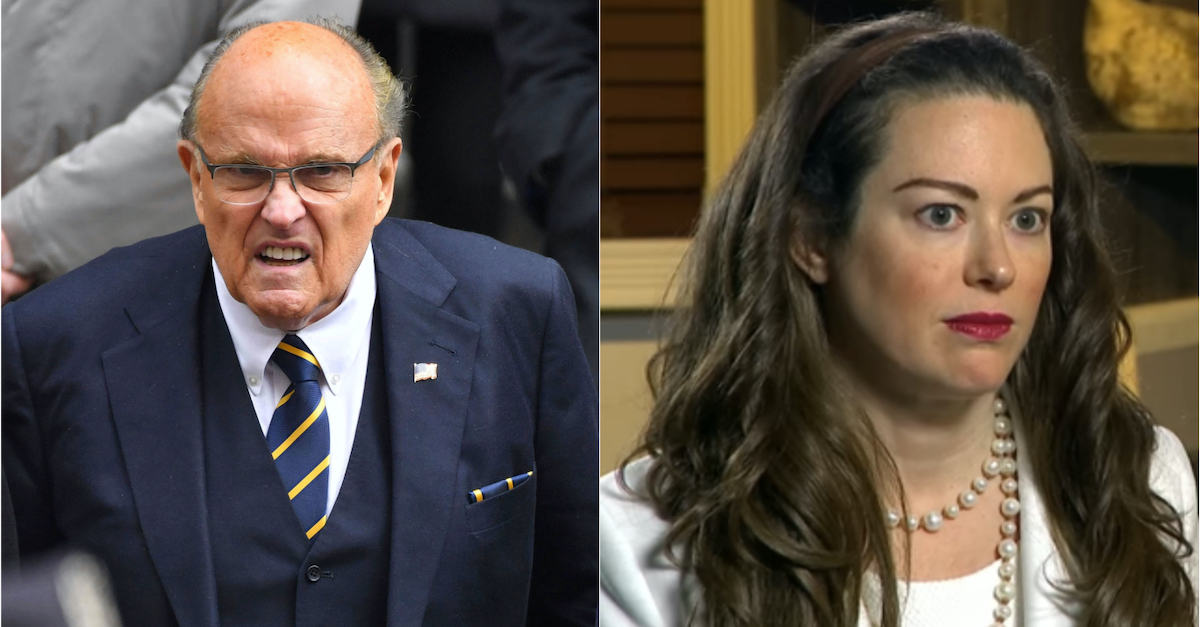
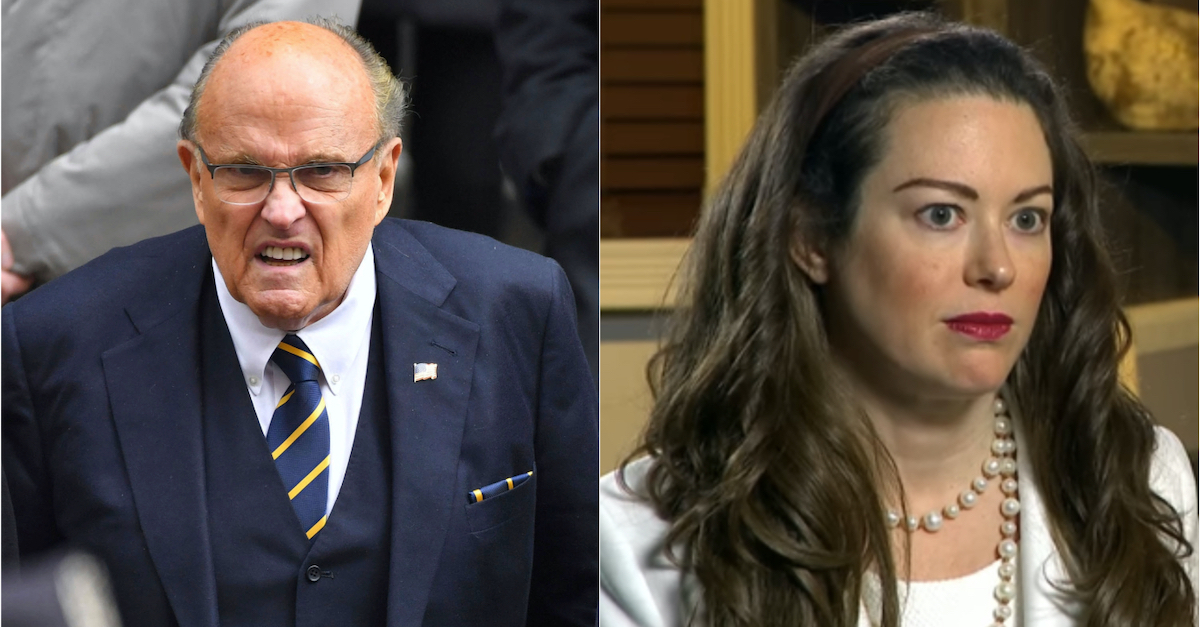
Left: Rudy Giuliani (zz/NDZ/STAR MAX/IPx 2022). Right: Noelle Dunphy (Inside Edition).
Rudy Giuliani has notched a major loss in civil litigation over allegations he forced his onetime assistant to have sex with him.
On Monday, a judge in New York State declined to dismiss the workplace harassment lawsuit filed by Noelle Dunphy, who says she worked for the former New York City mayor between 2019 and 2021.
The lawsuit was filed in May 2023. The complaint alleges Giuliani “went on alcohol-drenched rants that included sexist, racist, and antisemitic remarks,” and that he “constantly” took Viagra — often directing Dunphy”s attention to “his erect penis” in order to tell her “that he could not do any work until ‘you take care of this.'”
For years, the litigation moved slowly through scores of motions and other pretrial wrangling. In January 2025, Dunphy filed an amended complaint; Giuliani filed his motion to dismiss in March 2025.
In February of this year, the parties appeared for a hearing that ultimately whittled down the number of issues raised by the defense.
Now, in a seven-page ruling, Supreme Court of New York County Judge Nicholas W. Moyne dispensed with each of Giuliani’s remaining arguments in turn and allowed the case to move forward to discovery.
“The Court finds that the amended complaint states legally cognizable claims upon which relief can be granted,” the order reads. “Factual disputes over the credibility of the plaintiff’s narrative or the exact contours of the relationship are reserved for summary judgment or trial. The motion to dismiss is denied in its entirety.”
The former federal prosecutor’s first line of defense was to launch a standing attack on Dunphy by claiming that her damages had been inflated. This argument, however, did not actually align with how standing doctrine works.
The court explains, at length:
The defendants argue that Ms. Dunphy lacks standing because her demand for damages suspiciously increased from $3.1 million in her pro se Summons with Notice to $10 million in her amended complaint, which they claim demonstrates a lack of injury-in-fact. This argument is without merit. Ms. Dunphy alleges she was sexually assaulted and deprived of approximately $2 million in wages. Being the victim of sexual assault and wage theft constitutes a concrete, cognizable injury. Furthermore, under New York law, a summons with notice does not cap the damages in a subsequently filed complaint once the defendant appears; the complaint becomes the controlling document.
Giuliani went on to argue Dunphy’s specific assault claim was filed outside of the window under the Adult Survivors Act (ASA), a recently passed law that provided a limited look-back window for removing the statute of limitations on certain lawsuits filed by sexual assault victims.
Again, Moyne found the defense’s claims unavailing.
“The ASA created a one-year revival window,” the judge explains, adding that the clock began ticking on Nov. 24, 2022.
“Ms. Dunphy commenced this action within that window,” the order goes on. “The amended complaint alleges that Mr. Giuliani placed the plaintiff in reasonable apprehension of unwarranted sexual contact. Because these threats of violence were intertwined with the allegedly consummated sexual offenses alleged under Penal Law Article 130, the assault claim is sufficiently pled and preserved.”
In a footnote, Moyne takes a broader view of what the amended complaint alleges under Empire State criminal laws — effectively underscoring how relatively limited the claims are in the lawsuit.
Again, the decision and order, at length:
Giuliani’s alleged actions would, if proven, constitute sexual offenses as defined in Article 130 of the New York Penal Law, including but not limited to rape in the first degree (§ 130.35), rape in the third degree (§ 130.25) sexual abuse in the first degree (§ 130.65), sexual abuse in the third degree (§ 130.55), sexual misconduct (§ 130.20), and forcible touching (§ 130.52).
While the lawsuit does not seek criminal punishment, the claims dovetail closely with sexual assault-based crimes.
Dunphy also claimed liability under a statute that prohibits violence “due, at least in part, to an animus based on the victim’s gender.” And, again, Giuliani tried and failed to contest the applicability of this statute to the litigation at hand.
“The defendants argue that Ms. Dunphy failed to adequately plead gender-based animus,” Moyne goes on. “The defendants are wrong. The plaintiff’s claims in the amended complaint that she was subjected to non-consensual sexual intercourse and/or oral sex are sufficient to allege animus on the basis of gender. Rape and sexual assault are inherently dehumanizing violations of bodily autonomy, and ‘animus inheres where consent is absent.’ Because Ms. Dunphy explicitly alleges non-consensual sexual intercourse and oral sex, the animus requirement is satisfied at the pleading stage.”
The court also observes that the alleged “numerous misogynistic and degrading remarks made by Giuliani” against Dunphy provide “independent support for gender-based animus.”
Dunphy also sued under the state and New York City human rights laws. Here, Giuliani tried to claim the plaintiff was not entitled to those protections because she was not actually a New Yorker. Again, the judge was not having it.
“Ms. Dunphy alleges she was flown to New York, introduced to staff in New York, and performed substantial work (and suffered severe abuse) inside Giuliani’s Upper East Side apartment,” the order continues. “These allegations, and numerous others like them that are plead throughout the amended complaint, are more than sufficient to establish a sufficient nexus and impact in New York to survive a motion to dismiss.”
Notably, Dunphy also sued Giuliani’s eponymous businesses — adding reciprocal aiding and abetting claims into the litigation. Those claims also survived the defense motion to dismiss.
“The defendants ignore the fact that Giuliani could aid and abet the corporate defendants’ conduct, and they could aid and abet his,” Moyne goes on. “Ms. Dunphy alleges that Giuliani aided and abetted the Giuliani companies’ discriminatory conduct—specifically their failure to implement sexual harassment policies, lack of HR oversight, and condonation of his actions—and that the companies similarly aided and abetted Giuliani. An individual can be held liable for aiding and abetting an employer’s unlawful discrimination, even if the individual’s own actions served as the predicate.”
The order goes on to tersely reject an additional five arguments over various claims on which Dunphy seeks to make Giuliani and his businesses liable — keeping each claim alive for the plaintiff.


