
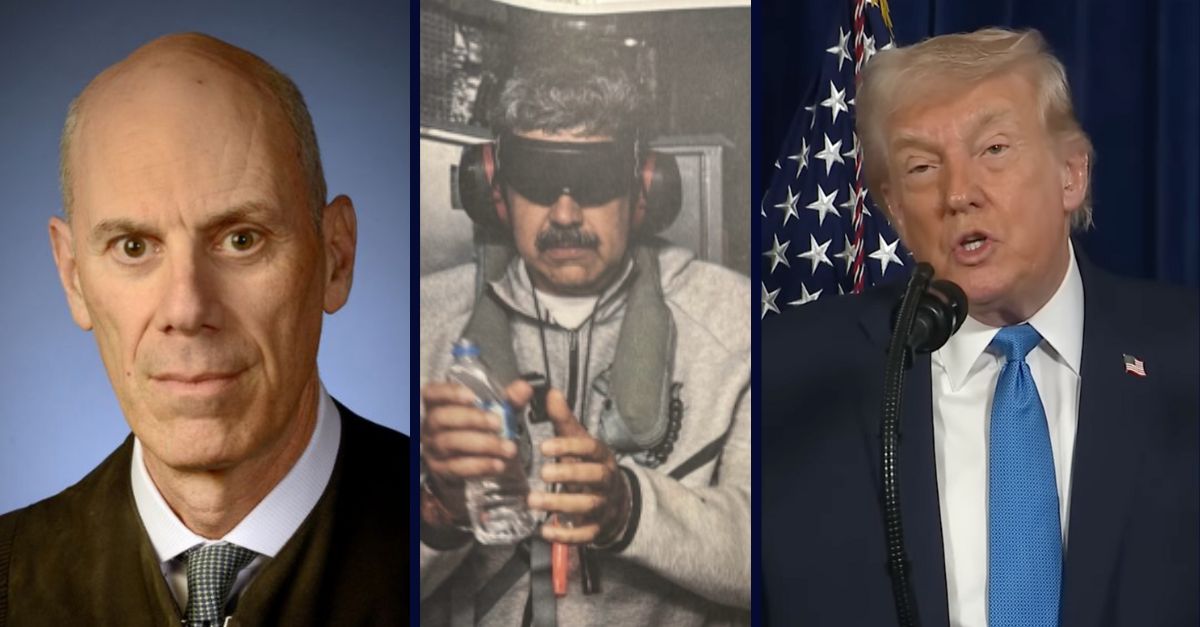

Left: Chief U.S. District Judge James Boasberg (U.S. District Court). Center: Nicolas Maduro pictured in custody on the U.S.S. Iwo Jima (@realDonaldTrump/Truth Social). Right: President Donald Trump holds a press conference on Jan. 3, 2026, on the overnight capture of Maduro and his wife (White House/YouTube).
The DOJ on Sunday told a federal judge that the military”s stunning late-night capture of Venezuelan leader Nicolas Maduro, now in the U.S. with his wife to face a “narco-terrorism conspiracy” and “cocaine importation conspiracy” indictment, has created a “fluid” situation that means the Trump administration needs more time to come up with “remedies” in Alien Enemies Act (AEA) litigation.
The brief weekend filing from the government to Chief U.S. District Judge James Boasberg, the jurist repeatedly stymied in his efforts to push forward a contempt probe into whether his orders were willfully and criminally ignored last year, sought a one-week extension to “evaluate and determine what remedies are possible.”
“Given substantial changes on the ground in Venezuela and the fluid nature of the unfolding situation, Defendants respectfully move for an extension to respond to this Court’s Order directing them to propose a remedy by Monday, January 5. Over the weekend, the United States apprehended Nicolas Maduro,” the filing said. “As a result, the situation on the ground in Venezuela has changed dramatically. Defendants thus need additional time to determine the feasibility of various proposals.”
Given that the deadline is today, it should only be a matter of time before Boasberg responds.
The DOJ’s court filing referenced a Dec. 22 opinion and order, in which Boasberg said the Trump administration “shall submit its proposal either to facilitate the return of Plaintiffs to the United States or to otherwise provide them with hearings that satisfy the requirements of due process by January 5, 2026.”
In the opinion accompanying the order, Boasberg explained that the class action plaintiffs are 137 Venezuelan men that President Donald Trump proclaimed “Alien Enemies” in March and deported to the Terrorism Confinement Center — or CECOT — in El Salvador, despite the judge’s March 15 temporary restraining order.
“Nine months ago, six Venezuelan men were hustled out of a detention center in Texas, loaded onto planes, and shipped to an infamous mega-prison in El Salvador with no explanation and no opportunity to challenge the reason for their hasty removal. On behalf of themselves and a putative class of similarly situated detainees, they have turned to the courts to vindicate their constitutional right to due process,” the judge summarized. “These efforts have precipitated multiple trips up and down the assorted tiers of the federal judiciary, complicated by their subsequent transfer to and release in their native Venezuela. After the D.C. Circuit vacated this Court’s prior preliminary injunction, Plaintiffs have again moved for an order enjoining the Government to facilitate their return to the United States to pursue their individual habeas claims.”
Boasberg not only certified the plaintiffs as a class, but also found their due process rights were violated, and he ordered the Trump administration to “facilitate their ability to obtain” a hearing, as “[o]ur law requires no less.”
The DOJ now says that, in light of the Maduro “situation,” it needs an extension to analyze how facilitating those hearings can occur.
As Law&Crime has reported, Boasberg has been pressing for answers on just how the government pushed ahead on March 15 with AEA removals of the more than 100 Venezuelans whom the government alleged were affiliated with the Tren de Aragua gang. The judge’s contempt probe is currently stalled, as it largely has been for months on end, and a D.C. Circuit Court of Appeals panel has yet to decide if he has the authority to move forward.


