
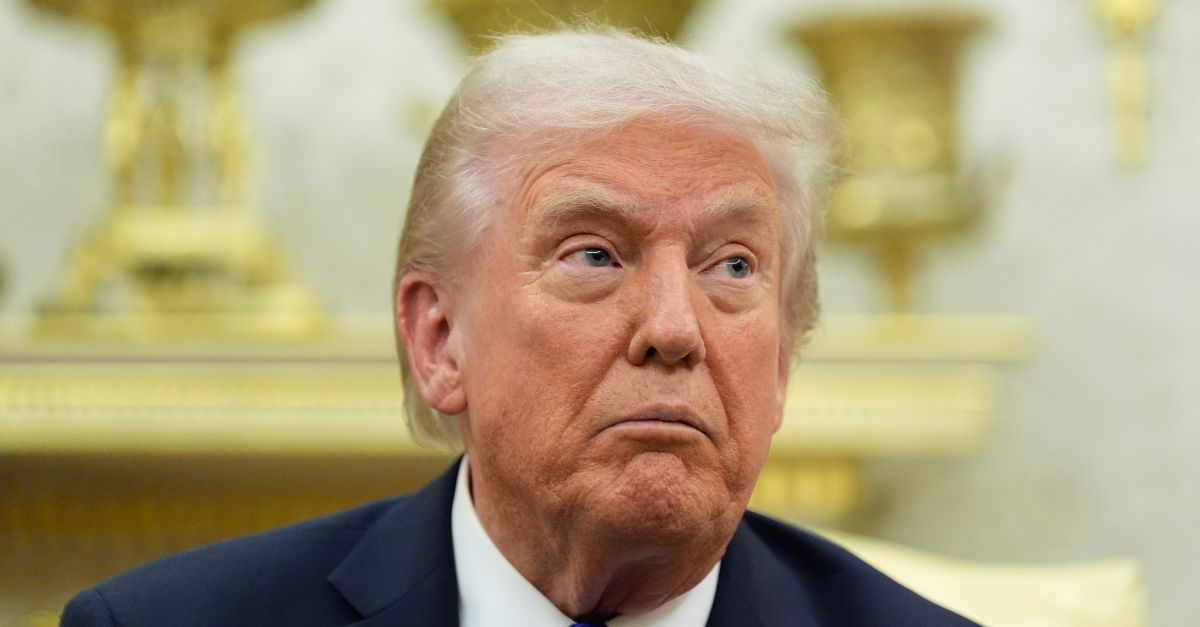
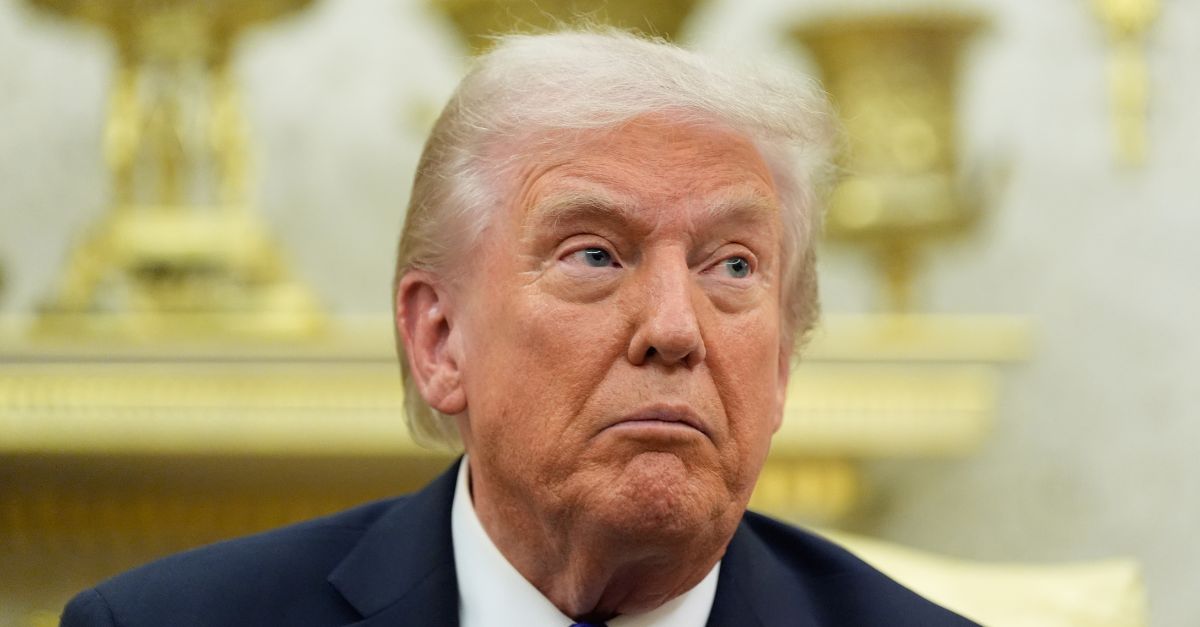
President Donald Trump listens to a question from a reporter as he meets with NATO Secretary General Mark Rutte in the Oval Office of the White House, Wednesday, Oct. 22, 2025, in Washington (AP Photo/Alex Brandon).
The Trump administration cannot dictate how Washington and Oregon conduct their elections, a federal judge in Seattle has ruled.
On March 25, President Donald Trump issued Executive Order 14248, titled: “Preserving and Protecting the Integrity of American Elections.” The order broadly seeks to reshape how elections are administered in the country by, among other things, purporting to enforce a requirement that all voters prove their citizenship by way of formal documentation and by putting a stop to vote-by-mail systems that count ballots postmarked by, but received after, Election Day.
In April 2025, Oregon and Washington sued because the default voting mechanism in each state is a postal ballot – and such vote-by-mail systems have been in place, non-controversially, for decades.
In May 2025, those two Pacific Northwest states moved for summary judgment, asking U.S. District Judge John H. Chun, a Joe Biden appointee, to permanently enjoin multiple sections of Trump”s order as unconstitutional and ultra vires, or, beyond the president’s power.
On Friday, the court ruled in the plaintiffs’ favor. In a 75-page order, Chun severely curtailed the reach of Trump’s executive order insofar as it applies to the states’ administration of their own elections.
“[T]he Constitution assigns the states all authority to regulate the time, place, and manner of elections, subject only to limitations by Congress,” the order reads. “As the Constitution assigns no authority to the President over federal election administration, the President’s authority to promulgate a national ballot-receipt deadline cannot stem from the Constitution.”
The order goes on like this, at length:
As stated by the Supreme Court, although the Constitution vests the executive power in the President, “[i]n the framework of our Constitution, the President’s power to see that the laws are faithfully executed refutes the idea that he is to be a lawmaker. Accordingly, the “Constitution entrusts Congress and the States—not the President—with the authority to regulate federal elections.”
In ruling against the government, the court said “the heart of this matter” is that Trump’s executive order, in some instances plausibly, and in some instances provably “violates separation of powers.”
“Separation of powers was designed to implement a fundamental insight: Concentration of power in the hands of a single branch is a threat to liberty,” the judge added in another section of the order.
In ruling for the plaintiffs, several provisions of the executive order were permanently enjoined by the court. The judge further declared the states’ ballot-receipt deadlines are not preempted by federal law.
“The Court declares that Washington’s and Oregon’s existing laws governing ballot-receipt deadlines are not preempted,” the order goes on. “Unless, and until, Congress amends these statutes or otherwise enacts a law that establishes a national ballot-receipt deadline of Election Day, the Elections Clause authorizes Washington and Oregon to maintain their existing laws, which permit the counting of certain ballots received after Election Day.”
The ruling also bars the federal government from forcing voters to prove their citizenship before registering to vote using federal forms, and blocks the Trump administration from making funding threats over voting laws.
The government had sought to condition “any available funding to a State” on the exclusion of ballots received after Election Day.
That effort got short shrift from the court.
“The President has no authority to unilaterally impose new conditions on federal funds or ‘thwart congressional will by canceling appropriations passed by Congress,'” the judge wrote, citing precedent.
In another case challenging the executive order, the government advanced the notion of using “criminal” prosecutions to secure compliance with the proposed ban. Such prosecutions by the federal government are now off the table, Chun ruled.
Conversely, the court said the federal government could still take “lawful, i.e. non-compulsive, actions to encourage Plaintiffs to adopt a different ballot-receipt deadline.”
The judge rubbished the notion that the Trump administration was merely trying to enforce the laws as they currently stand on the books. Rather, the court found, the federal government was reaching for power which “simply cannot be squared with the text, purpose, legislative history, nor historical application” of the relevant laws.
“[W]henever the President issues an executive order, the power ‘to issue the order must stem either from an act of Congress or from the Constitution itself,'” Chun continued. “If the President lacks a statutory or constitutional basis the act is unlawful.”
The judge also mused about the upshot of its ruling in broad terms.
“In granting this relief, the Court seeks to restore the proper balance of power among the Executive Branch, the states, and Congress envisioned by the Framers,” the court said.


