
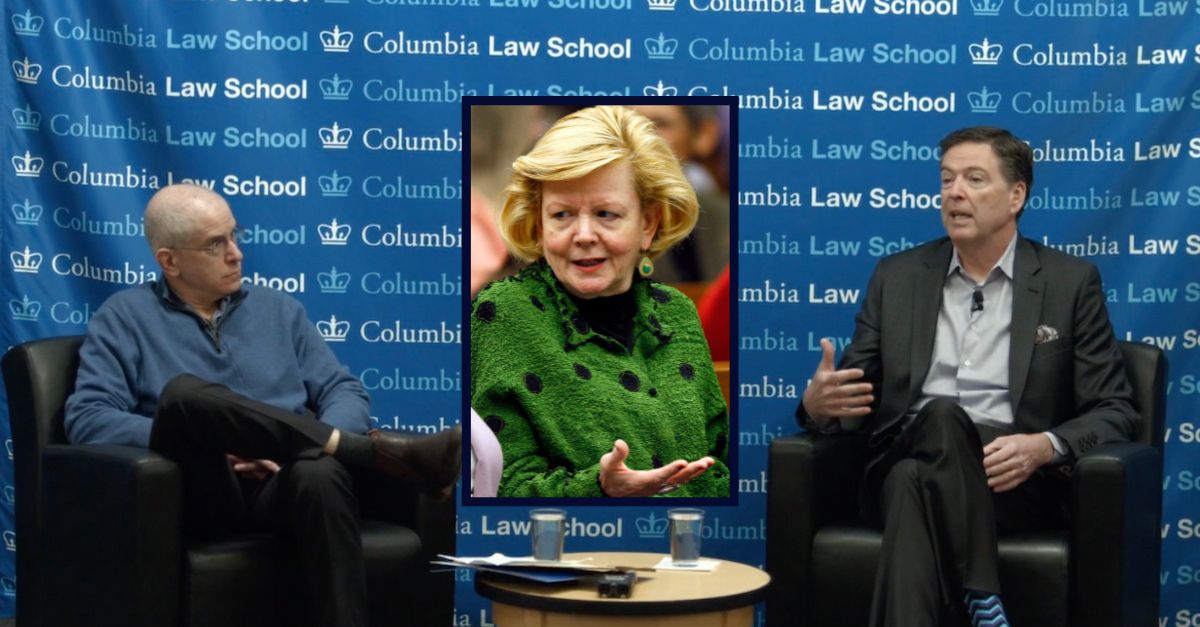
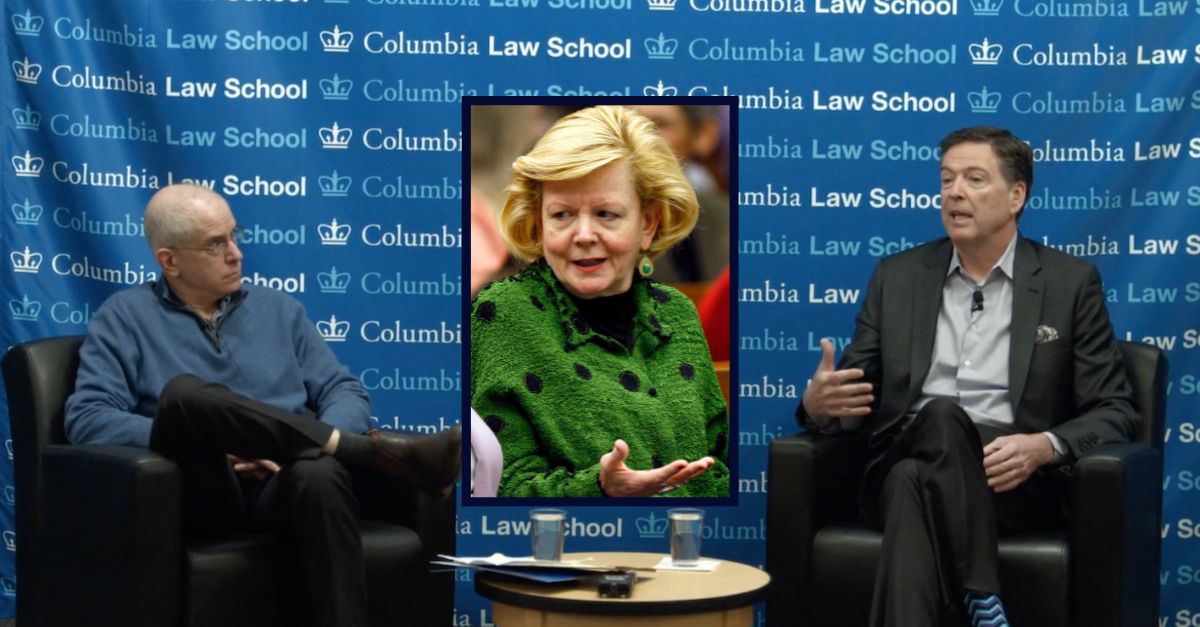
Main: Daniel Richman and James Comey speak on the Hillary Clinton investigation and other topics at Columbia Law School on February 5, 2020 (Columbia Law School/YouTube). Inset: U.S. District Judge Colleen Kollar-Kotelly, who is also the Presiding Judge of the United States Foreign Intelligence Surveillance Court, is pictured before the start of a ceremony at the federal courthouse in Washington, Thursday, May 1, 2008. (AP Photo/Charles Dharapak).
A federal judge over the weekend tersely reminded the DOJ that it cannot simply search the long ago seized files of James Comey”s former lawyer and friend for “classified material” absent a “valid search warrant,” as the government appeals the dismissal of the ex-FBI director’s prosecution.
Senior U.S. District Judge Colleen Kollar-Kotelly said her prior orders were already clear that the DOJ cannot conduct warrantless searches for classified information in Daniel Richman’s personal computer files, but just in case the Trump administration wasn’t fully aware of that reality, she took it upon herself to “re-emphasize those obligations.”
In the Saturday order, the judge chided the government for apparently asking her for “permission” to search Richman’s seized files for “classified material” without “obtaining a valid search warrant,” the very behavior her orders siding with Comey’s friend walled off in the first place.
Richman’s lawsuit against the government began in late November, not long after another federal judge dismissed Comey’s case on the grounds that U.S. Attorney General Pam Bondi “unlawfully appointed” Lindsey Halligan as interim U.S. attorney for the Eastern District of Virginia.
Richman claimed that the government trampled on his Fourth Amendment rights and conducted illegal searches of his files to prosecute Comey, using files seized up to six years ago as part of an FBI leak probe that led to no charges against Richman. The DOJ countered that the plaintiff’s lawsuit was to provide cover for a friend against a reindictment.
Kollar-Kotelly, appointed to judgeships by Presidents Ronald Reagan and Bill Clinton, and once appointed the presiding judge of the FISA court by then-Chief Justice William Rehnquist, said earlier in December that Richman “made each of the necessary showings to obtain a narrow temporary restraining order” against the DOJ, blocking the feds from searching his files without a warrant.
The judge found Richman was “likely to succeed on the merits of his claim that the Government has violated his Fourth Amendment right against unreasonable searches and seizures by retaining a complete copy of all files on his personal computer (an ‘image’ of the computer) and searching that image without a warrant.” She ordered that the DOJ could not “access the covered materials” or share them “without first seeking and obtaining leave of this Court.”
Kollar-Kotelly subsequently clarified that the DOJ was allowed to access the “covered materials” for the “limited purpose” of “permanently delet[ing]” one “purportedly classified memorandum” from “any such” Richman device before returning the device to the plaintiff.
On Christmas Eve, Halligan and Deputy Attorney General Todd Blanche filed an emergency motion for more time to certify that the DOJ has complied with the judge’s order. But in that motion, the judge said Saturday, the government seemed to contemplate a warrantless search for classified information beyond the lone memorandum.
“[T]he Government’s Motion also appears to request permission to search Petitioner Richman’s materials for classified material without first obtaining a valid search warrant, which would be in direct contravention of the Court’s prior Orders,” Kollar-Kotelly wrote. “Accordingly, because the Court has already ordered that the Government may not search Petitioner Richman’s material to identify additional classified information without first obtaining a valid search warrant, the Court shall DENY the Government’s request to do so.”
While the judge gave the DOJ until Jan. 5 to confirm its compliance, she emphasized that she has “repeatedly explained” what Richman has “consented” to regarding the single memo and what the DOJ must do from here.
“[T]he Court has explained that, on the present record, there is only one purportedly classified document within Petitioner Richman’s materials: the memorandum from Mr. Comey that was contained in the material originally seized in 2017 from Petitioner Richman’s personal computer hard drive,” Kollar-Kotelly summarized. “Petitioner Richman has consented multiple times to having the Government delete this classified memorandum from the material that is returned to him.”
“While the Court has clearly ordered that the Government may delete the single classified memorandum from Mr. Comey from the material seized from Petitioner Richman’s personal hard drive before returning those materials to Petitioner Richman, the Court has been equally clear in ordering that the Government ‘may not conduct any additional review of Petitioner Richman’s materials for classified material without first obtaining a valid search warrant,'” she added.
The judge noted that the Trump administration “reviewed” Richman’s files “numerous times” — “both lawfully and unlawfully” — and “failed to identify any purportedly classified material beyond the single memorandum identified in the record.”
As a result, Kollar-Kotelly ordered that the DOJ “shall not review” the files in search of “classified material beyond the single classified memorandum […] without first obtaining a valid search warrant.”


