
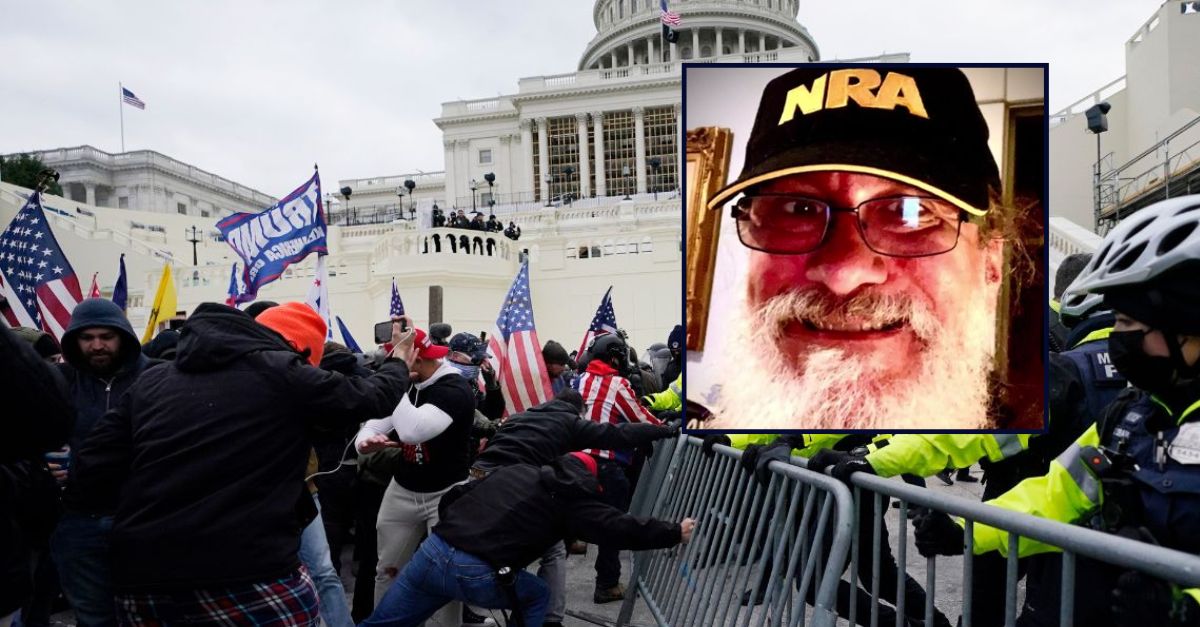
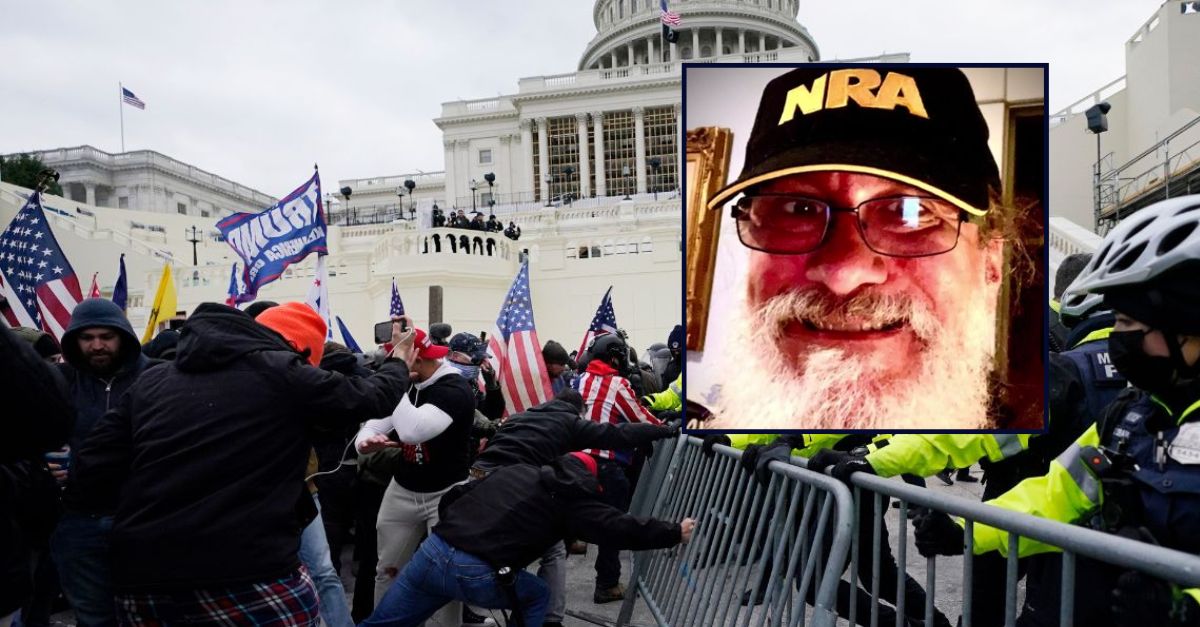
Inset: William McCall Calhoun, Jr. (WXIA). Background: FILE – In this Jan. 6, 2021, file photo, Trump supporters try to break through a police barrier at the Capitol in Washington. (AP Photo/Julio Cortez, File).
A Georgia attorney who admittedly “stormed” the U.S. Capitol “looking for members of Congress” during the Jan. 6 attack may soon find himself banned from ever practicing law again in the Peach State.
In a 13-page per curiam opinion, the Supreme Court of Georgia rejected the notion that William McCall Calhoun Jr. should get off relatively easy by being disciplined in the form of a public reprimand.
Instead, disbarment should be something not entirely unlike the default choice in the matter, the unanimous court determined.
The facts of the case are not in dispute, the court notes.
Calhoun has repeatedly, under oath, admitted to taking part in the pro-Donald Trump riot at the national seat of legislative government. The attorney has even recently “acknowledged that his conduct was inappropriate and reflected poorly on the legal profession.”
From the opinion, at length:
Calhoun admitted that he entered the Capitol Building and walked around the Capitol Building. He further admits that when he entered the building, he heard alarms going off and understood that he was entering a restricted building that he should not enter. Moreover, Calhoun admits he “understood [what he] was guilty of” and that he “could be charged with criminal trespass.”
The latest mea culpa came when Calhoun himself floated the idea that his actions on that fateful day should be punished by a “public reprimand.” This form of sanction was subsequently endorsed by the State Bar of Georgia and the special master overseeing the case.
After the special master issued their final report and recommendation, however, the justices were not at all convinced.
“Having reviewed the entire record in this case, we disagree with the parties that a public reprimand is appropriate here,” the opinion reads.
The justices say the kind of conduct admitted to by Calhoun implicates an ethical rule for lawyers which “imposes discipline for conduct similar” to a series of other rules and that such violations “in general are considered very serious.”
“And while violations of [the other rules] do not necessarily require it, they frequently result in disbarment,” the opinion goes on. “The cases involving [other rule] violations are particularly relevant here, given that while Calhoun may have ultimately been pardoned for federal offenses, pardons do not prevent disbarment for the underlying activity that formed the basis of the crime that was later pardoned.”
Notably, the court spends some time — and a footnote — discussing Calhoun”s criminal conviction “and subsequent dismissal with prejudice of the indictment resulting from his presidential pardon on January 20, 2025.” Ultimately, the state’s highest court dismisses the pardon as a non-issue in terms of ethical obligations for attorneys.
Instead, the court’s focus is that the “criminal acts” committed by Calhoun “reflect adversely on his fitness as a lawyer.”
“As part of the State Bar’s response to Calhoun’s petition for voluntary discipline, it introduced Calhoun’s social media posts from January 6, 2021, which clearly suggest that he intended to participate, willingly and knowingly, in a violent takeover of the Capitol to overturn the 2020 election and that he sought to interfere with the administration of justice,” the opinion explains.
The court goes on to document some of those social media posts, including claims that he was part of a group that “physically took control” of the Capitol building “in a hand to hand hostile takeover.” In other comments, Calhoun said the rioters “occupied the Capitol and shut down the Government” and that he was one of the “first two hundred to rush up the steps and inside after the Vanguard had clashed hard with the police and had made them retreat.”
The court takes particular umbrage at “comments directed towards certain members of Congress that the group intended to harm.”
The opinion noted Calhoun’s own version of what happened when he and other rioters entered the building:
[They] kicked in Nancy Pelosi’s office door and pushed down the hall towards her inner sanctum, the mob howling with rage – Crazy Nancy probably would have been torn into little pieces, but she was nowhere to be seen – then a swat [sic] team showed, and we retreated back to the rotunda and continued our hostile take over of the Capitol Building.
“If Calhoun was as involved as his posts indicate, then it is hard for us to see how anything less than disbarment can be accepted here,” the opinion concludes. “Accordingly, we reject the petition for voluntary discipline and remand this matter for further proceedings.”


