
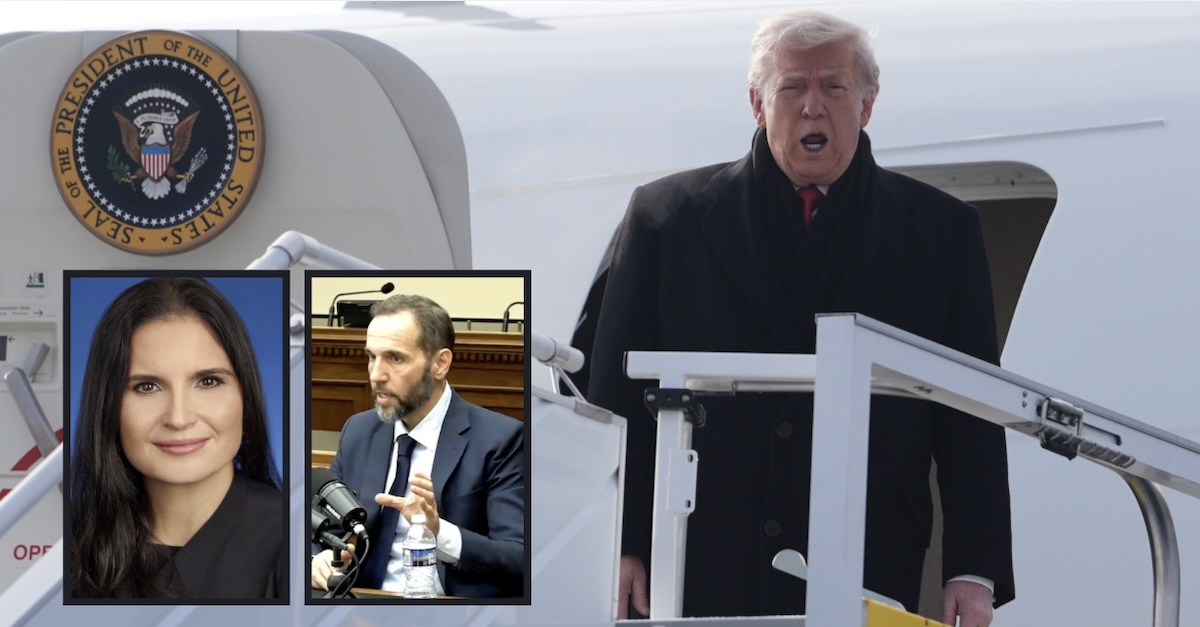
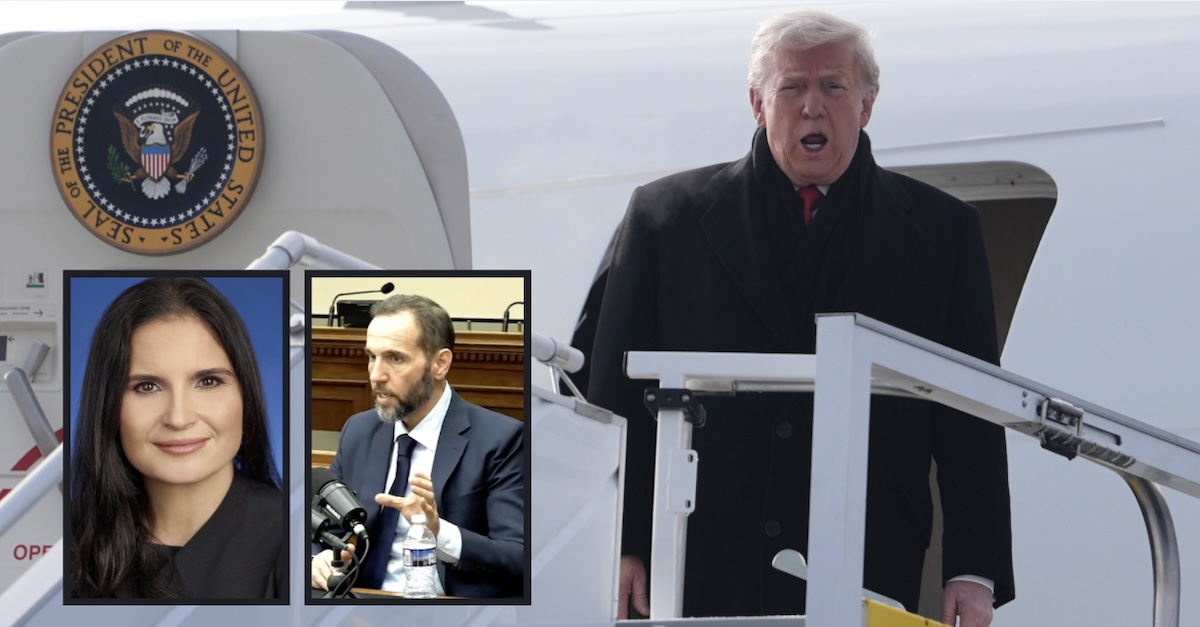
Left inset: Judge Aileen Cannon (U.S. District Court). Right inset: Jack Smith sits for House Judiciary Committee deposition in defense of his investigations on Dec. 17, 2025 (House Judiciary Committee/YouTube). Main: President Donald Trump steps off Air Force One after arriving at Zurich International Airport for the World Economic Forum, Wednesday, Jan. 21, 2026, in Zurich, Switzerland. (AP Photo/Evan Vucci).
The DOJ”s Office of Legal Counsel issued an opinion this week that purports to absolve President Donald Trump from having to “comply” with a Richard Nixon-era records preservation law.
The legal opinion penned by Assistant Attorney General T. Elliot Gaiser, a former clerk to Justice Samuel Alito, explained that the office was responding to the question of whether the Presidential Records Act (PRA) is constitutional.
“We conclude it is not,” the memo said from the start.
The PRA was enacted in 1978 with Watergate fresh on Congress’ mind; no longer were presidents’ records to be regarded as their personal property, which they could even destroy as they saw fit.
The legislation gave the United States “complete ownership, possession, and control” over presidential records, requiring that the chief executive “adequately” document “activities, deliberations, decisions, and policies that reflect the performance of the President’s constitutional, statutory, or other official or ceremonial duties” for their submission to the National Archives (NARA) and, by extension, the American people.
But according to the DOJ, Trump doesn’t have to worry about that law — “invalid in its entirety” and lacking an enforcement mechanism — any longer.
“[T]he PRA is unconstitutional, and the President need not further comply with its dictates,” the memo stated, going so far as to claim that Congress “cannot preserve presidential records merely for the sake of posterity.”
At another point, the memo called for a return to the days when losing papers to history was “accepted” as the cost of doing business in a presidential-records-are-personal world.
“Until President Nixon, every President treated his official documents ‘as private papers to hold, give away, withhold from others, transfer for consideration or bequeath as he saw fit,'” the document went on. “This tradition of presidential control came at a recognized, but accepted, cost: Historical records—even official documents of public interest—were inevitably lost.”
The memo tossing the PRA in the trash was issued on April Fools’ Day, which also happened to be the eve of Pam Bondi’s ouster as attorney general.
On page 26 of the memo, the OLC referenced Trump’s dismissed classified documents prosecution — and blamed the PRA for it.
“The seeming acquiescence of the Executive Branch since the PRA’s enactment may be motivated by nothing more than discretionary choices to avoid an interbranch conflict. But, over time, it has subtly reshaped how the political branches and the public perceive the separation of powers,” the opinion continued. “This shift has already gone so far that attempts have been made to subject a former President to criminal liability for his handling of presidential records that, for most of this Nation’s history, would have been subject to his complete discretion.”
What the DOJ described as Trump’s “handling of presidential records” was the basis for charges that he took willfully retained classified documents at Mar-a-Lago as a former president and conspired to obstruct their return to NARA.
Trump’s Mar-a-Lago criminal defense team, which included the now-acting AG Todd Blanche, attempted to use the PRA to defeat special counsel Jack Smith’s case.
U.S. District Judge Aileen Cannon, a Trump appointee, ultimately tossed the indictment in July 2024 by finding Smith was unlawfully appointed.
Several months prior, Blanche suggested that presidents since George Washington had at their “own discretion” taken “materials out of the White House” and, thus, Trump could decide classified national defense documents were “personal” and the indictment should fail.
The special counsel successfully countered that the PRA “[did] not exempt Trump from the criminal law, entitle him to unilaterally declare highly classified presidential records to be personal records, or shield him from criminal investigations—let alone allow him to obstruct a federal investigation with impunity.”
Smith won that battle but Cannon ensured he would lose the war, and the results of his Mar-a-Lago investigation continue to be buried.
The executive director of one of the groups suing in the hopes of bringing Volume II of Smith’s report to light called the OLC memo a “permission slip” to hide “corruption.”
“From its inception nearly half a century ago, the Presidential Records Act has been clear: presidential records belong to the American people, not to any one president,” American Oversight’s Chioma Chukwu said in a statement to Law&Crime. “The Trump administration’s attempt to evade the Presidential Records Act is as legally suspect as it is dangerous.”
“It is a permission slip to hide evidence of corruption, abuse of power, and misconduct from the public. The law exists to ensure that no president can rewrite history or conceal wrongdoing — and efforts to sidestep it strike at the core of government accountability,” Chukwu added.


