
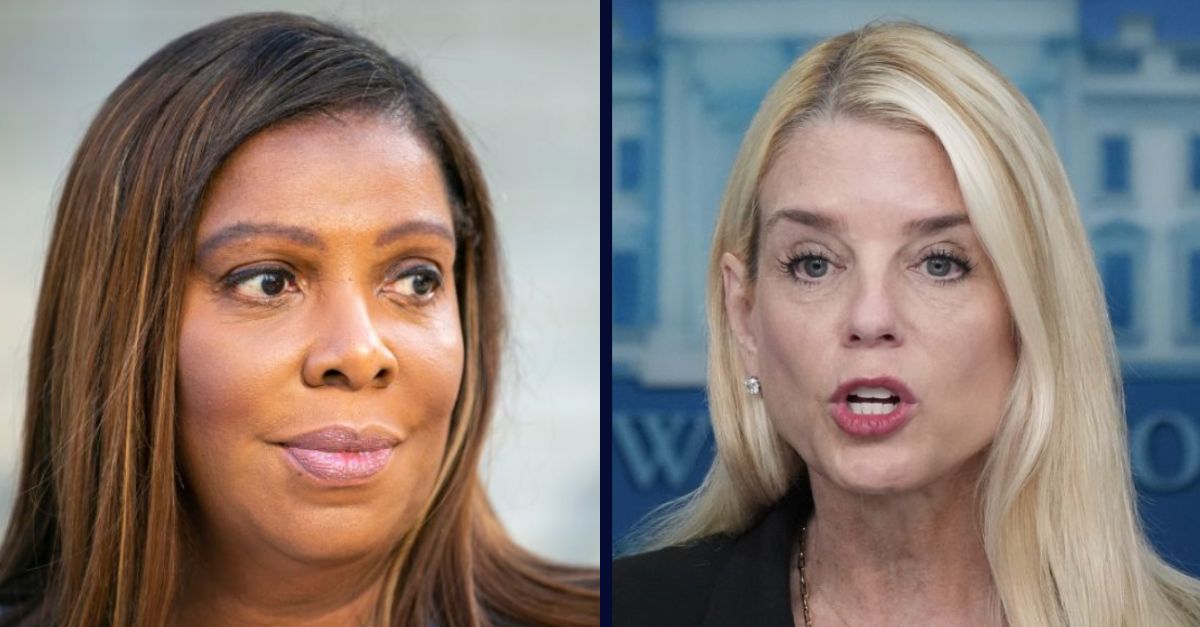
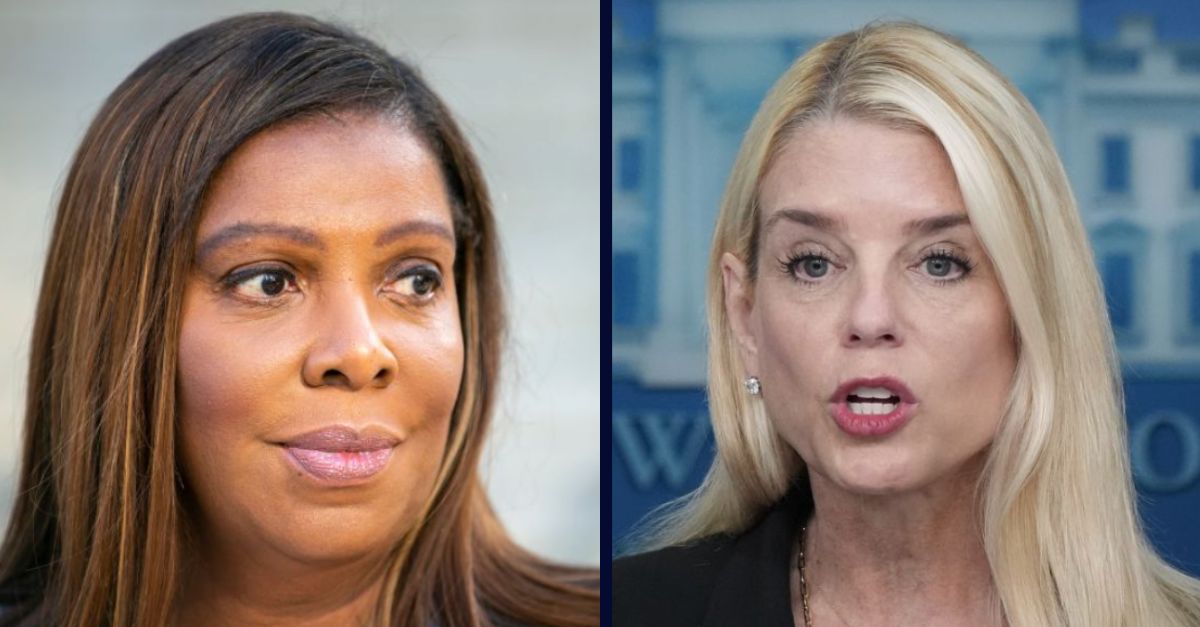
Left: New York Attorney General Letitia James speaks to the media, Nov. 6, 2023, in New York (AP Photo/Ted Shaffrey, File). Right: Attorney General Pam Bondi, speaks during a news conference with President Donald Trump in the James Brady Press Briefing Room at the White House, Monday, Aug. 11, 2025, in Washington (AP Photo/Alex Brandon).
A federal judge granted New York Attorney General Letitia James a resounding victory in quashing grand jury subpoenas sought by Attorney General Pam Bondi”s handpicked acting U.S. attorney, the result of yet another major disqualification ruling.
Without even having to reach James’ arguments that John Sarcone was out for political “revenge” on President Donald Trump’s behalf in investigating James’ investigations, Senior U.S. District Judge Lorna Schofield, a Barack Obama appointee, ruled Thursday morning that the purported Northern District of New York top prosecutor “was not lawfully serving as Acting U.S. Attorney when the subpoenas were issued.”
The judge noted that the DOJ can try to “re-issue the subpoenas at the direction of a lawfully authorized attorney for the Federal Government, without Mr. Sarcone’s involvement,” though that could lead to a renewed motion to quash from James.
As Law&Crime reported in the lead-up to a key hearing on the issue, the Democratic AG cited federal judges’ repeated invalidations of Bondi’s temporary U.S. attorneys and special attorneys — whether Alina Habba, Sigal Chattah, Bill Essayli, or perhaps most famously Lindsey Halligan — to argue that the same result should await Sarcone.
In a motion to quash filed in August, James said Sarcone’s subpoenas for documents on her civil fraud lawsuit against Trump and his family business and on her lawsuit against the NRA were little more than “revenge” — “because the President is unhappy that [her office] successfully enforced the laws of the State of New York against him and his allies.”
Referring to Sarcone as a “self-proclaimed Acting U.S. Attorney,” James said Bondi’s appointment method for Sarcone raised the question of whether the subpoenas were valid at all.
Sarcone, a Trump loyalist who lacked prosecutorial experience and at least once called the Democratic Party “evil,” was appointed by Bondi in late February 2025 and then sworn in as interim U.S. Attorney for the Northern District of New York.
Like Habba, Sarcone was an interim U.S. attorney whom a federal court ultimately declined to appoint as his 120-day stint reached its expiration date. And yet, Bondi kept them in place by simultaneously naming them a supervising “Special Attorney to the Attorney General” and first assistant U.S. attorneys, normally the second in command to the U.S. attorney but here the number one — the acting U.S. attorney — by default.
James also called attention to the fact that the criminal bank fraud case against her was thrown out due to Bondi’s “invalid” appointment of Halligan on an interim basis.
Schofield took stock of the way the wind has blown against Trump’s DOJ, in multiple jurisdictions and regarding several interim or acting U.S. attorneys, and came to the “same conclusion.”
“A growing body of persuasive authority reinforces this conclusion. Since August 2025, courts in New Jersey, Nevada and California have held that similarly installed Acting U.S. Attorneys lacked lawful authority,” the judge wrote, referring Habba, Chattah, Essayli, and then Halligan. “Most recently, in November 2025, the Third Circuit affirmed the New Jersey decision. The Eastern District of Virginia also reached a comparable result in a slightly different procedural posture.”
“When the Executive branch of government skirts restraints put in place by Congress and then uses that power to subject political adversaries to criminal investigations, it acts without lawful authority,” Schofield added. “Subpoenas issued under that authority are invalid. The subpoenas are quashed, and Mr. Sarcone is disqualified from further participation in the underlying investigations.”
In a parting shot, the judge made clear that Sarcone was disqualified from “any further involvement in prosecuting or supervising the instant investigations, regardless of his title,” consistent with “similar remedies” of other courts and applying the “same principles” to “prevent” him from “continuing to direct the investigations at issue.”


