
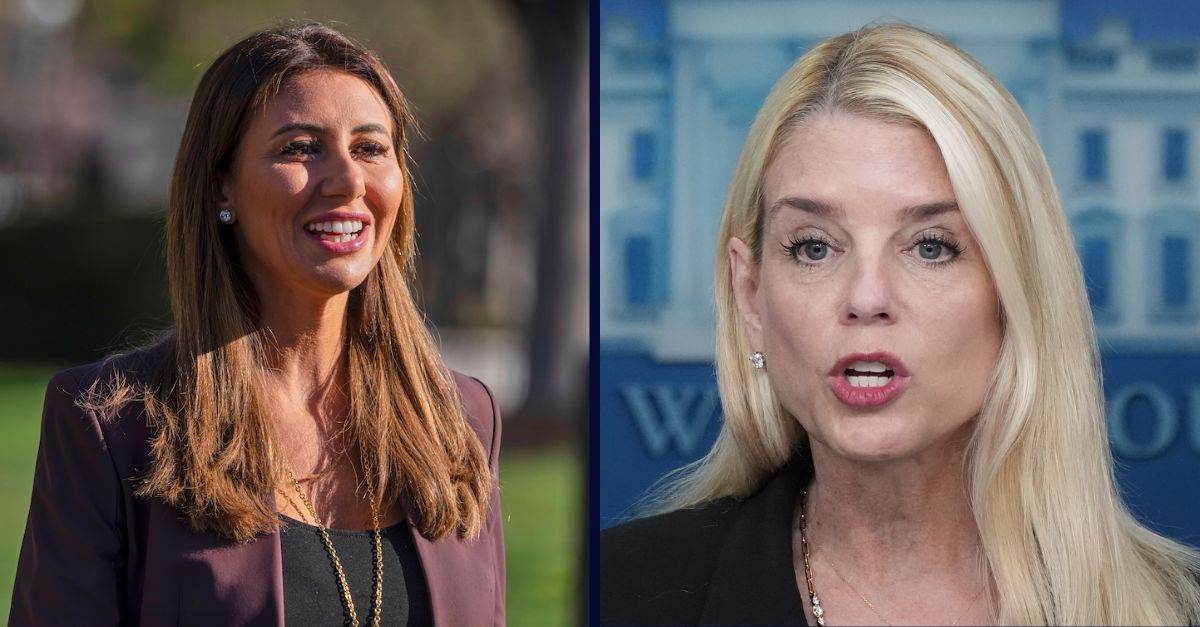
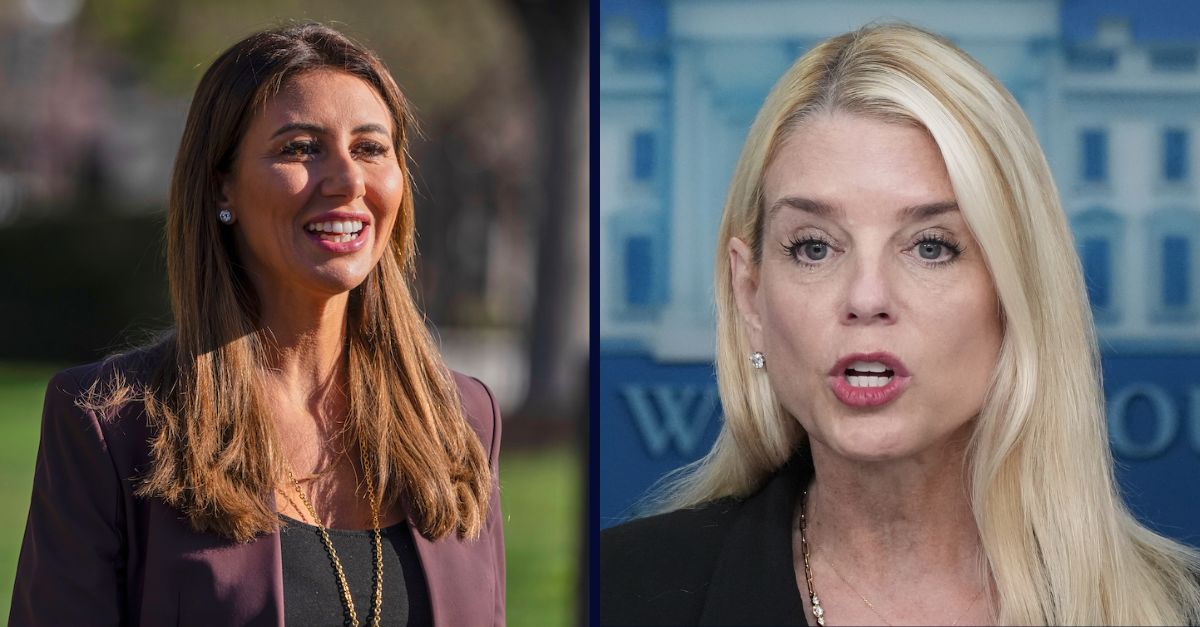
Left: Alina Habba, President Donald Trump”s pick to be the interim U.S. Attorney for New Jersey, arrives to speak with reporters outside the White House, March 26, 2025, in Washington (AP Photo/Mark Schiefelbein, File). Right: Attorney General Pam Bondi, speaks during a news conference with President Donald Trump in the James Brady Press Briefing Room at the White House, Monday, Aug. 11, 2025, in Washington (AP Photo/Alex Brandon).
The U.S. Department of Justice is imploring a federal appellate court to reconsider its opinion nixing President Donald Trump’s appointment of Alina Habba as the top federal prosecutor for New Jersey.
In March 2025, the 45th and 47th president named Habba interim U.S. Attorney for the District of New Jersey, later formally nominating her and setting up a would-be showdown in the U.S. Senate.
The appointment, however, appeared dead on arrival as multiple senators telegraphed their intention to nix the nomination. In turn, the DOJ played a game of musical chairs aimed at keeping the 45th and 47th president’s former personal attorney secure in the post.
To keep Habba in the position, Trump pulled her nomination to the permanent role and Habba herself resigned. Then, Habba’s first assistant was fired and Habba was reinstated in that inferior position – meaning she was the highest-ranking remaining official – and became Acting U.S. Attorney. Meanwhile, New Jersey’s federal judiciary voted not to keep Habba in charge; opting instead for the office to be led by the fired first assistant, Desiree Leigh Grace.
In August 2025, a federal district judge sided with criminal defendants who sought to disqualify Habba from prosecuting their cases. This ruling explicitly sided with the judiciary and against the DOJ.
“Faced with the question of whether Ms. Habba is lawfully performing the functions and duties of the office of the United States Attorney for the District of New Jersey, I conclude that she is not,” Middle District of Pennsylvania’s Chief U.S. District Judge Matthew Brann, a Barack Obama appointee, who was assigned to take over the case, wrote.
In December 2025, a three-judge panel on the U.S. Court of Appeals for the 3rd Circuit affirmed the lower court’s decision.
Now, the Trump administration is asking the full appellate court to rehear the case, arguing the panel “improperly” and “erroneously” interpreted the Federal Vacancies Reform Act of 1998 (FVRA).
“Indeed, the panel’s interpretation of the FVRA would hobble Presidential transitions and has been routinely violated by the last four administrations without any court holding the practice unlawful,” the 21-page petition reads. “Rehearing en banc is warranted.”
To hear the government tell it, the panel made a mistake when describing Habba as a “de facto” U.S. Attorney.
“Under the Government’s delegation theory, Habba may avoid the gauntlet of presidential appointment and Senate confirmation and serve as the de facto U.S. Attorney indefinitely,” the panel opined in its 32-page opinion. “This view is so broad that it bypasses the constitutional [appointment and confirmation] process entirely.”
In essence, the panel said the government simply tried to imbue Habba with far too much authority. Specifically, the court said Habba had been “delegated the full scope of powers of an Acting U.S. Attorney.” This grant of power, in effect, created a workaround that did not deal with the strictures of the FVRA, the panel found.
The government, however, says the panel read far too much into Habba’s appointment and that it was done in line with the FVRA.
“Here, the Attorney General delegated the authority to prosecute crimes and supervise litigation in the District of New Jersey to Ms. Habba as the First Assistant U.S. Attorney for the district,” the petition goes on. “The plain text of the FVRA does not prohibit that delegation: the FVRA does not prohibit the exercise of delegable functions.”
Rather, the government says, the relevant section of the FVRA is an “exclusive” vehicle for installing acting officials while the appointment and confirmation process plays out – instead of a means by which to police a delegation of authority.
“It does not purport to prohibit the exercise of delegable functions by non-acting officials,” the petition continues.
In other words, the government is arguing that the statute cited to disqualify Habba “simply does not address” the issue.
The Trump administration further argues that, to the extent the FVRA might apply in a case like Habba’s, a separate section of the statute only purports to invalidate “non-delegable, exclusive functions” of an office.
Trying for a logical argument, the petition notes that the U.S. attorney general routinely and “broadly” delegates her authority “such as her delegation to the Deputy Attorney General to exercise all the non-exclusive functions of the Attorney General, which includes the non-exclusive functions of each and every U.S. Attorney.”
“There is no reason why Congress would have prohibited the delegation of all the delegable duties of an office but allowed the delegation of all but one (or two, or three, or four) of those duties,” the filing goes on. “Those are the limits that Congress chose.”
Matt Naham contributed to this report.


