
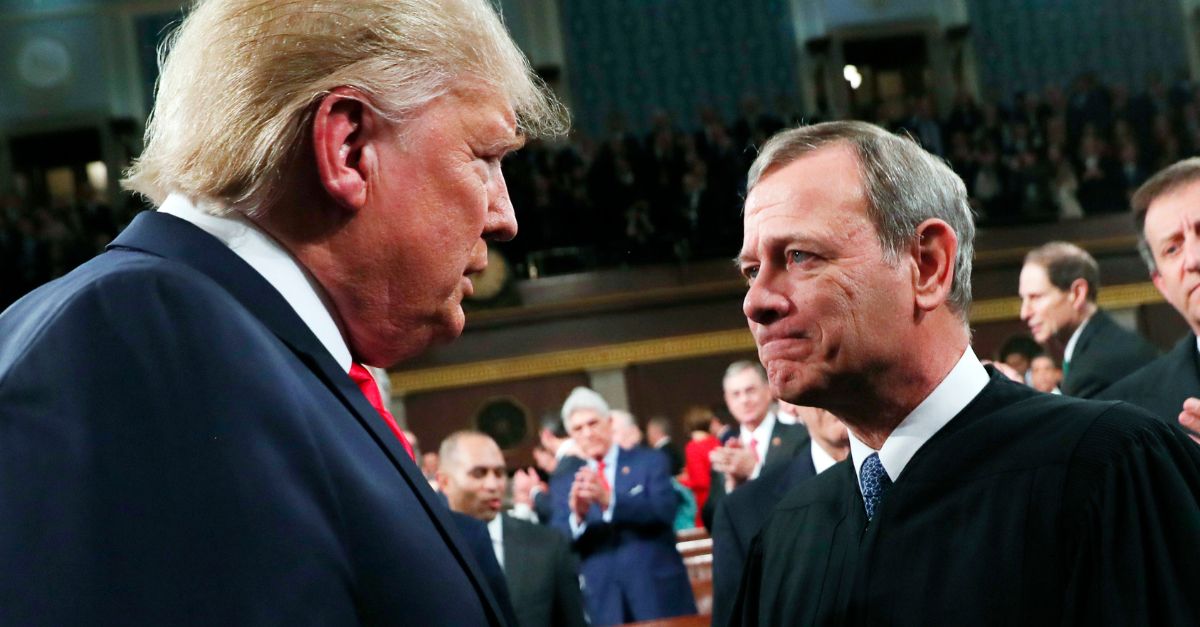
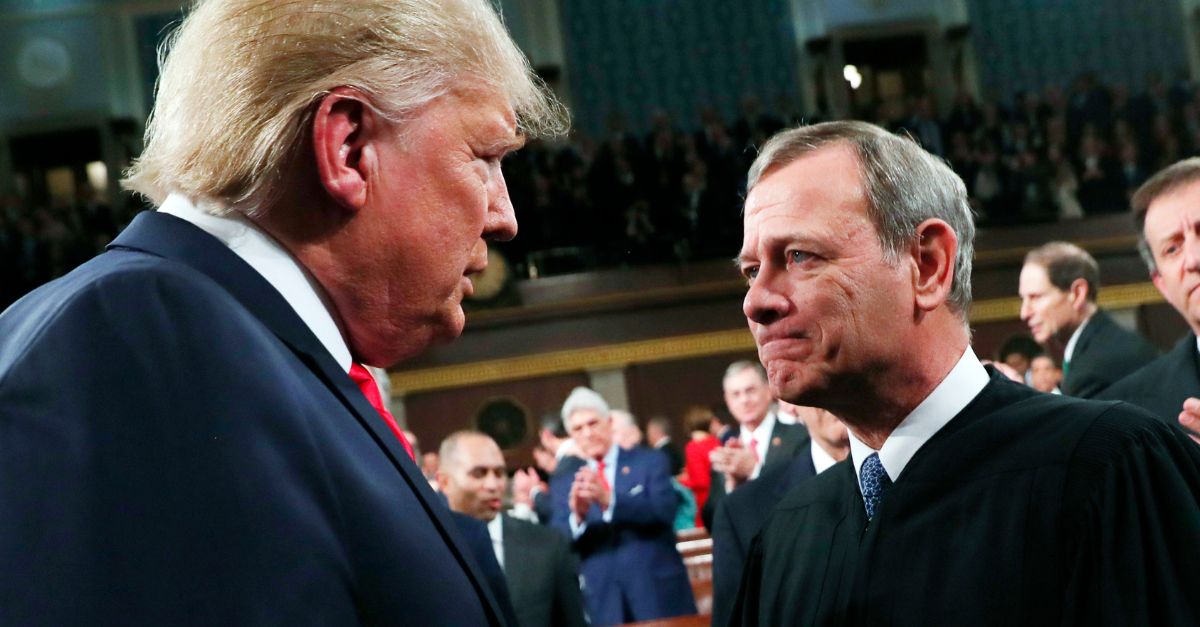
President Donald Trump greets Supreme Court Chief Justice John Roberts as he arrives to deliver his State of the Union address to a joint session of Congress in the House Chamber on Capitol Hill in Washington, Tuesday, Feb. 4, 2020 (Leah Millis/Pool via AP).
A lawsuit filed by a pro-Donald Trump law firm co-founded by Stephen Miller was tossed for lack of jurisdiction as a federal judge reminded the plaintiff that judicial entities are not subject to Freedom of Information Act (FOIA) litigation.
U.S. District Judge Trevor McFadden, a Trump appointee, rejected the lawsuit”s fundamental contention that Chief Justice John Roberts exercises powers that fall under the “ambit” of the executive branch and place him, in one role, under the supervision and control of the president.
In April, America First Legal argued that the highest-ranking judge in the nation, Roberts, actually wields executive branch authority in his capacity as presiding officer of the Judicial Conference of the United States, the “policymaking body” of the federal courts, which also supervises the Administrative Office of the U.S. Courts (AO).
The complaint aimed to expose “lawfare” on the part of congressional Democrats who accused conservative justices Clarence Thomas and Samuel Alito of “ethical improprieties” and lawbreaking for not including luxury trips and “personal hospitality” perks in financial disclosure forms.
The suit said the Judicial Conference and AO closed the “personal hospitality” loophole under pressure from Sen. Sheldon Whitehouse, D-R.I., and Rep. Hank Johnson, D-Ga. The lawsuit demanded to learn through FOIA what “both entities,” Whitehouse, Johnson, or “their staff members” communicated on the subject.
Calling the Judicial Conference and AO “independent agencies within the executive branch” rather than courts, the lawsuit insisted that Roberts acts “as an agency head” and a “principal officer […] required to be presidentially appointed.”
The initial FOIA requests went nowhere, as the Judicial Conference and the AO countered that the transparency law does not apply to entities of the judicial branch.
The lawsuit that followed didn’t make any headway, as McFadden granted lead defendant Roberts’ motion to dismiss for lack of subject matter jurisdiction.
“While FOIA promises access to many Executive Branch records, Congress excused itself and the courts from FOIA’s reach,” the judge said straightforwardly, before picking apart the rest.
“The case boils down to one issue. Are the Judicial Conference and Administrative Office ‘agencies’ subject to FOIA?” McFadden asked and answered no.
“For starters, neither is like the Executive Branch entities FOIA explicitly contemplates as examples of an ‘agency,'” the judge said, adding the Judicial Conference and AO “do not appear to be the type of entities Congress had in mind in creating FOIA—Executive Branch departments and independent agencies.”
Instead, the entities “fall within FOIA’s exception for ‘courts of the United States'” though they are not themselves courts, McFadden went on.
“Nothing about either entity’s structure suggests the President must supervise their employees or otherwise keep them ‘accountable,’ as is the case for executive officers,” he concluded.
Read the dismissal in full here.


