
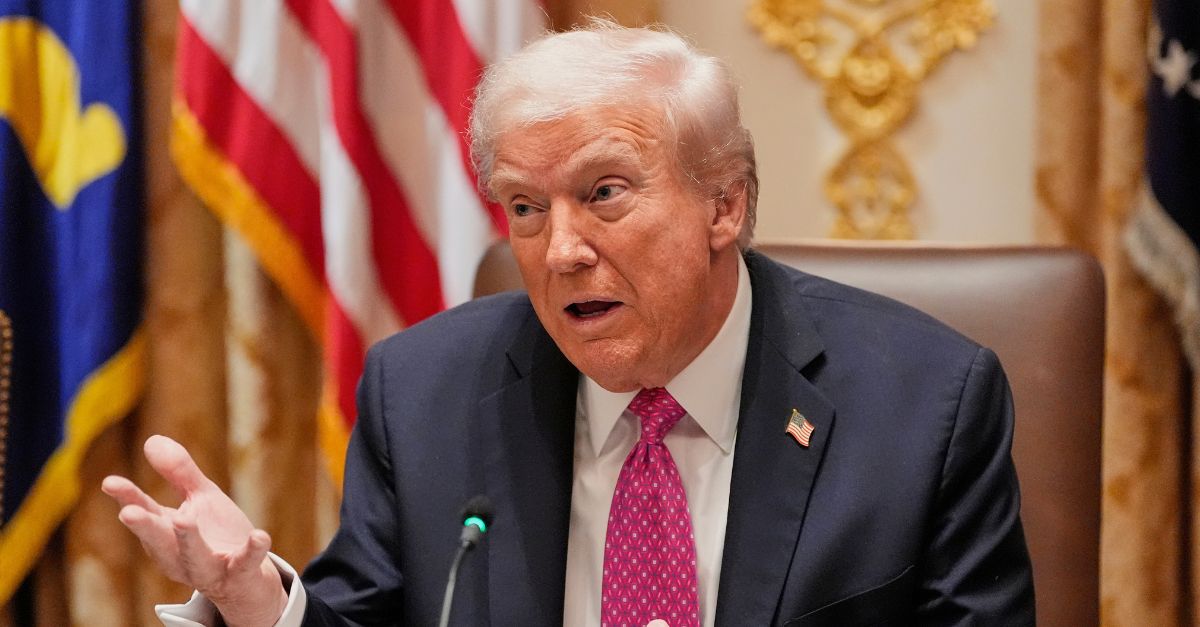
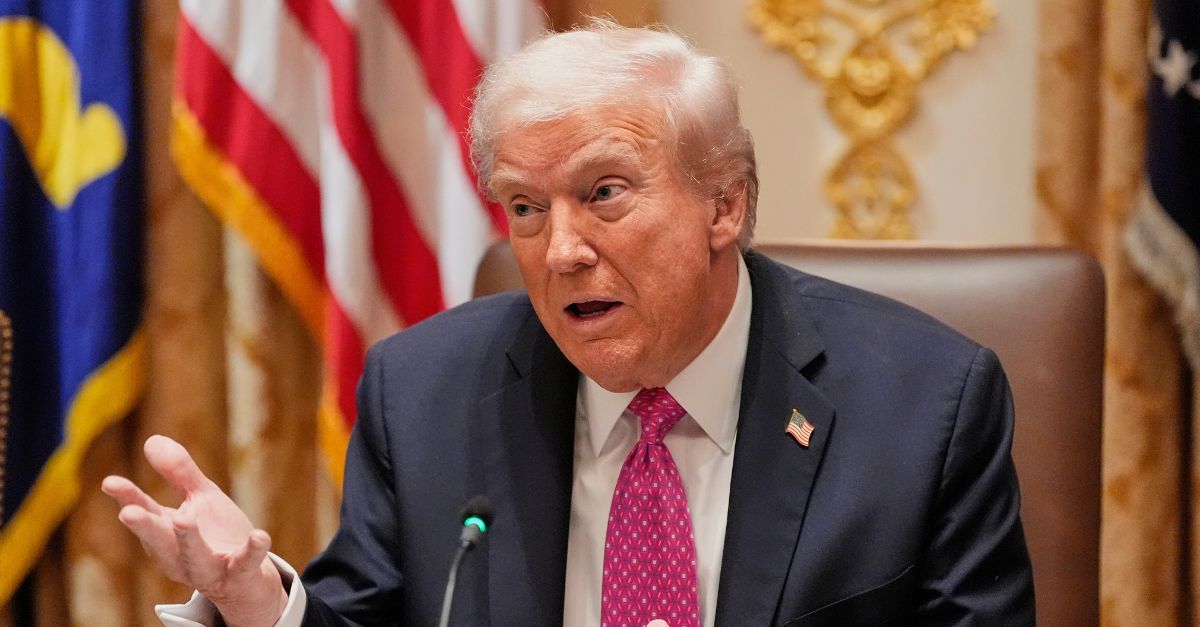
President Donald Trump speaks in the Cabinet Room of the White House, Friday, Oct. 17, 2025, in Washington (AP Photo/Alex Brandon).
Oregon does not have to turn over comprehensive voter registration to the Trump administration, a federal court ruled this week.
In September 2025, the U.S. Department of Justice sued the Beaver State and its Secretary of State Tobias Read. The lawsuit alleged violations of the National Voter Registration Act (NVRA), the Help America Vote Act (HAVA), and the Civil Rights Act (CRA) of 1960.
In November 2025, Oregon filed a motion to dismiss. Days later, the state received an assist when the Democratic National Committee filed an amicus, or friend of the court, brief in support of that motion.
On Wednesday evening, in a bench ruling, U.S. District Judge Mustafa T. Kasubhai, a Joe Biden appointee, signaled he would rule in Oregon”s favor by likely dismissing the DOJ’s lawsuit in the coming days.
“I’m very cautious and doubtful that what you’re asking for, which is an unredacted list, is actually going to give you the information that you need to establish a violation,” the judge told a DOJ lawyer during a motion hearing, according to a courtroom report by Oregon Public Broadcasting.
In ruling against the government, the court seemed to accept Oregon’s argument that the granular level of data sought by the federal government was simply not part of federal law.
Oregon argued, and Kasubhai apparently agreed, that the state regularly provides a list of voter registration data with information like names, addresses, party identification and birth years. The Trump administration, however, wanted quite a bit more – demanding birth months, Social Security numbers, and driver’s license numbers.
“The list itself is not an uncommon thing to be requested, but the (National Voting Rights Act) doesn’t distinguish between the special list that you have to provide the federal government with this additional private information,” Thomas Castelli, an attorney for Oregon, argued. “It’s just not in there.”
In its 22-page lawsuit, the DOJ accuses Oregon of violating “federal voting laws” by “failing to provide information necessary” for DOJ to assess the state’s compliance with multiple provisions of NVRA and HAVA. Specifically, the government alleges Oregon has failed to maintain “accurate and current voter registration rolls” and, closely related, has failed to conduct routine removals of “ineligible” voters. To that end, the Trump administration tried to use Title III of the Civil Rights Act to force Oregon into providing the requested documents.
The state argues Title III – which does, in fact, have a document production provision – cannot be used by the government in this way because its lawsuit has nothing to do with civil rights.
“[T]he stated purpose falls outside the scope of the CRA,” Oregon’s 30-page motion to dismiss reads. “The CRA’s text and history limit Title III to investigations of civil rights violations, namely, efforts to prevent eligible voters from voting or registering to vote for illegal reasons like racial discrimination.”
Part and parcel of the DOJ’s argument was that Oregon had registered far too many people to vote by the time of the 2024 general election — with numbers eclipsing the national average.
“When you see a state that’s consistently above 90% of the citizen voting age population, it’s a potential yellow flag,” DOJ lawyer James Thomas Tucker argued. “When the state goes above the 95% threshold, that’s a red flag.”
Kasubhai rejected the federal government’s understanding of the Civil Rights Act during the Wednesday hearing, nixing the argument that Oregon had failed to remove enough voters from its rolls.
“I can appreciate that the context in which the Civil Rights Act was promulgated was because of the historical exclusion of people on the basis of race from voting,” the judge said. “And so I think exclusion was the primary consideration, not over-inclusion.”
In the end, the Trump administration had not provided enough facts to supports its argument that Oregon was not properly maintaining its voter rolls, Kasubhai found, according to a courtroom report by The Oregonian. While states are expected to make a “reasonable” effort, the court agreed with Oregon’s lawyers that the federal government has better alternatives — other than obtaining sensitive personal information — to ensure such efforts are carried out.
While Kasubhai said the exact contours of his written order could be a bit different than his “tentative” bench ruling — meaning that full dismissal of the lawsuit might not occur — the Eugene-based judge said keeping voters’ private information out of the DOJ’s hands was likely to remain in the order.
“I feel we have done justice,” the judge said.
The state’s top voting administrator welcomed the tentative ruling.
“The federal government tried to abuse their power to force me to break my oath of office and hand over your private data,” Read said in a statement provided to local media. “I stood up to them and said no. Now, the court sided with us. Tonight, we proved, once again, we have the power to push back and win.”


