
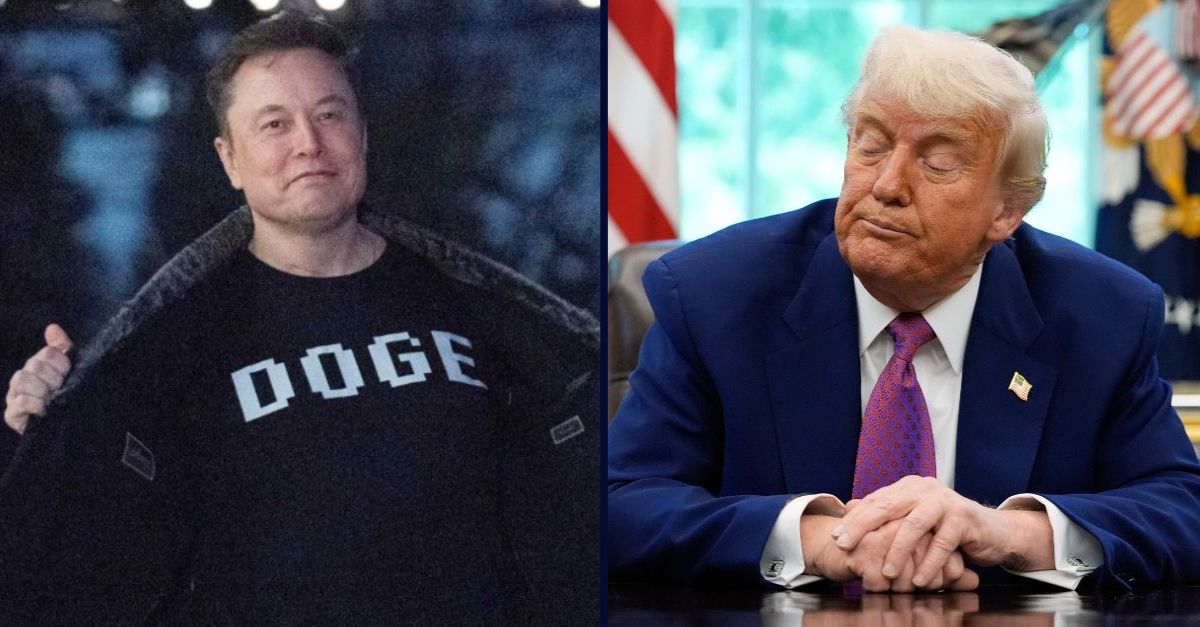
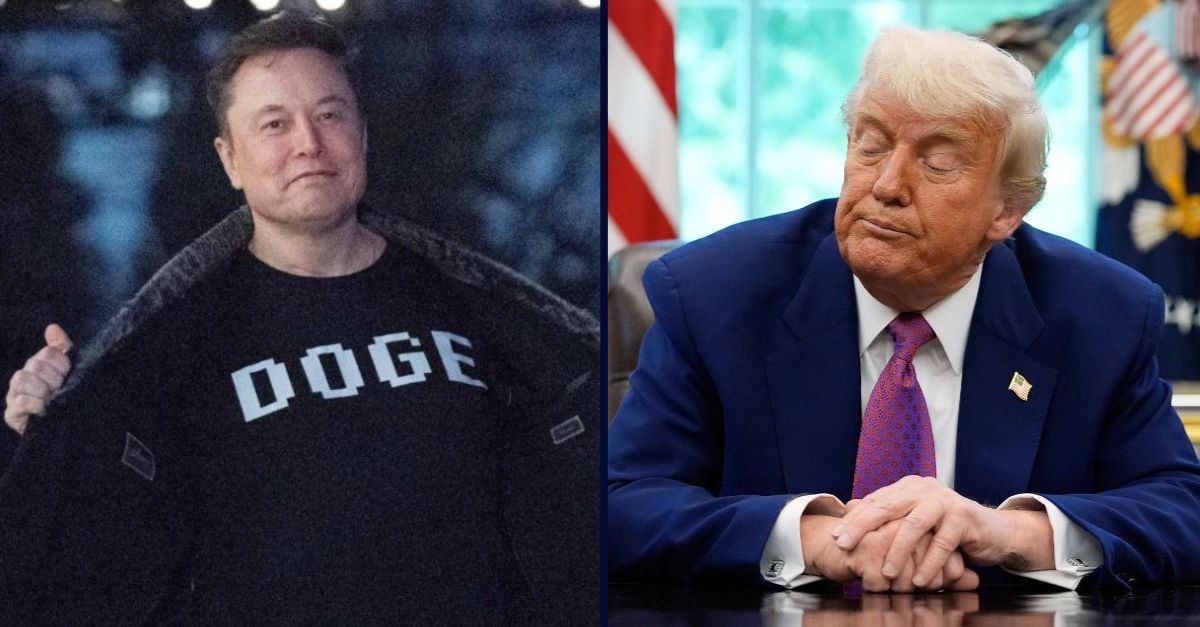
Left: Elon Musk flashes his T-shirt that reads “DOGE” to the media as he walks on South Lawn of the White House, in Washington, Sunday, March 9, 2025 (AP Photo/Jose Luis Magana). Right: President Donald Trump pauses as he speaks in the Oval Office of the White House, Tuesday, May 20, 2025, in Washington (AP Photo/Alex Brandon).
A federal judge has rejected an effort by former and current members of the Trump administration to avoid being deposed in a lawsuit over cuts to the U.S. Agency for International Development (USAID).
In the underlying litigation, pseudonymous USAID staff and contractors sued Elon Musk, the U.S. Department of Government Efficiency (DOGE) and several others, chiefly arguing the dismantlement of the agency ran afoul of the U.S. Constitution”s Appointments Clause and the separation of powers doctrine.
Last month, U.S. District Judge Theodore Chuang, a Barack Obama appointee, rejected efforts by the defendants to pause discovery.
Now, in a similar vein, the court has denied a defense motion for a protective order aiming to keep Musk and others from being deposed.
“[L]ongstanding limitations on deposing high-level Executive Branch personnel requires Plaintiffs to show exceptional circumstances exist before the depositions occur,” the U.S. Department of Justice argued in its November 2025 motion. “Because Plaintiffs have not made—and cannot make—that showing, a protective order is warranted.”
In denying the request, the court essentially accepts the framework provided by the defense — deferring to standards in the U.S. Court of Appeals for the 4th Circuit, which tend to reject depositions for “high-ranking government officials” absent “extraordinary” circumstances.
The argument falls apart for Musk and the other would-be deponents when Chuang gets into the details of what those terms mean.
The court says “it is at best unclear” whether the deposition targets “are properly deemed to be high-ranking government officials” under the 4th Circuit’s understanding of the doctrine.
“Notably, in cases in which courts have barred depositions of cabinet secretaries, depositions of senior, Senate-confirmed subcabinet officials have been permitted to proceed,” the memorandum order reads.
Chuang’s mention of Senate confirmation is instructive because it sketches out perhaps the highest level of government officials left untouched by the protective doctrine. And, in the present case, none of the targeted individuals come close to such a level of authority.
“Here, USAID was not a cabinet-level agency, none of the designated officials were the head of that agency, and several were operating in an informal or acting role at the time of the relevant events,” the court goes on.
When the judge explains the justification behind the protective doctrine, the government’s case falls apart even more.
The court, citing precedent, notes high-ranking government officials “have greater duties and time constraints than other witnesses.”
In the present case, however, “Musk has left the government” and two other witnesses “no longer serve in their roles as Deputy Administrators of USAID or the equivalent,” Chuang explains.
The fact that Musk worked in various roles before leaving the Trump administration offers no greater protection either, the judge found.
“Although Defendants assert that Musk’s role as a Senior Advisor to the President qualifies as a high-ranking government official, that assertion is not dispositive here because Plaintiffs seek Musk’s testimony in relation to his separate role as the head of DOGE or an unofficial role at USAID, and any concerns about intrusion on the President’s constitutional role can be addressed through limitations on the subject matter of the deposition rather than outright preclusion,” the court’s order goes on.
While the court leans toward rejecting the high-ranking status of Musk and the other witnesses, the order ultimately finds that question not dispositive because the plaintiffs have, in fact, demonstrated exceptional circumstances.
From the order, at length:
First, as reflected in the Court’s prior rulings, where Plaintiffs’ Appointment Clause claim is based on the allegation that Musk made certain decisions relating to the shutdown and dismantling of USAID at times when he lacked the authority to do so and when there was no duly authorized official who approved or ratified the decisions, there is a specific need for testimony on Musk’s role in relation to DOGE and USAID, the timing of his placement in certain roles, and the timing of the placement of USAID officials such as [Peter] Marocco and [Jeremy] Lewin in certain positions. There is also a specific need for evidence on the identity of the decisionmakers and the timing of certain key decisions relating to the shutdown and dismantling of USAID, such as the specific decisions to shut down USAID Headquarters and the USAID website.
In other words, the court says the plaintiffs’ argument is that Musk was acting without legal authority to make many such decisions. Chuang adds that the plaintiffs have identified statements by Musk supporting this argument. So, the court reasons, the Tesla head and the other witnesses need to be asked about what happened during this timeframe.
“Plaintiffs have shown that the identified witnesses likely have personal, first-hand knowledge of facts relevant and essential to the resolution of this case,” the court summarizes.
Finally, the judge rejects the idea that the plaintiffs should look elsewhere, or try another form of interrogation, for the requested information. And here, the court faults the Trump administration’s prior behavior up to this point.
“Defendants assert that, instead of the proposed depositions, Plaintiffs should be required to first seek stipulations, additional interrogatories, and depositions of lower-ranking officials,” Chuang notes. “Plaintiffs, however, have submitted requests for stipulations and interrogatories to which Defendants have not responded adequately or at all.”
The judge offers a telling example of such behavior, at length:
Significantly…the Court directed Defendants to submit documentary evidence of certain specific actions relating to the shutdown of USAID, which presumably would have identified the date of the action and the authorizing official, but Defendants failed to provide evidence addressing these issues in relation to certain key decisions, including the decision to shut down USAID headquarters and to shut down the USAID website.
“[T]hey have effectively acknowledged that these orders were given orally, with no documentary record, such that the only evidence on these questions would be the oral testimony of the officials present when the decisions were made,” the order concludes. “Accordingly, the Court finds that there is no alternative to the proposed depositions.”
Counsel for the plaintiffs welcomed the ruling.
“With each step of this case, Defendants’ unconstitutional conduct becomes clearer,” Marziani, Stevens & Gonzalez PLLC attorney Beth Stevens said in an email. “Our clients are everyday Americans who had their life’s work providing foreign aid ripped away by the callous lawlessness of Defendant Musk and the Trump Administration. We will continue to work relentlessly to make the record necessary to achieve justice and restore the rule of law.”


