
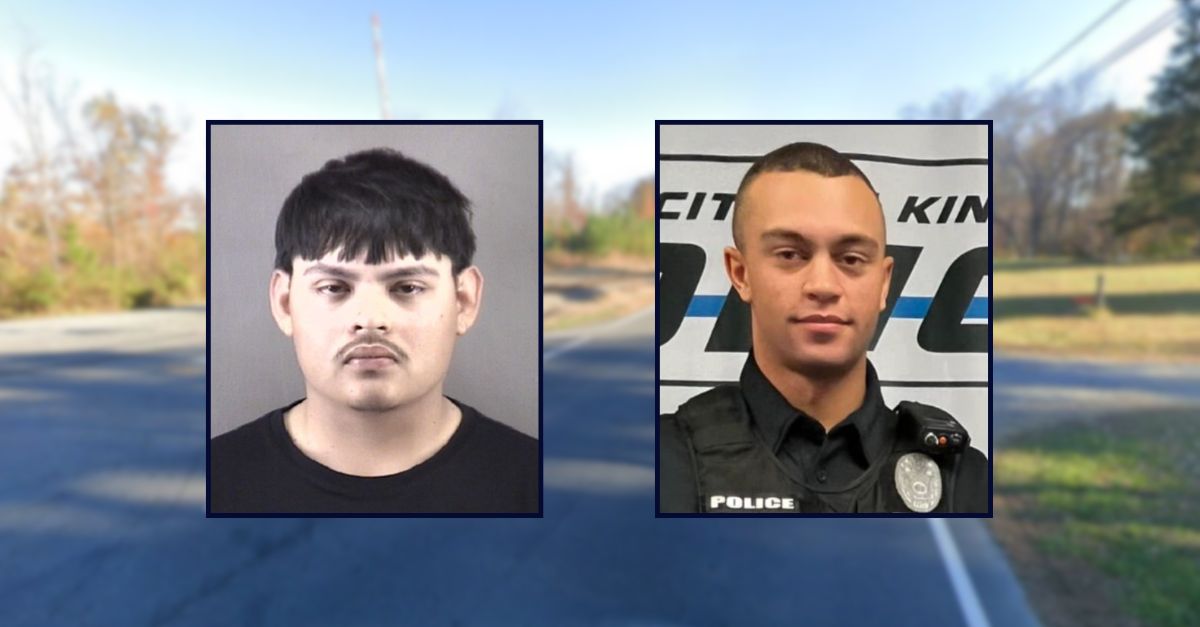
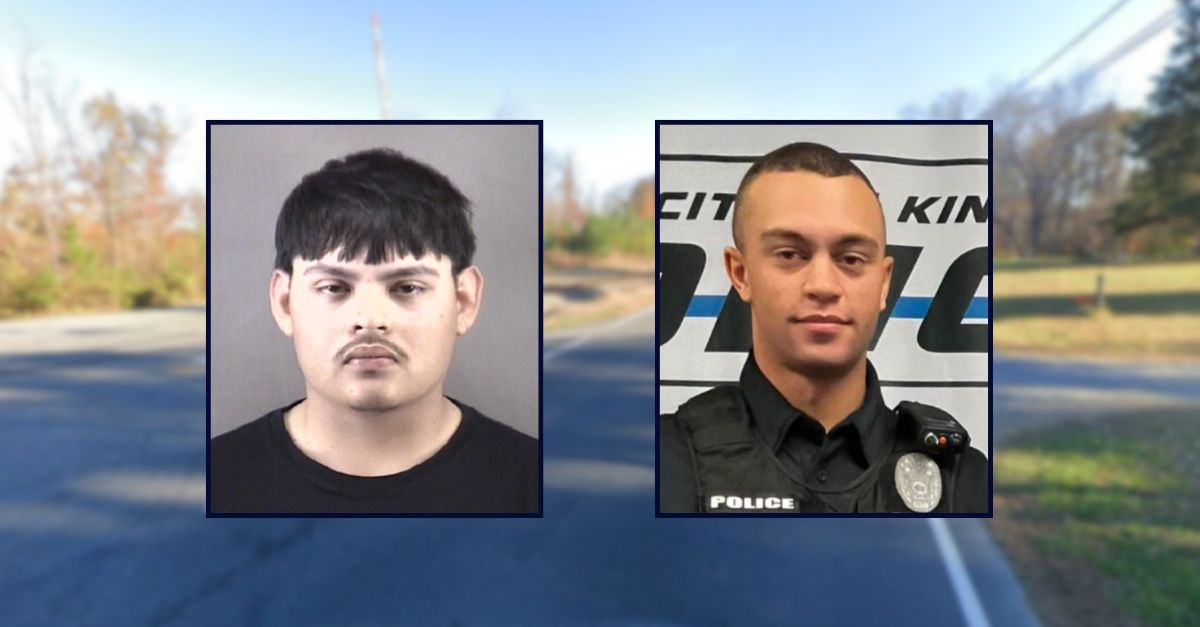
Inset left: Bryan Castillo (Forsyth County Detention Center). Inset right: Kaleb Mitchell (City of King). Background: The stretch of road where Castillo allegedly killed Mitchell during a head-on collision in Walkertown, N.C. (Google Maps).
A North Carolina man is behind bars for killing a sheriff”s deputy during a high-speed head-on collision, Tar Heel State authorities say.
Bryan Castillo, 19, stands accused of one count of murder in the second degree, according to the Forsyth County District Attorney’s Office. He was initially charged with one count each of misdemeanor death by vehicle, reckless driving, speeding and driving left of center.
The underlying incident occurred over the weekend and took the life of 24-year-old Forsyth County Sheriff’s Office Deputy Kaleb Mitchell, according to two arrest warrants obtained by Law&Crime.
The charging documents in the case are highly conclusory and do not offer much in the way of a detailed narrative about the incident.
On Saturday afternoon, the defendant was driving a Chevrolet pickup truck north along Walnut Cove Road in Walkertown – a small town and suburb located some 10 miles north of Winston-Salem – at speeds of 100 mph, according to the arrest warrants.
The speed limit on that stretch of road, however, is 55 mph, authorities noted.
At some point during the journey, Castillo crossed over the center line, veered into oncoming traffic, and slammed into Mitchell’s vehicle, which was heading south, according to statements issued by the North Carolina Highway Patrol and the Sheriff’s Office.
Mitchell was rushed to nearby Atrium Health Wake Forest Baptist Hospital, where he was pronounced dead shortly after his arrival.
The original arrest warrant on the misdemeanor homicide charge juxtaposes the pickup truck’s alleged rate of speed with the speed limit and says: “This violation was the proximate cause of death.”
The arrest warrant on the more egregious charge alleges simply and in a single line: “On or about the date of offense shown and in the county named above the defendant unlawfully, willfully, and feloniously did murder Kaleb Mitchell.”
On Tuesday, a judge said Castillo could face life in prison without the possibility of parole, according to a courtroom report by Winston-Salem-based ABC affiliate WXLV.
The upgraded charges were filed the day after the initial slate of charges. During a press conference this week, authorities said the new charge was based on an additional investigation.
“It’s a very sad day for the people of Forsyth County,” Forsyth County District Attorney Jim O’Neill said during the press conference.
While the deputy’s death has shaken the community – and elicited a string of eulogies from numerous law enforcement agencies and elected officials – the legal response has played out in typical fashion.
“This defendant is being treated the same way he would be treated if Deputy Mitchell had been a non-law enforcement officer,” O’Neill said.
The prosecutor added that the decision to charge the defendant beyond the misdemeanor offense is due to the legal concept of “malice.”
“You understand that the individual charged here is charged with driving in excess of 100 miles per hour on the roads here in Forsyth County,” O’Neill went on. “That’s an abandonment of the social obligation we hold for one another.”
Mitchell began working in law enforcement in 2022 with the King Police Department, a spokesperson for the department told Police1, an online law enforcement news outlet. Mitchell moved over to the Forsyth County Sheriff’s office in the spring of 2025.
The deceased deputy leaves behind a wife, a son, and an unborn daughter, according to Forsyth County Sheriff Bobby Kimbrough.
“The condition that has been created here is that there’s a wife without a husband, there’s a son without a father, a mother without her son, a community without a first responder, a 24-year-old young man that is no longer a part of this community,” the sheriff said.
Castillo is being detained in the Forsyth County Detention Center without bond.
He is next slated to appear in court on March 19.


