
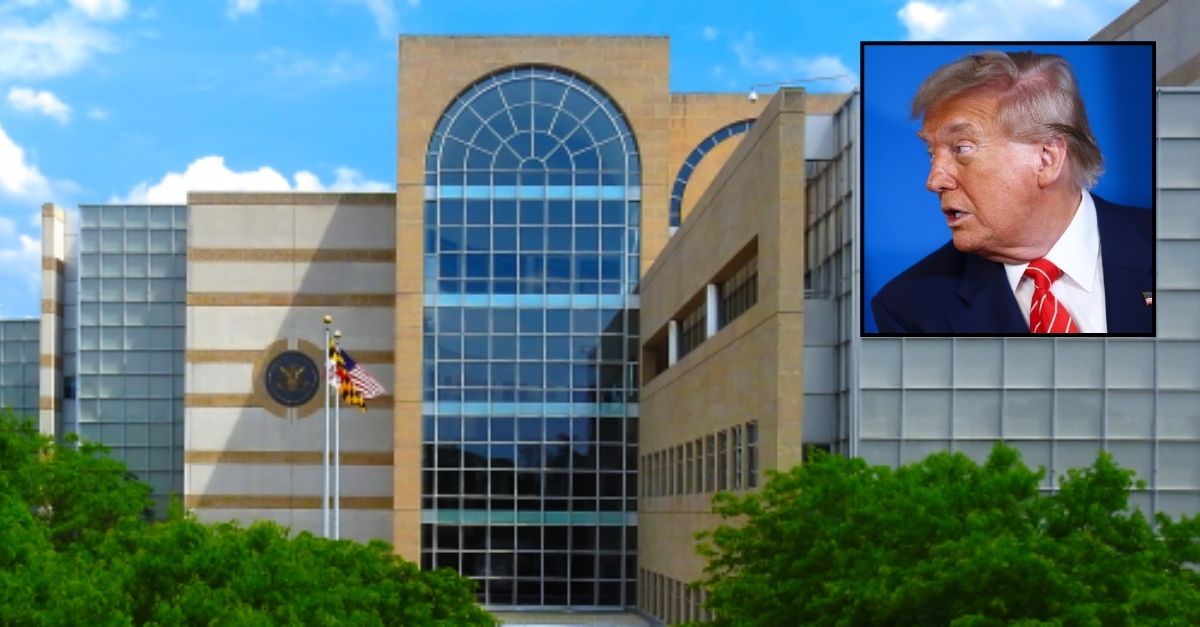
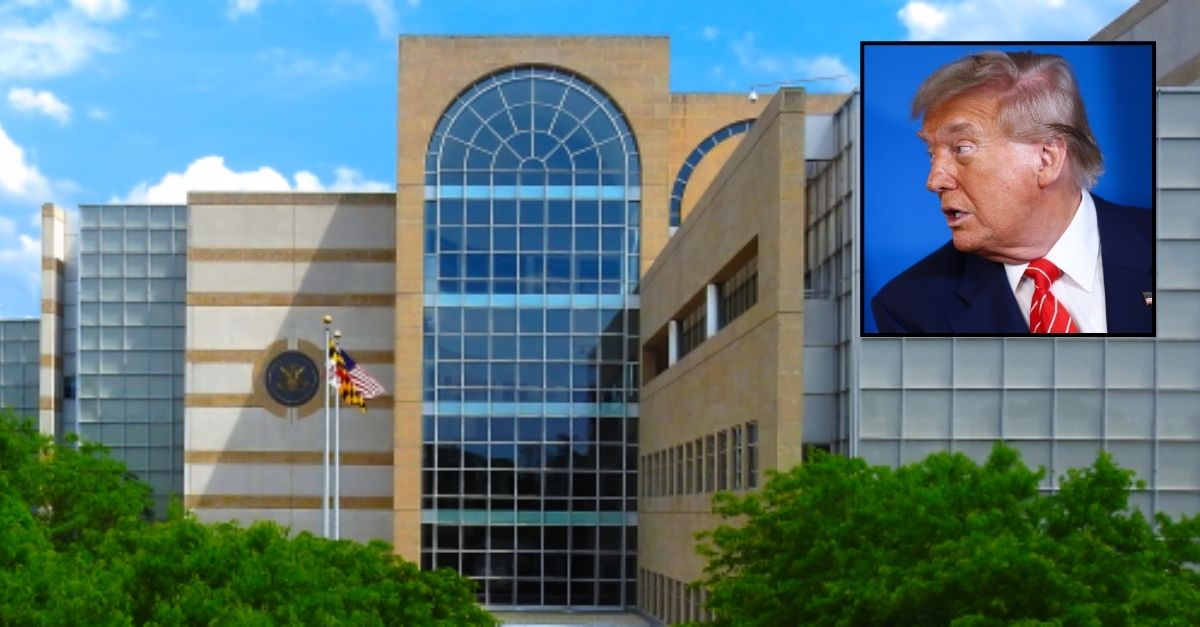
Background: U.S. District Court building for the District of Maryland”s Southern Division in Greenbelt, Maryland (U.S. District Courts) Inset: President Donald Trump speaks during a meeting with NATO Secretary General Mark Rutte as he arrives for a NATO summit in The Hague, Netherlands, Wednesday, June 25, 2025 (Piroschka Van De Wouw, Pool Photo via AP)
The DOJ told an appellate panel on Monday that judicial immunity was no obstacle to suing all of a Maryland federal court’s judges, an action the government still defends as the “proper” and “most efficient” way of reacting to “unlawful” automatic two-day stay orders in habeas corpus cases.
In a lengthy filing before the 4th U.S. Circuit Court of Appeals, the DOJ argued the judge below “made three critical, reversible legal errors” when he dismissed the lawsuit in August. Contrary to U.S. District Judge Thomas T. Cullen’s belief, the Trump administration claimed it had a cause of action, had standing to sue because the standing orders “interfer[ed] with its enforcement of immigration law,” and asserted it was not “barred” from suing the judges and the clerk of the court.
Instead, the lawsuit — which was dismissed — was an example of “how the system is supposed to work,” the government maintained in the brief.
“Invoking a longstanding equitable cause of action, the government filed an action seeking prospective injunctive relief against the district court and its judges in their official capacities,” read the DOJ’s description of its suit. “Courts and judges are not above the law, and the government properly sought judicial relief as the remedy for an unlawful rule.”
The DOJ and the Department of Homeland Security brought the “unprecedented” suit claiming that Chief U.S. District Judge George Russell III’s “standing orders” in response to an “influx of habeas petitions” were evidence of “judicial overreach” purporting to thwart President Donald Trump’s “executive authority” and his 2024 election mandate to swiftly carry out deportations.
When Cullen, a Trump appointee, tossed the “novel and potentially calamitous” lawsuit, he called it “not normal” and an unnecessary “constitutional free-for-all” in light of the existence of “proper” ways to raise challenges — whether with the Judicial Council or through appeals — short of a “constitutional standoff.”
“Much as the Executive fights the characterization, a lawsuit by the executive branch of government against the judicial branch for the exercise of judicial power is not ordinary,” Cullen observed. “The Executive’s lawsuit will be dismissed, and its motion for preliminary injunction denied as moot. Whatever the merits of its grievance with the judges of the United States District Court for the District of Maryland, the Executive must find a proper way to raise those concerns.”
The DOJ has now responded to that suggestion with a no-can-do, even though the Maryland district court has since revised its standing orders “in material ways to at least attempt to address the jurisdictional and legal deficiencies that the government identified.”
“The district court said that the government could avoid this lawsuit’s perceived procedural problems by appealing or seeking mandamus in individual cases or by asking the Fourth Circuit Judicial Council to review the Standing Orders’ validity, and it relied on the perceived availability of those options as a reason not to find a cause of action. But those options would not solve the problem for numerous reasons,” the government stated.
The first argument the Trump administration advanced in the brief is that standing order changes mooted the appeal. For that reason, before filing its brief the DOJ attempted to dismiss the appeal as moot and also vacate its loss in the court below. Neither request was granted.
“The government continues to believe that Appellees mooted the appeal by rescinding the challenged rules. Yet if the Court disagrees, the pervasive errors in the district court’s reasoning warrant reversal on the merits so that the government’s challenges may proceed,” the DOJ has now responded.
Former U.S. Solicitor General Paul Clement previously wrote that his clients didn’t “object to dismissal of this appeal” but that Cullen’s word on the matter should stand because the “Executive has expressly reserved the right to sue all over again.”


