
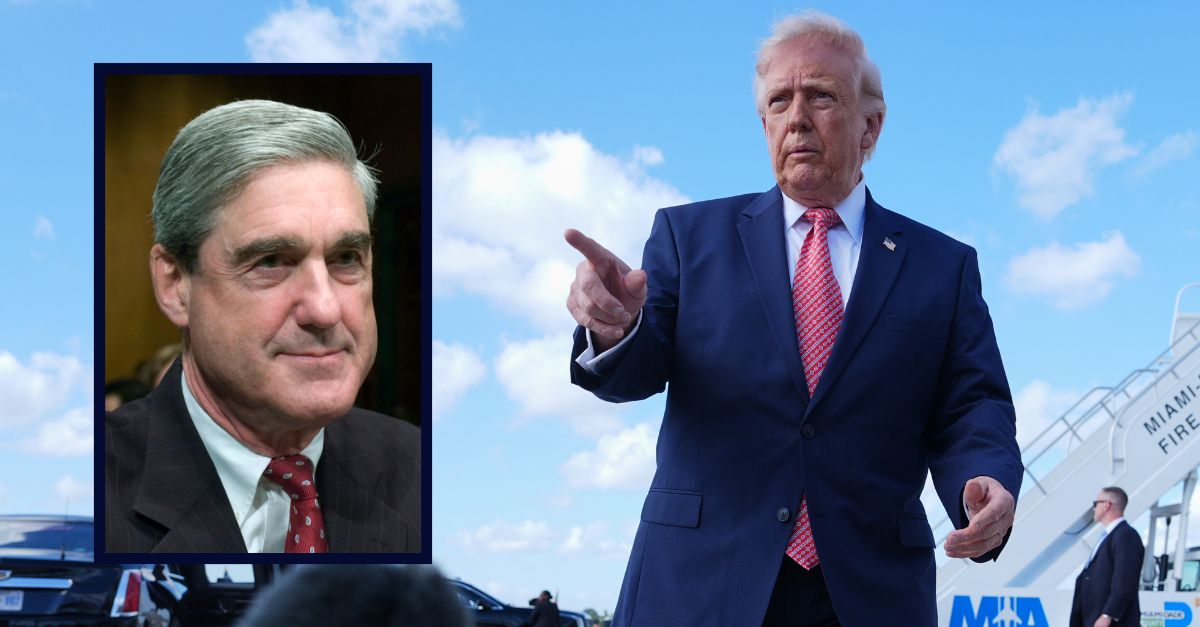
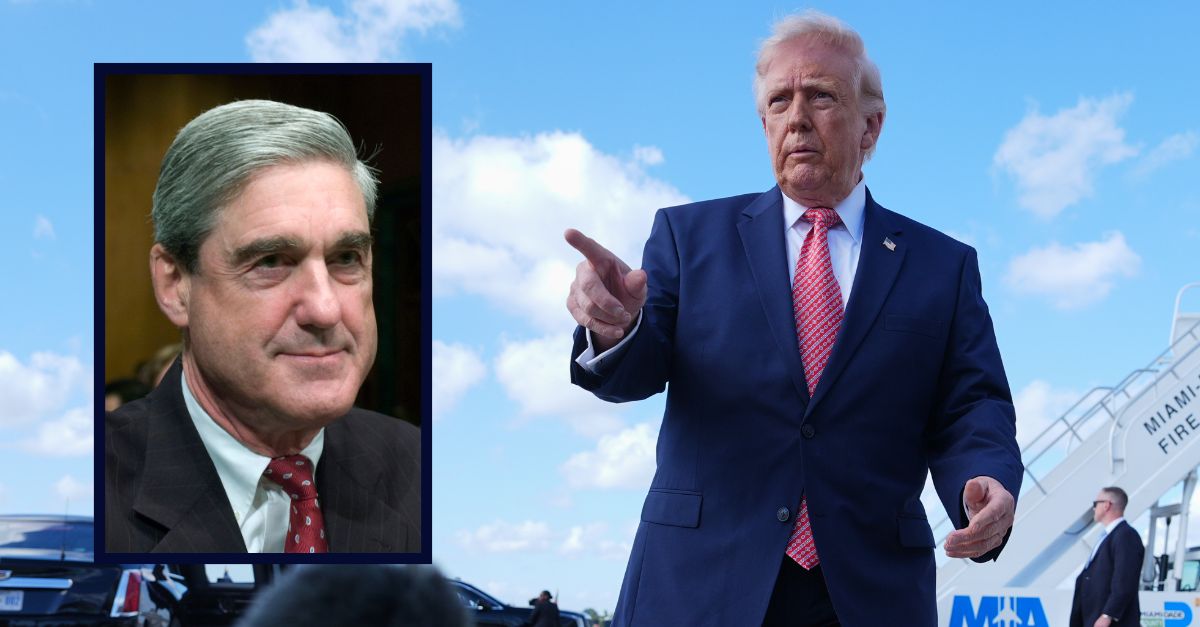
Left inset: Then-FBI Director Robert Mueller makes an appearance before the Senate Judiciary Committee to discuss recent activities involving FBI agents, Washington D.C., March 5, 2008. (Patsy Lynch/MediaPunch /IPX). Main: President Donald Trump speaks to reporters after stepping off Air Force One, Friday, March 27, 2026, at Miami International Airport in Miami (AP Photo/Mark Schiefelbein).
The DOJ returned to court Thursday and told the U.S. Court of Appeals for the District of Columbia Circuit that President Donald Trump”s executive orders to strip elite law firms of security clearances and tear up their government contracts must be revived, even if that means a Democrat eventually comes into power and deems MAGA lawyers enemies of the state.
Chief U.S. Circuit Judge Sri Srinivasan, U.S. Circuit Judge Cornelia Pillard and U.S. Circuit Judge Neomi Rao — two appointees of Barack Obama and a lone Donald Trump appointee, respectively — formed the three-judge panel in a case the DOJ was prepared to drop in March.
In April, after the DOJ’s sudden reversal, the court issued an order spelling out how arguments would proceed, given that it had consolidated DOJ appeals — one an appeal of its losses on Trump’s executive orders against law firms and the other of its distinct but related failure to strip Ukraine whistleblower attorney Mark Zaid of his security clearance.
Perkins Coie LLP v. U.S. Department of Justice was up first, with Abhishek Kambli appearing for the government and former Bush administration U.S. solicitor general Paul Clement arguing for Jenner & Block, Perkins Coie, Susman Godfrey and the late special counsel Robert Mueller’s former law firm WilmerHale.
Trump’s “Preventing Abuses of the Legal System and the Federal Court” memorandum from March 2025, and several other individualized orders like it, singled out firms that investigated or sued him or that otherwise associated with or advocated for the Democratic Party and its causes.
One memo, for example, suspended Covington & Burling LLP’s security clearances for representing former special counsel Jack Smith. Another order against Jenner & Block mentioned that the firm was “thrilled” to hire Andrew Weissmann again after his time as a prosecutor on Mueller’s team. And the order targeting Perkins Coie cited “dishonest and dangerous activity” that “has affected this country for decades,” most recently in 2016, when, “while representing failed Presidential candidate Hillary Clinton, Perkins Coie hired Fusion GPS, which then manufactured a false ‘dossier’ designed to steal an election.”
Kambli, a deputy associate attorney general to Acting Attorney General Todd Blanche reportedly seen as a “go-to advocate for high profile matters,” is leaving the DOJ at the end of the month. He wrote in a LinkedIn post that the “greatest joy of this job was working with some of the most brilliant people who came together with a shared mission of advancing President Trump’s agenda,” Bloomberg Law reported.
The agenda Kambli advanced Thursday was support for Trump’s “potentially business-ending sanctions,” even if there will be what goes around, comes around-style consequences.
In a bit of a preamble, the DOJ attorney claimed losses across the board boiled down to district court judges rushing to block “orders that they clearly didn’t like the content of” — effectively nullifying the president’s unreviewable “security clearance determinations” and restoring them without authority.
Early on in arguments, Pillard asked about the unintended consequences of taking the position that there’s nothing the courts can do if a Democrat is elected president in 2028 and targets lawyers who work for Republicans with the same kinds of executive orders.
“So if an incoming president — let’s say a Democrat — says, I think that any lawyer who represents a Republican, by virtue of that representation, even if the lawyer is him or herself a Democrat, I think that the representation of my enemies is a threat to national security. So any lawyer who represents a Republican immediately today has their security clearance revoked?” she asked.
Kambli agreed that would be judicially unreviewable, offering up impeachment, the “ballot box,” and congressional changes to the law as the only remedies, repeating something he had just told Srivinasan. He argued that Trump’s exercise of his security clearance power is just as unquestionable as his use of the pardon power.
“And your view is — the pardon power example is where you go — that this power over security clearances is so intrinsic that even … you could be race-based, and it could be race-based,” and there would be no judicial review, Srivinasan asked.
In response, Kambli said yes and referred the judge to the aforementioned “other remedies.”
Pillard had a follow-up question.
“If a president said, I don’t trust law firms that represent Catholics, law firms that represent African Americans, law firms that represent Asian Americans, and so just law firms that represent people in those three groups, they have to give me lists of their clients who are under control by people in those three groups, and we will deny security clearances to any lawyer in those firms. Political question? Nonjusticiable?” she asked.
“So Your Honor, yes, because of the threshold question before you even examine any of those facts,” the DOJ lawyer replied.
When it was Clement’s turn, he said the court need not turn a blind eye to the fact the “four law firms here were not singled out because they had unusual hiring practices or demonstrated with demonstrated problems handling classified materials.”
“Instead, they were singled out because they represented clients or associated with attorneys who raised the President’s ire. That is not conjecture,” he said. “While most cases alleging retaliation depend on either speculation or extensive discovery, here the executive orders lay the president’s motives bare. The executive orders inflict a wide array of punishments on the law firms because of the clients the law firms represented and the lawyers they associated with, the executive orders run afoul of the better part of the Bill of Rights. In identifying the order’s constitutional defects, it’s hard not to start with the First Amendment, but it would be a mistake to end there.”
“You’re opening the door for a president to say ‘I just don’t think Democrats are trustworthy, or law firms that represent Democrats are trustworthy,’ and I don’t think you want to open that door,” Clement warned. “And I’m quite sure that we didn’t open that door.”
Rao jumped in here and firmly revealed where she stood.
“What if the president says no security clearances for people who have expressed support for state sponsors of terrorism, you know, Hezbollah, Hamas, something like that. That’s justiciable?” she asked.
“Sure,” Clement said.
“I think you agree that the president could make that type of group determination that those people are untrustworthy,” Rao replied.
“Absolutely, I hope he does, frankly,” Clement answered, before saying that the circumstances in his case are different.
“We cannot look behind those decisions, so a court cannot determine whether it’s okay to discriminate against supporters of Hezbollah, but not okay to discriminate against, you know, I don’t know various partisan supporters,” Rao stated.
When Clement remarked “I’m a unitary executive guy” saying this, he received a sharp reply from Rao: “Not anymore.”


