
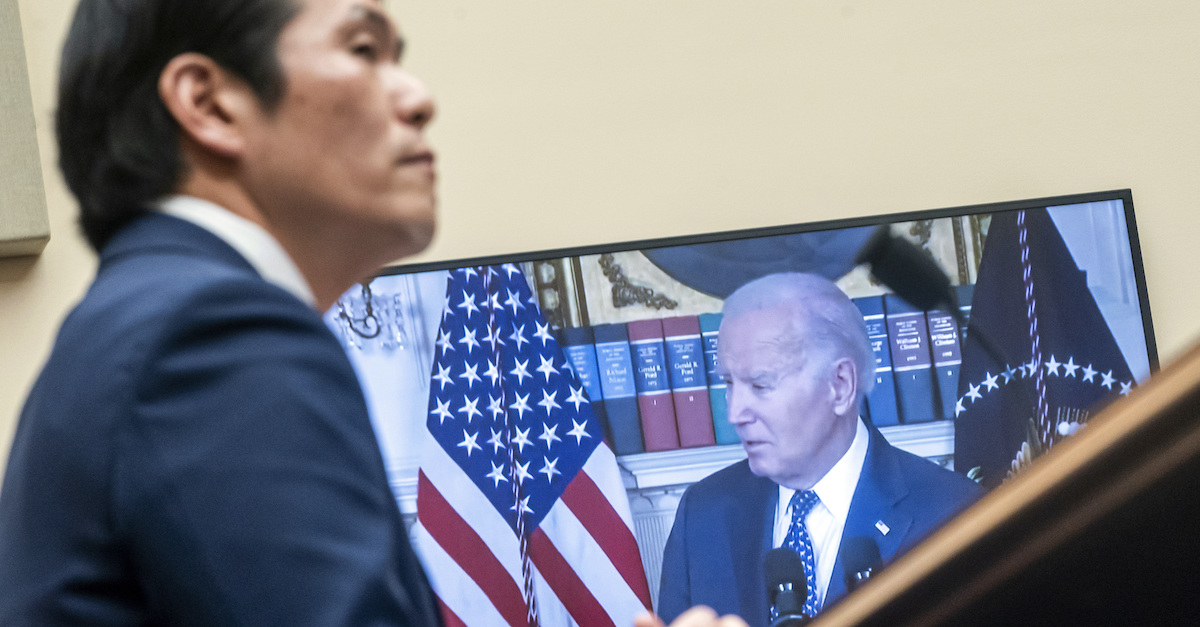
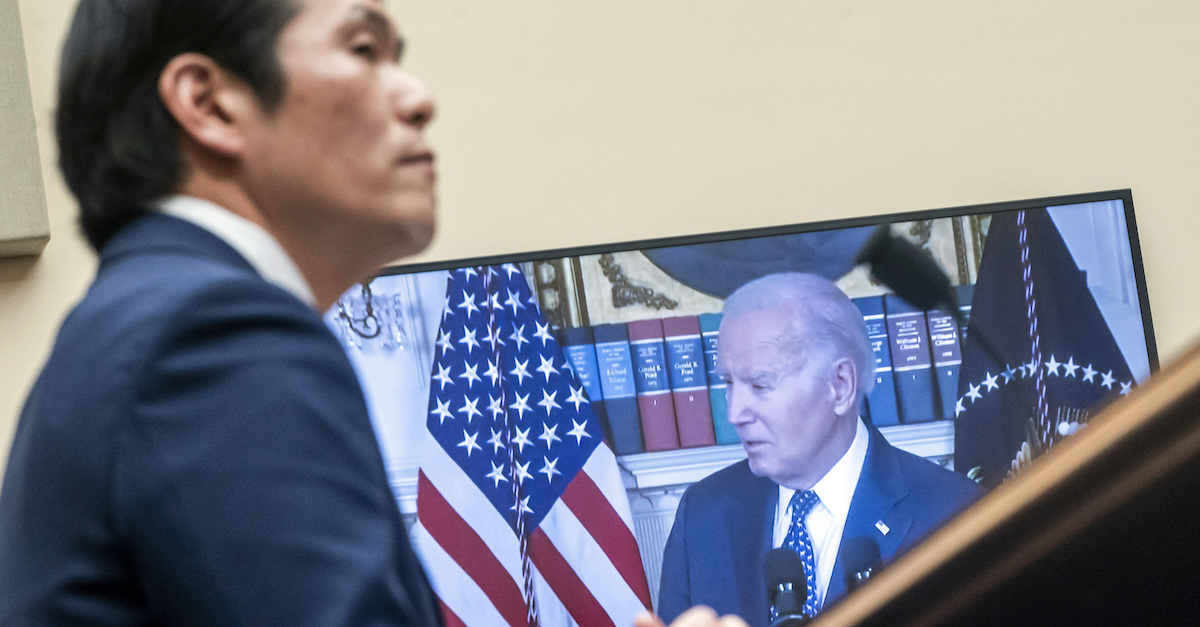
Special Counsel Robert Hur listens to recorded remarks of then-President Joe Biden during a hearing of the House Judiciary Committee in the Rayburn Office Building on Capitol Hill in Washington, March 12, 2024. (AP Photo/Nathan Howard, File)
A federal judge kicked off a motion hearing Thursday afternoon in Washington, D.C., by making crystal clear that she needs more time to decide the “hard issues” in former President Joe Biden”s attempt to block the DOJ from disclosing audiotapes and transcripts from former special counsel Robert Hur’s classified documents probe.
U.S. District Judge Dabney Friedrich, who was appointed by President Donald Trump in his first term and later backed Russia probe special counsel Robert Mueller’s authority, noted there is an existing deadline of June 15 for the DOJ to hand over recordings and transcripts of conversations then-former vice president Biden had with his “writing partner” or ghostwriter Mark Zwonitzer in 2016 and 2017.
Those conversations took place in the course of creating “Promise Me, Dad,” a memoir about the former president’s son Beau Biden’s 2015 death from brain cancer.
In the lead-up to the hearing, the judge “reviewed the tapes and transcripts” at issue in her chambers, and she concluded that she needed more time.
“It’s difficult to rule on all these issues in less than a week,” Friedrich said, asking attorneys for the DOJ and the conservative Heritage Foundation: “What’s the urgency?”
While the Freedom of Information lawsuit has been ongoing since March 2024, Biden is separately suing the DOJ to block the release of the materials. Lawyers for the House Judiciary Committee chaired by Rep. Jim Jordan, R-Ohio, just days ago told a different federal judge that Congress has a “valid legislative purpose” in subpoenaing the tapes, based on the possibility of reforms surrounding DOJ appointments of special counsels.
Hur’s investigation concluded there was evidence Biden “willfully retained and disclosed classified materials” after his vice presidency. But a combination of factors, including the “elderly” Biden’s “poor memory,” meant there would be no recommendation of criminal charges.
When Hur released his report in 2024, he doubted a jury would convict a “sympathetic, well-meaning, elderly man with a poor memory.” Additionally, DOJ policy ruled out charging a sitting president and the alleged facts were not as serious as those Trump faced in his dismissed Mar-a-Lago classified documents prosecution, Hur said.
Former U.S. Attorney General Merrick Garland’s DOJ repeatedly opposed disclosure, arguing that bad actors might create “deepfakes” of the president as he was running for reelection. The arguments were made even after Biden’s debate debacle but before he officially announced he would not run.
Chapter 17 of Hur’s report said the Zwonitzer tapes were once “deleted” but recovered due to the ghostwriter’s candor. Once recovered, the special counsel said, the materials provided “significant evidentiary value” in the probe of documents on U.S. “military and foreign policy in Afghanistan.” Hur’s report further characterized the ghostwriter sessions as “often painfully slow,” with the then-former vice president “struggling to remember events” and “straining at times to read and relay his own notebook entries” several years before he was elected president.
Heritage Foundation attorney Samuel Dewey argued Thursday that the public has a right to discover the depths of a “cover-up of President Biden’s cognitive state” which overrides the former president’s claims that DOJ redactions of “sensitive, personal information” about him and his family “are wholly inadequate to protect [their] privacy interests.”
Friedrich, after hearing agreement from the DOJ on moving the disclosure deadline to June 19, teased the road ahead while stressing that she hasn’t decided the issue.
“If the court were to conclude that the Privacy Act claim is not viable under the APA [Administrative Procedure Act], do you agree that the department’s decision whether to invoke certain FOIA exemptions is committed to the department’s discretion?” the judge questioned Biden attorney Amy Jeffress, also known for representing former FBI lawyer Lisa Page in her Privacy Act case.
Biden’s attorney answered that the challenge of the DOJ’s decision to release the materials under FOIA was an “abuse of discretion” under the APA.
DOJ attorney John Halloran countered that the “department has demonstrated and determined its judgment that the information should be disclosed, so we believe that the exemption for FOIA productions in the Privacy Act would provide immunity to FOIA decision maker.”
The judge acknowledged the DOJ’s “several levels of argument,” but said this is no easy decision.
“I’m not, I don’t mean to telegraph that I’ve decided any of these issues. I think they’re very difficult, and issues of first impression,” Friedrich remarked on the novel case.
“It’s difficult to see why, in order to assess the former president’s competency and manner of speaking from personal portions of the audio that don’t reflect any confusion or lack of memory, why there’s a high enough public interest in those portions of the tape and the audio that would exceed his own privacy interests,” the judge added.


