
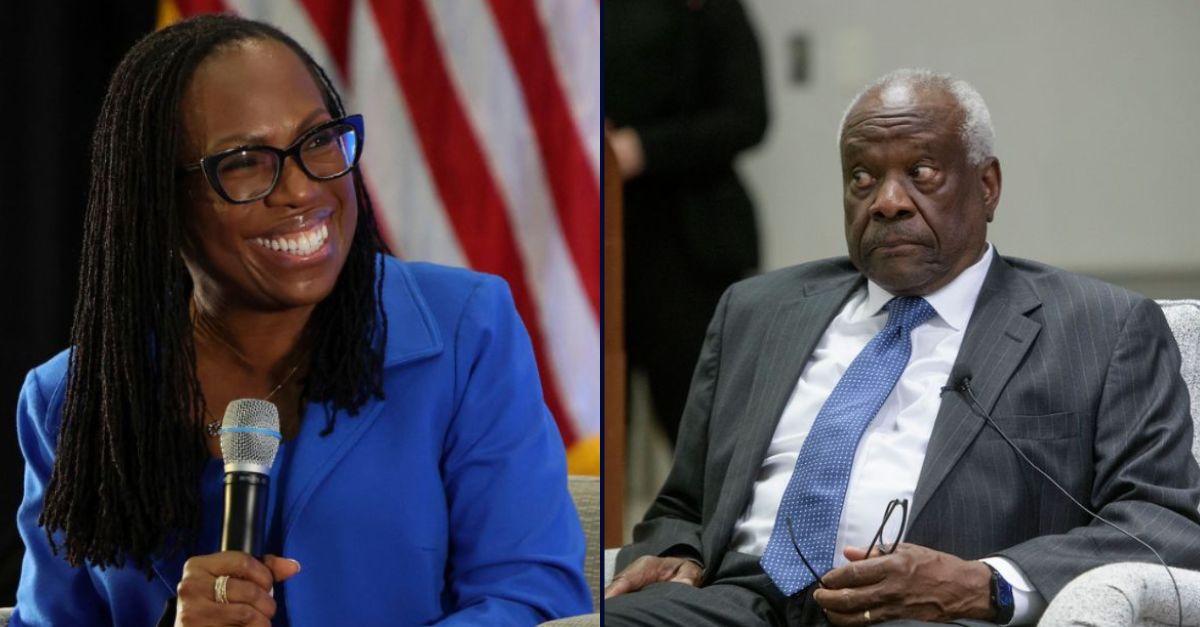
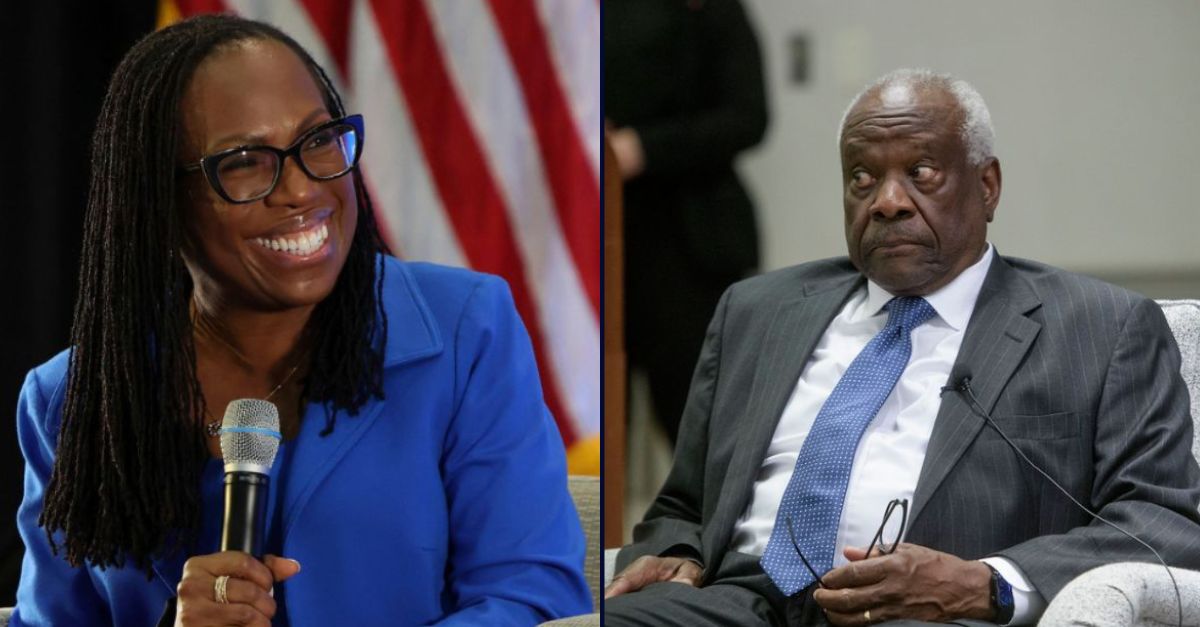
Left: U.S. Supreme Court Justice Ketanji Brown Jackson is seen during an Evening with Ketanji Brown Jackson at Chapman Conference Center at MDC Wolfson Campus on March 10, 2025 in Miami, Fla. (Photo by Alberto E. Tamargo/Sipa USA). Right: U.S. Supreme Court Associate Justice Clarence Thomas speaks at The Catholic University of America”s Columbus School of Law, Thursday, Sept. 25, 2025, in Washington (AP Photo/Rod Lamkey, Jr.).
The U.S. Supreme Court issued a major decision wrecking the federal government’s attempt to prosecute a Texas man who uses marijuana “a few times a week” and also owns a gun, with Justice Ketanji Brown Jackson providing an assist while blasting the effects of the conservative majority’s Second Amendment jurisprudence after the case of New York State Rifle & Pistol Association, Inc. v. Bruen.
Writing the opinion of the court, Justice Neil Gorsuch sided with Ali Hemani in holding that the government’s attempt to imprison him for up to 15 years and strip him of his gun rights for admittedly using marijuana every other day was not “consistent with the Second Amendment.”
“No matter that the government did not assert Mr. Hemani was a drug addict,” Gorsuch said. “No matter that it did not contend his drug use had ever led him to pose a danger to himself or others. No matter, too, that the government did not claim Mr. Hemani had done anything with his gun other than possess it in his home.”
The government nonetheless argued that 18 U.S.C. § 922(g)(3) — a federal statute governing gun ownership and possession — as applied in Hemani’s case was constitutionally “consistent with the Nation’s tradition of firearm regulation” because “habitual drunkard laws” are deeply rooted in the country’s history.
Gorsuch, joined by Chief Justice John Roberts, Justices Clarence Thomas, Brett Kavanaugh, Amy Coney Barrett, Sonia Sotomayor and Jackson, ruled that “analogy fails under every measure it asks us to consider” because the “historical laws on which it relies targeted different kinds of people, did so for different reasons, and operated in different ways.”
Jackson penned a concurrence, which Sotomayor joined, explaining why she landed in the majority — while also taking direct aim at the conservative majority’s “‘history and tradition’ metric” from Bruen and its progeny.
“I join the Court’s opinion in full because it correctly applies our decisions in New York State Rifle & Pistol Assn., Inc. v. Bruen, and United States v. Rahimi. But I continue to believe that we veered off course in Bruen,” Jackson said. “I write separately to emphasize that means-end scrutiny—the approach courts applied before we adopted Bruen’s ‘history and tradition’ metric—offers a more rational way of assessing the constitutionality of firearm regulations.”
“As I and others have elsewhere explained, Bruen is unworkable. It imposes on judges the unfamiliar and difficult tasks of sifting through centuries-old evidence in order to answer ‘contested historical questions,’ and ‘applying those answers to resolve contemporary problems,'” she added. “Given those challenges, it is unsurprising that Bruen’s test is vulnerable to inconsistent and arbitrary application, as judges draw different conclusions from the same historical evidence and reach divergent assessments of the same laws.”
In a parting shot, the newest justice called on the court to “consider whether to retire the failed Bruen experiment and return to an explicit assessment of Congress’s ends and means when deciding the constitutionality of firearm restrictions.”
Back in 2022, Thomas ruled in Bruen that New York unconstitutionally infringed on the Second Amendment rights of “ordinary, law-abiding citizens […] to carry handguns publicly for their self-defense.” To strike down the state’s “licensing regime,” six conservative justices scrutinized “whether it comported with history and tradition” and decided it did not.
Just over a year later, as Law&Crime reported, then-President Joe Biden’s son Hunter Biden was facing a prosecution under 18 U.S.C. § 922(g)(3), for being an “unlawful user of or addicted to any controlled substance” and possessing a firearm.
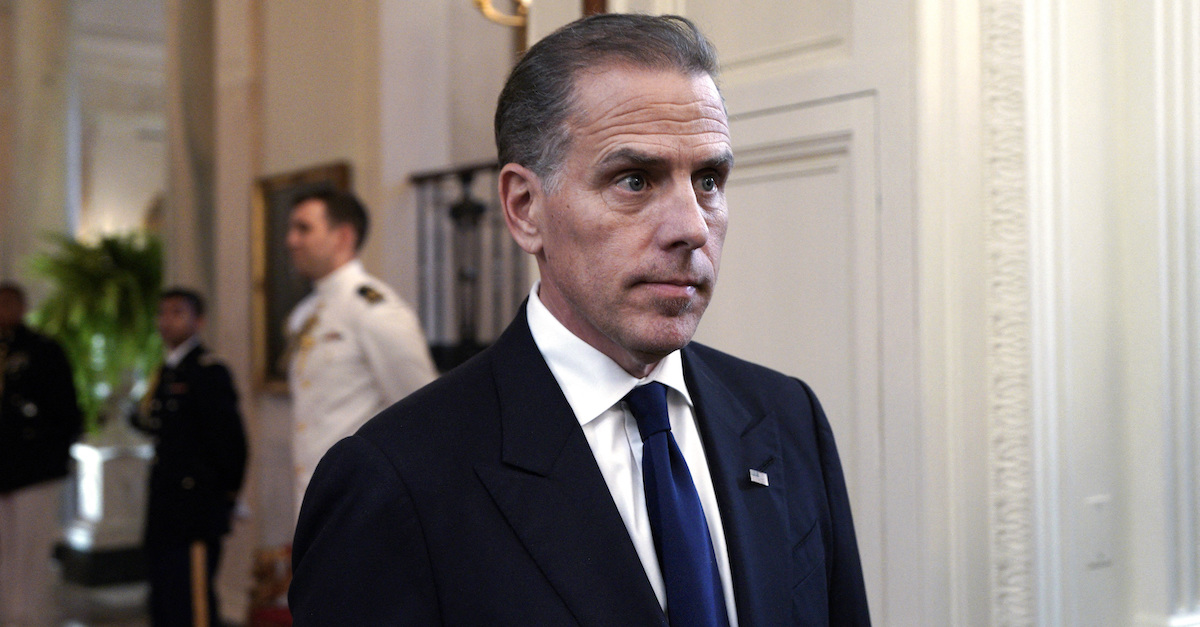
Hunter Biden, son of US President Joe Biden, attends a Medal of Honor Ceremony in the East Room at the White House in Washington on July 3, 2024 (Yuri Gripas/Abaca/Sipa USA/ AP Images).
In a strange bedfellows moment before his father pardoned him, the younger Biden approvingly cited Thomas to argue the statute was “indefensible” and unconstitutional.
On Thursday, Thomas penned a solo concurrence expressing his doubts that Congress can “criminalize[] possession of firearms apart from any purchase or sale of goods and services across state lines” under the Commerce Clause.
Justice Samuel Alito’s separate concurrence in the judgment, joined by Justice Elena Kagan, went so far as to say that “marijuana use today is like alcohol use at the founding” — “widespread and increasingly considered socially acceptable in many quarters.”
“And from a practical standpoint, law enforcement widely tolerates the use of marijuana. These similarities underscore the deficiency of the Government’s analogues,” Alito said.


